Showing posts with label Thomas Cochrane. Show all posts

Friday, December 14, 2012

Booty: Lovely Blog and Giveaway

Holy heck! Look at that up there. "One Lovely Blog." That's staggering, actually. But not surprising in its origin. My dear, dear friend Undine, whose World of Poe blog is one of my favorite corners of the web, has bestowed this award not only on Triple P but also on that little place I go to muck about with my other interests: HoodooQ. And that's one of the nicest recognitions I could ever get. Everyone likes to be told they're doing a good job, but it really means a lot more when it comes from someone you deeply admire. Thank you, Undine.

As always, there are requirements that must be met. Fair enough. I shall:

First: Include the Lovely Blog Award label in this post (done)
Second: Regale your followers with seven facts about yourself.
Third: Gift seven blogs you enjoy with the Lovely Blog Award, link to them and leave a comment so that they know about their award.
Fourth: Include these requirements (done)

Here are some things about me.

1) I'm allergic to cats. This means that cats LOVE me and will do anything in their power to get as close to me as possible. Bless them.

2) As of this writing, I have personally rescued five dogs from abusive situations. If you have the ability, I strongly urge you to donate to a local (not nationwide - they use your money to fund their administrative machine, not save animals) rescue organization or no-kill shelter. They do wonderful things for creatures that we tamed and now cannot help themselves.

3) I volunteer in my community. A lot. You should too.

4) December 26, 2012 will mark my 25th wedding anniversary. Fortunately, I'm married to the most perfect person for me. In case you're wondering, I chose the day after Christmas because French Revolutionary hero Camille Desmoulins married his true love, Lucile Duplessis, on the same day at Sacre Ceour in Paris. We've been a bit more fortunate than that tragic pair; both were guillotined during the Reign of Terror.

5) I am lucky in love and friendship.

6) My favorite holiday is Hallowe'en (sorry, Christmas).

7) Cancer can kiss my ass - 'nuff said.

Now to the good part. Here are the lovely blogs that I hope you will click over to and experience for yourself:

Aubrey/Maturin on Tumblr: This one has not been updated for a while, sad to say, but the archives are a delight for fans of Patrick O'Brian's masterpiece.

Calliope Street: Arthur's heart-felt love letter to the city of New Orleans will make you wish you were there.

History Myths Debunked: I learn something new from this wonderful site every time Mary posts. A great boon to writers of historical fact and fiction.

The Historic Seaport Blog: the site of tall ships Lady Washington and Hawaiian Chieftain. The fan photos alone will keep you coming back for more. You can also buy tickets for their regular and pirate cruises through the blog.

Homo Gastronomicus: a site I referenced in Tuesday's post. India's careful research brings 18th century cooking and eating to life miraculously.

Isis' Wardrobe: Isis is an incredibly talented artist with the needle. Her recreations of 17th and 18th century clothing are nothing short of breathtaking. Another wonderful reference for writers and artists.

Log Lines: the newly created blog of the USS Constitution Museum. Wonderful information about life aboard ship and ashore for sailors in the early U.S. Navy.

Once again, my thanks to Undine for her kindness and generosity. There's nothing new there, of course, but it is rash and ill-mannered to miss a chance to say thank you.

Finally, I've something especially for the Brethren at this Holiday Season: a give-away!

The booty up for grabs is a new, paperback copy of Benerson Little's The Sea Rover's Practice. This is an absolute must for anyone researching buccaneers/pirates and covers the century from 1630 to 1730 when West Indies piracy was in its heyday. I refer to the book constantly but was given this copy as a gift, making it a duplicate. So, just as the gift of the Lovely Blog Award was passed on to me, I want to pass this incredible book on to you. Here are the simple rules:

1) leave a comment on this post and/or tweet about the giveaway referring back to @Paulineagain so I know.

That's it - seriously. Your name will be put in a fishbowl and First Mate Timmy! will draw a winner at random on our 25th anniversary. We'll then bundle your prize off to you - perhaps with an extra treat just for the New Year - for you to enjoy all through 2013 and beyond. I'm not picky about International shipping so all are welcome.

Happy Friday ~ and bonne chance mes amis! And a Happy Birthday to that hero of the Royal Navy and the Chilean revolution: Admiral Thomas Lord Cochrane ~ Huzzah!

Thursday, September 13, 2012

History: "O'er the Land of the Free..."

On a chill fall afternoon, September 13, 1814, a 35 year old lawyer boarded HMS Tonnant, a man-of-war anchored bellow the ramparts of Baltimore's Fort McHenry.

Francis Scott Key and his companion, Colonel John Skinner, were aboard Tonnant to retrieve prisoners of war from the British. A like exchange had been accomplished at the Fort earlier in the day and Key and Skinner, who was the U.S. Prisoner Exchange Agent for the area, had no reason to suspect that they wouldn't be home safe in their beds that same night.

The British, however, had other plans.

Greeted with all civility aboard Tonnant by an impressive array of Royal Navy officers, the Americans were probably a bit stymied when they were asked to dine with their hosts. These included Vice Admiral Alexander Cochrane, who was in command of the Jamaica station and, as an aside, the uncle of Triple P's favorite Royal Navy officer, Thomas Cochrane. Army Major General Robert Ross and Rear Admiral  George Cockburn rounded out the impressive line-up. Key and Skinner could hardly decline the invitation and sat down to a sumptuous feast in Tonnant's great cabin somewhere around 2:00 PM.

At approximately 4:00 PM, after the cloth had been drawn and the port brought out, Skinner asked to see the prisoners and afterward escort them ashore. Cochrane, the senior officer, doubtless was the one to deliver the unfortunate news that no American would be leaving Tonnant that night. Instead, Key and Skinner would wait out the British surprise attack on Fort McHenry below decks with the other prisoners.

There was no reason to protest; the British were armed while the American's were not. Key and Skinner joined their comrades near sunset. Shortly thereafter, the bombardment of Fort McHenry began.

The Americans watched through the night as the bombardment continued. One U.S. flag flew resolutely, illuminated by the British rockets as it rippled in the breeze off the ocean. When the sun peaked over the Atlantic, that flag was still there. And Key, who was released along with his fellows on September 14th, managed to pen an homage to the stalwart flag before leaving HMS Tonnant a free man.

Key's "Defence of Fort McHenry" was published in the Baltimore Patriot on September 20th to great acclaim. Though Key had intended the poem to become a song, it never quite caught on. The American victory at the Battle of New Orleans four months later meant that Key's rousing verse was shelved, perhaps never to be heard from again.

The poem was rediscovered, so to say, in the early 20th century. President Woodrow Wilson proclaimed it America's National Anthem in 1916 and, under its new guise as "The Star Spangled Banner", the anthem was approved by congress in a resolution signed by President Herbert Hoover in 1931.

Much disparaged today as a jingoistic battle cry, such muck raking over the U.S.'s National Anthem displays a complete ignorance of history that is unfortunately not uncommon in America. "The Star Spangled Banner," far from encouraging the madness of war, celebrates a young country defending herself against an invading super power. The now popular "America the Beautiful" cannot hold a candle to Key's anthem in power or resonance. As long as the U.S. has a flag to wave, may "The Star Spangled Banner" celebrate her.

Header: Fort McHenry today, looking toward the spot where HMS Tonnant would have been anchored via Wikipedia

Sunday, May 6, 2012

Seafaring Sunday: Daring Success

May 6, 1801: Thomas Cochrane, commanding 14 gun sloop HMS Speedy, takes the much larger Spanish xebec frigate El Gamo commanded by Francisco de Torris off Barcelona.  De Torris was killed in the action while Cochrane made his name as a daring, capable naval commander.

Header: HMS Speedy takes El Gamo via Age of Sail (click over to read an excellent evaluation of the action)

Saturday, April 21, 2012

Sailor Mouth Saturday: Seaman

This is a term seldom bestowed among seafaring men upon their associates, unless they are known to be pre-eminent in every duty of the thorough-paced tar; one who never issues a command which he is not competent to execute himself, and is deemed an authority on every matter relating to sea-craft.


Thus begins Admiral Smyth’s definition of the often improperly used word seaman in The Sailor’s Word Book. In the terms used by seasoned mariners, a seaman in a sailor’s sailor. Almost without fail he is an officer who has come up through the ranks, if not starting out there, he has at least spent time as a foremast jack where he learned to heave a lead and haul a cable like any other tar. In his capacity of command he has not lost the memory of those days and, indeed, continues to embrace the work of running a ship. He pushes on the capstan, reefs the sails and works the pumps alongside those he commands. He is sound in judgment; no flogging captain has ever been called a seaman. This type of commander runs a happy ship.

From the annals of history, the names of such captains tend to spring to mind more readily than those of a different nature. Horatio Nelson, James Cook and Thomas Cochrane are all premier examples when discussing the Royal Navy. On the other side of the Atlantic, John Paul Jones, Stephen Decatur and David Porter are names that only scratch the surface of such a list. Then too, perhaps to many’s surprise, there were such men among pirates and privateers: Bartholomew Roberts, for instance, was known as an artist, the word used in his era for an expert navigator, and a sober if initially reluctant captain. Woodes Rogers was a right seaman as well, and I would be remiss as an admirer and a descendant to go without including the Baratarians Dominique Youx and Renato Beluche.

In mentioning those last two names, which I always do fondly, the perhaps unfamiliar term seaman-gunner comes to mind. This is a man who has such thorough knowledge of guns and artillery that he is well qualified to both lead a gun crew and train men to the guns. As both men proved on Rodriguez canal that fateful week in 1814-1815, they were both veteran seamen-gunners.

Seamanship is, as Admiral Smyth advises:

The noble practical art of rigging and working a ship, and performing with effect all her various evolutions at sea.

Finally, albeit reluctantly, I must mention that to this day the seaman’s disgrace is another term for that worst case scenario known as a foul – now frequently spoken as fouled – anchor. And a shame it is, too.

Happy Saturday, Brethren; may you all, in your lifetimes or only shortly after, be remembered by your peers as able seaman.

Header: Crow’s Nest by Scott Waddell via American Gallery

Friday, February 3, 2012

Booty: A Hero's Cutlass

Speaking of David Porter, Thomas Cochrane and Jack Aubrey, as we were on Wednesday, I thought it only fitting to introduce you to the kind of cutlass that the former would most probably have carried. Porter’s handsome sword would, sorry to say to the British Brethren, have made the other two pea green with envy.


Pictured above is the now very rare but in its heyday surprisingly ubiquitous “Baltimore pattern” naval cutlass. This sturdy and gorgeous piece of steel was the go to sword for naval officers from 1804 on. The one shown above is in the collection of our mate Mike over at The Pirate’s Lair. According to their website, it was acquired by them from the Drechsler Collection; prior to that it was in the possession of Samuel Kaplin.

The Baltimore cutlass was developed in the fledgling U.S. from designs popular in both Britain and France, but with improvements that proved very worthwhile. One of these was the so called figure eight handle made of metal rather than wood, to better protect the user’s hand. Some grips were of turned wood, usually oak, covered with metal. These would probably have been made custom for well to do officers. Men like Porter, who had known the life of a foremast Jack, would have carried the standard issue weapon, at least early in their careers.

Another improvement was the blade. Earlier cutlasses which had one edge that was “false” while the other was sharp. In the case of the Baltimore pattern, both edges were sharp, making the cutlass twice as deadly. The point of the blade was also “clipped”. This point was sharper and less rounded, making stabbing as with an epee blade more effortless and, again, deadly.

Authentic Baltimore cutlasses are stamped, usually on the hilt, with the initials “US”. As noted over at The Pirate’s Lair, this is an indicator that the sword was indeed issued for military service. Of course, these types of cutlasses are very rare today. Most of those in private collections that are not family heirlooms turned up in or around Baltimore, thus the modern name. Baltimore was a central port for the U.S. up until the Civil War and may very well have been a common place to stage sales of surplus naval equipment from the late 18th century until the mid-19th. This may explain the concentration of surviving cutlasses in this area, but that is pure speculation on my part.

Having only ever fenced with an epee Musketeer-style myself, I would love to get my hands on one of these testosterone-fueled weapons. I can only imagine the satisfying – if gory – hacking that such a hefty, double-edged sword would afford. But, alas, my wallet is far lighter than my ambition. Should any of the Brethren have upwards of $16,000 U.S. to invest, however, Heritage Auctions has a Baltimore pattern cutlass fit for a Commodore available here.

Header: Baltimore pattern cutlass via The Pirate’s Lair website where you can find more pictures and links to more information about these swords

Wednesday, February 1, 2012

Books: Curious Connections

I'm not one of those people who looks for links and conspiracies in everything they see, trying desperately to connect the unconnected dots of life and research to make some sort of sense out of nonsense. That’s just silly. But when there is a legitimate connection between things and/or people I find fascinating, I get genuinely excited. Today’s post is about one of those curious connections.


On February 1, 1780 David Porter Jr. was born in Boston. Porter’s father served in the Continental Navy. Two of Porter’s sons, David Farragut and David Dixon Porter, would go on to achieve greatness in the U.S. and Union navies. Porter himself was held prisoner in Tripoli during the Barbary Wars, was the first Commodore of the New Orleans Naval Station and, as captain of USS Essex, all but wiped out the British whaling industry in the South Pacific during the War of 1812. With all that success, Porter was an outspoken leader who was not well liked by his peers or superiors; his unfortunate propensity for speaking the truth made them skittish at best. After what he felt were unjustified reprimands following his pirate hunting success commanding the Mosquito Fleet out of Key West, Porter left the U.S. and took command of the fledgling Mexican navy. This operation would find but little success and Porter eventually returned to his natal country. He died in Turkey in 1843, where he was serving as U.S. Ambassador. He is buried in Philadelphia, Pennsylvania.

Porter’s brilliant if unstable career is oddly mirrored by a well known seaman from the other side of the pond: Thomas Cochrane. Both found success and then vilification in their countries’ navies. Both moved on to command the maritime forces of rebellious Spanish colonies. And both returned to their countries to take up positions of state rather than turn back to the sea. The two men, according to their biographers, admired and envied one another, even exchanging correspondence on more than one occasion.

These facts in and of themselves stand as curious connections but, to my mind, it gets better. Enter the literary genius who was known as Patrick O’Brian.

O’Brian is often disdainful of Americans in general and the U.S. Navy in particular in his Aubrey/Maturin novels. Two of the nastier intelligencers in the series, Henry Johnson and Louisa Wogan, are from the U.S. Stephen’s beloved Diana is whisked from his grasp by the treacherous Johnson. Jack thinks so little of the U.S. Navy that he asks British women aboard HMS Java if they have been raped by the Americans after they capture the ship. These are just a few highlights. All that said, it is to David Porter – not Thomas Cochrane – that O’Brian turns for inspiration in more than one of his wonderful books.

Anthony Gary Brown addresses this point directly in The Patrick O’Brian Muster Book. Of The Far Side of the World he notes:

In this book O’Brian states his inspiration as the pursuit of USS Essex by HMS Phoebe in 1814; the American intent to disrupt the valuable British whaling trade was real enough, but O’Brian’s plot is almost entirely of his own invention (and Peter Weir’s version of it in his 2003 movie based on the book was largely that director’s own creation).

The pursuit and eventual destruction of Essex by Captain Hillyar’s Phoebe was one of the low points in Porter’s career, despite his huge success in the Great South Sea. He lost a number of officers and men in the battle at Valparaiso Harbor and only barely made it home in a leaky whaling vessel.

Brown also points out that the “battles between English and French surrogates at Moahu” in The Truelove (published as Clarissa Oakes in Britain) were most probably inspired by direct action on Porter’s part. In 1813 Porter and his crews assisted in a mêlée between Typee and Happah tribesmen on the island of Nooaheevah in the Marquesas. The hope was to secure the island itself and eventually the entire chain under U.S. protection but the bloody action eventually came to nothing. Virtually the same situations – right down to a brutal slaughter of natives with cannon and a compliant lady companion for Captain Aubrey – are detailed in The Truelove. The similarities here are even more striking than they are in The Far Side of the World. The ultimate failure of Aubrey’s bid for British control of the island mirrors Porter’s experience.

O’Brian was not only a master story teller but an excellent researcher who knew that fact was usually more interesting than fiction, if told the right way. It’s not surprising that he saw the similarities between his larger-than-life hero Aubrey and David Porter, USN. For me personally, it remains one of those delightfully curious connections that keep me excited about history and literature and writing year after year.

Header: Master and Commander desktop via dutchtilt

Wednesday, December 14, 2011

People: The Real Master and Commander

Thomas Cochrane, the tenth Earl of Dundonald, was a man of outstanding courage and determination.  He had a brilliant record as a frigate captain but he was also a fearless fighter for radical causes, a friend of the opressed and a champion of liberty.  When Lord Byron learnt of his arrival in the capital of Peru following the liberation of that country from the colonial rule of Spain he wrote, "there is no man I envy so much as Lord Cochrane.  His entry into Lima, which I see in today's paper, is one of the great events of the day." ~ from the prologue of Cochrane: The Real Master and Commander by David Cordingly

Cochrane, often spoken of as one of Patrick O'Brian's main inspirations for his heroic character Jack Aubrey, was born on this day in 1775.

Header: Miniature by an unknown artist thought to be of a young Lieutenant Thomas Cochrane

Tuesday, December 14, 2010

History: Aboard Pallas

... there is no man I envy so much as Lord Cochrane.

The above quote, written down by none other than George Gordon Lord Byron, sums up the way many a man on both sides of the Atlantic felt about Thomas Cochrane, 10th Earl of Dundonald, one of the most dynamic leaders ever produced by the Royal Navy. Born on this day in 1775 at the family estate on the Firth of Forth in Scotland, Cochrane is frequently referred to as the inspiration for Patrick O’Brian’s engaging fictional character Captain Jack Aubrey and indeed there are many similarities. Not the least of which are the successful actions undertaken by Cochrane against the French during the Napoleonic Wars. And the frigates both men held dear.

Cochrane’s enormous career, which included not only service in the Royal Navy but a stint as Admiral in the Revolutionary Navies of Chile and Greece, has far too broad a scope to discuss in one simple blog post. Cochrane was a complex man who was both loved and hated by his peers and who was eventually excused the service due to his conviction for “jobbing” the stock market in 1814. Before that, though, it seemed that Captain Cochrane had nowhere to go but up.

After making Post upon the glorious capture of the Spanish ship El Gamo while he was Master and Commander aboard the British sloop-of-war Speedy, Cochrane was given a brand new frigate straight out of the Plymouth dockyards. Her name was Pallas and, though she was of an older design from 1753 and she was by any standards a small frigate, she must have seemed like a ship of the line to Cochrane. Speedy, which he would later write was a “burlesque” of a fighting ship, carried only a few small guns and 80 men. Pallas, on the other hand, crewed 215 and her guns totaled 26 12-pounders and 12 24-pound carronades, particularly favored by Cochrane. She was literally armed to the teeth at her launch in the winter of 1804. Cochrane, a fighting Captain, must have been more than pleased.

Pallas offered a man of Cochrane’s size and height – he was over six feet tall and usually referred to as “sturdy” – much better accommodations than his previous command. His cabin alone afforded headroom equal to his stature, a vast rather than cramped space and six enormous stern windows that could be opened to let in the breeze. His men were better off in their berths as well. Cochrane, who tended to complain, had nothing to grouse about in Pallas.

And so he was off, first cruising the English Channel and then out to the French coast to rendezvous with Vice-Admiral Edward Thornborough’s squadron, which Pallas did in February of 1806. Cochrane was ordered to cruise independently and harass all manner of French shipping. As he had in the past, Cochrane proved a master at such assignments. He and his men made quick raids ashore and captured more than one merchant ship, replenishing Pallas’ stores at French expense.

In March, Cochrane got word of French corvettes readying to leave the estuary of Garonne off the Bay of Biscay near Bordeaux. Despite the treacherous seas in the Gironde delta, Cochrane planned a night raid on the French ships to be led by his First Lieutenant, John Haswell. Haswell took 177 men upstream into the estuary in Pallas’ boats where they encountered Tapageuse at 3:00 AM on April 6th. The French crew were overcome as they had no notion of being boarded at anchor. Haswell managed to sail Tapageuse out of the estuary, managing to beat of a French sloop with Tapageuse’s 14 12-pounders as they went.

Meanwhile, Pallas encountered another three French ships the next morning. Cochrane’s ship was bigger and better armed than any of the French but he had only 40 men aboard him to man the capstan, tend the sails and work the guns. Cochrane, in his usual fashion, came up with a creative solution. He had his men go aloft and make the sails ready before securing them with a length of easily cut yarn. Then most of the men returned to the deck and hauled up Pallas’ anchor as the Frenchmen came closer. When Cochrane gave the order, the yarns were cut and, in his own words, the ruse:

… succeeded to a marvel. No sooner was our cloud of canvas thus suddenly let fall than the approaching vessels hauled the wind and ran off along shore, with Pallas in chase.

By day’s end all three French ships had been run aground and fired upon to ensure they could not return to sea. On April 7th, Pallas rendezvoused with Tapageuse and Cochrane proudly returned to the squadron with his prize. He submitted a report that gave glowing recommendations of all his men, particularly Lieutenant Haswell. These sentiments were in turn echoed by first Thornborough reporting to Lord St. Vincent and then St. Vincent in his report to the Admiralty. In very unusual language, Lord St. Vincent, then in command of the Channel Squadron, informed the Admiralty that Cochrane and his people had recommended themselves by their success which called for his Lordship’s “… warmest approbation.” It would be one of the few times that the future First Lord of the Admiralty would speak so highly of Thomas Cochrane.

Pallas and her people would continue their success under Captain Cochrane, including a stunning engagement with the French 40 gun frigate Minerve later in 1806. But that is another story for another time. For now, let me simply say Huzzah! for Thomas Cochrane and his exploits, and happy Birthday to one of the world’s great sailors.


Header: Contemporary engraving of Cochrane as Admiral of the Chilean Navy c 1822

Saturday, October 16, 2010

Sailor Mouth Saturday: Powder

Since we talked at length about working a cannon this week, I thought we’d close her out with the use of the ubiquitous word powder aboard us. Powder, up until about 150 odd years ago, meant black powder, the unstable and unpredictable forerunner of gunpowder. Now, of course, it is simply short for gunpowder.

To powder means, surprisingly, to salt meat or fish. You would think it might mean to prime a gun. A powdering tub is a large basin, often of copper, used for pickling meat.

A powder bag is a leather sack which can hold up to 40 pounds of powder. These took the place of the metal petard (as in “hoisted on his own”) during the Napoleonic Wars. Petards were less reliable and more prone to catching a spark and exploding. The Royal Navy grants Captain Thomas Lord Cochrane the honor of having first made the switch.

A powder magazine is the space, usually an enclosed cabinet or pantry, used for storing powder aboard ship. During wartime a powder vessel might be employed. This is a naval ship used as a floating magazine. A powder-hoy, however, is a boat specifically fitted out to supply ships at anchor with black powder stored on land. Almost universally the powder-hoy will fly a red flag and puts up a call of “fires out” when she comes along side. Even the galley stove must be extinguished before powder can be brought aboard and stowed in the magazine.

Finally, a powder monkey is the young boy who runs canisters of powder from the magazine to his assigned gun. He is part of a gun crew and his speed and agility are much valued by his mates.

I’m off to a puppet show (I am not making that up) with my dear friend and Triple P supporter Blue Flamingo this evening. Hope you fair as well, Brethren. I’ll spy ye in the week ahead.


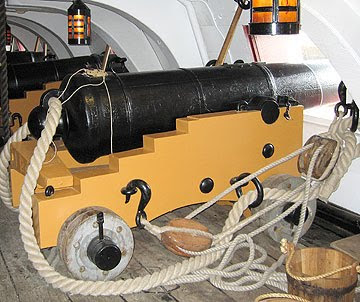
Header: Cannon aboard HMS Victory via markcoggins.com. I will link to Mark's post on Thursday. You'll know why then.

Monday, June 7, 2010

Books: Cochrane And Cordingly

Finding David Cordingly's exhaustive biography of Thomas Cochrane was entirely serendipitous for me. I was wandering the stacks on a hunt for a completely different type of research material and there it was. With my penchant for all things Patrick O'Brian and the fact that my own historical novels include more than a brief brush with the Royal Navy of the era, I couldn't resist the purchase. Frankly, that's where irresistible stops on just about all levels.

Cordingly is nothing if not a consummate historian. As discussed previously, his book Under A Black Flag is considered the preeminent work on pirates of the Golden Age. Nothing is missed in that one and I would be lying through my teeth if I didn't tell you that my tattered and dog-eared copy of that book is referred to at least weekly to verify my own research.

Cochrane: The Real Master and Commander is an entirely different kind of animal however. Full of every possible detail about the man who many firmly believe was Patrick O'Brian's inspiration for his hero Jack Aubrey, it reads more like a doctoral thesis than a lively biography. Given the vast scope of the life in question that is both understandable and disappointing. There are a lot of names, dates and places in this book but not a lot of heart or soul. You will learn everything about Cochrane - or just about. By the time you come out of the rabbit hole, however, you won't like him very much. And you'll probably need a nap.

Thomas Cochrane, 10th Earl of Dundonald was the first son of Archibald Cochrane, a down-at-hand Scottish Lard whose penchant for dabbling in scientific experiments didn't help the family fortune along. As the eldest son, young Tom was sent to sea where he could make his own fortune and bring it home to Culross Abbey House. Cochrane joined the ranks of the British Navy as a midshipman and had the good fortune to be assisted not only by his shipmates (he was old for a mid at 17 and knew virtually nothing about sailing when he showed up in his shiny uniform) but family "connexions" as well. Though Archibald angered the Admiralty with letters about promotions his son wasn't getting, Thomas made Master and Commander fairly quickly.

The now famous taking of the Spanish frigate El Gamo by Cochrane's sloop Speedy in 1801 was the turning point for his career. Though it took a few months, Cochrane was made Post and quickly got on with the business of serious heroic exploits in and around the Mediterranean. Sailors considered Cochrane lucky and fights broke out for a berth on any ship he commanded. He was well liked and capable, but his own personality, which lead him to balk at discipline from "lubbers" at the Admiralty, didn't win him any points. He got involved in politics and made enemies in Parliament. Things came to a head when he was struck from the roles of Post Captains after being convicted (though many historians, including Cordingly, say unjustly) of "jobbing" the stock exchange in 1814.

By this time, 32 year old Cochrane had married the sixteen year old orphan Katherine Corbett Barnes and as Lady Dundonald she became a regular fixture in her husband's exploits. Unlike Sophie Aubrey in the O'Brian books, Kate was not one to stay at home and wait for her man. Cochrane starts a new life at sea commanding the Chilean navy for the revolutionary leader Bernardo O'Higgins. Kate and their very young children are along for the ride. Indeed, it is in this portion of the book that Cordingly really shines, giving us some more intimate information about the Cochranes that makes even Thomas seem far more human than he has before.

But while he shows us Lady Dundonald on the gun deck - unfortunately fainting away and having to be carried below - and tells us of the death of her eleven month old from fever, Cordingly leaves a lot out. What did Kate think of one Maria Graham, for instance, who exults about the heroic Thomas in poetry and seems to follow him all over South America? Cordingly never tells us what the two's relationship really was and given the level of his abilities as a researcher, one has to wonder.

Cochrane returns to England and, something like Byron, gives his all for Greek independence later in life. The failure of the Greek revolution seems to be the last straw and, though he buys a fine home outside London and tries to make a go of parties and balls, his world is crumbling. He and Kate eventually split permanently and Cochrane is left with a small townhouse in the city where he takes the air with his housekeeper. Cordingly, in his usual crisp fashion, assures us that though Kate and the children imagined Thomas and the housekeeper were lovers, they were not. Cochrane dies in the townhouse in 1860, a well traveled if broken man and quite elderly at 85.

Given the huge mountain of information presented in this well written and impeccably researched book, I was disappointed in the end by what was left out. Maybe it's because I'm a woman but I don't think so. The private lives of our heroes are just as valid as - and sometimes more telling than - their public exploits. Unlike Stephan Talty with his salty, grumpy and all-for-success vision of Henry Morgan in Empire Of Blue Water, Cordingly offers us very little that is human in Cochrane. Lord Dundonald comes across, at least to me, not as heroic but as selfish, grasping and too ready to lay blame. And I'm not sure that was the intent.

Whatever Cochrane was, he was surely no Jack Aubrey. But then how many of us are?

Tuesday, March 16, 2010

People: "Brilliant And Intrepid"

Most of us who are rabid fans of Patrick O'Brian's Aubrey/Maturin novels know the story well. Jack Aubrey is "loosely" based on the vigorous and controversial hero of Nelson's Royal Navy, Captain Thomas Lord Cochrane. It's one of those established "facts" that no one questions for the most part. After a chance meeting with a handsome portrait followed by some research, your humble hostess would now argue that a certain capable officer of the same era is being left out of the mix. Today, Brethren, allow me to introduce you to Captain Sir William Hoste.

Unlike Cochrane, Hoste was not from a family of landed gentry. Born on August 26, 1780, Hoste was the son of Dixon Hoste, rector of Godwick. Much like his hero and mentor, Horatio Nelson, Hoste was a clergyman's child. The Hostes rented Godwick Hall from Sir Thomas Coke while young William was growing up and it was through this connection that he would come to the sea.

Coke, as it turned out, was acquainted with the then Captain Nelson. This relationship allowed William to have his name entered into the Royal Navy books at the tender age of 5. This little trick allowed Hoste to accumulate "book time" while at home attending to his studies. It would also make him eligible to become an officer at a remarkably young age.

In April, 1793, Nelson took William aboard his HMS Agamemnon, a 64 gun man-of-war, as Captain's servant. William excelled in his duties and caught Nelson's attention. In a not unusual instance of complete disregard for his wife's feelings, Nelson wrote her that William "...each day rivets himself stronger to my heart." He made only passing and belittling mention of his other young servant, his wife's son Josiah Nesbit. Leaving the hapless Josiah in the dust, William was promoted to Midshipman by February, 1794.

From there, William's career took off. He followed Nelson into HMS Captain and fought with him in the Battles of Cape St. Vincent in 1796 and Santa Cruz de Tenerife in 1797. William was with Captain Nelson when he lost his arm. He was promoted to Lieutenant in 1798 (thanks in no small part to Nelson and all that book time William scored starting at age 5).

Aboard HMS Theseus commanded by Ralph Miller, William participated in the famous Battle of the Nile. After this victory, Nelson recommended the 18 year old for promotion to Master and Commander and the promotion was confirmed in December. William took command of HMS Mutine at Naples. Three years later he was still in charge of Mutine but now under Lord Keith, who saw no reason for further promotions. The brilliant career slowed down and might have stalled all together if it weren't for William's perpetual benefactor Nelson. On his recommendation, and based on more than one capable action aboard Mutine, William made Post-Captain in 1802.

Mutine had largely spent her time around the Nile delta and William contracted malaria some time before his promotion. By 1803 he was suffering from a "lung infection" which may or may not have been the first signs of tuberculosis. He was forced to take some time off but returned to the Mediterranean aboard HMS Eurydice in 1804.

By 1805 he was again reporting to Nelson and in command of HMS Amphion. He was engaged in "diplomatic" (read intelligence) work in Algiers when the Battle of Trafalgar was fought. Upon hearing of Nelson's death, William was inconsolable. He wrote his father that "...to have lost such a friend... is really sufficient to overwhelm me."

It didn't, of course. William was given a cruise in the Adriatic where he captured or sunk 200 enemy vessels and brought trade with France to a halt locally. He was then given a Commodore's flag with two other ships under his command. In March, 1811 his squadron was attacked by the able French Captain Dubourdieu. The seven French frigates came straight at William's three but, with the signal Remember Nelson flying from Amphion, William and his ships won the day. Dubourdieu was killed, one of his ships was grounded and William took two as prizes. The battle, which occurred in the Bay of Vis, prompted the locals to name a small promontory there Hoste Island.

This success certainly was used as an example by O'Brian. A later victory, in which William had cannon raised up onto a rocky cliff above an enemy fortress with block and tackle in 1814 was used almost verbatim in The Hundred Days.

William Hoste, however, was becoming a sick man. Malaria ate away at him and he eventually contracted TB. He returned to England, received a Baronet in 1814 and was knighted in 1815. William married Lady Harriet Walpole in 1817. His health didn't deter him from the business of family. By 1825 they had six children. Appointed to the royal yacht Royal Sovereign that same year, William continued as her Captain until 1828. He contracted a cold in January and never managed to recover. By December he was gone.

The man that inspired O'Brian and that Admiral Alexander Cochrane called "...brilliant and intrepid" is buried in St. John's Chapel, London. Another place I must visit when I'm there.

Thursday, December 3, 2009

History: Adventures Afloat Part 2

As we saw yesterday, Captain Thomas Lord Cochrane was nothing if not ready for action. He was surprisingly ready to complain about any given situation as well and that would get him into plenty of trouble as his career in the Royal Navy went on. But let us look into the rest of his Adventures Afloat as Captain of the sloop of war, Speedy.

His French prize from the port of Tunis handily taken and sent in to Port Mahon, Cochrane is cruising again by March 18, 1801. He spies what he refers to as a "...large frigate in chase of us." Although he does not give her exact size or the number of her guns, she must have been impressive. The chase continues through the day and night and into the next day. Finally, on the second night, Cochrane resorts to a ruse that will be more than familiar to O'Brian readers: "After dark, we lowered a tub overboard with a light on it..." Speedy douses her lights and changes course, slipping away from her pursuer in the dark.

In April another prize is taken before Speedy is forced back to port to "... refit and procure fresh hands, many having been sent away in prizes." It was customary for a "prize crew" to be put aboard a captured ship and sent back to port while their mates continued their cruise so, aboard a small ship like Speedy, hands could become very lean with a lucky Captain like Cochrane.

In early May, Speedy is off Barcelona when she encounters the Spanish xebec frigate Gamo (or El Gamo, shown above with the much smaller English sloop off her lee). The frigate ships over 300 men and 32 cannon but Cochrane and his officers decide to take her. The action is quick and surprisingly efficient. Speedy maneuvers close to Gamo where she can fire upward with her small guns while Gamo's large cannon can only shoot impotently over her. The Spanish Captain is killed in the initial broadside and Cochrane gives the order to board leaving only his surgeon, Mr. Guthrie, at the helm of little Speedy.

Cochrane's 54 men manage to subdue Gamo's 319 and Gamo loses more men than Speedy has in her entire crew. The whole engagement is a tremendous success for the Royal Navy and Cochrane in particular and the papers in the Mediterranean and at home in Britain hail Cochrane and his men as heroes. Midshipman Archibald Cochrane, Thomas' younger brother, is given command of the prize and she is taken in to Port Mahon.

In the pamphlet, Cochrane grumbles about "... the peculations of the Mediterranean Admiralty Courts" with regard to the prize money owed him and his men and it may be that he was vocal at the time as well. Notoriously his own worst enemy, Cochrane is given assignments after the glorious capture of Gamo that he feels are either inappropriate for his little sloop (appealing to the Dey of Algiers for return of a British frigate) or well beneath him (escorting a "... tub of a mail packet to Gibraltar" without being acknowledged for his trouble). Clearly, the powers that be have their teeth on edge about our hero.

When Cochrane discovers that Gamo has been sold to Algeria rather then refit as his new command, he quits playing nice. While escorting the mail packet to Gibraltar he keeps his eye out for the enemy. One night, upon finding a French sloop laden with oil in an estuary, he orders her set afire. The blaze draws attention from not one but three French frigates and the chase is on.

Early the next morning things become dire for Speedy and, though she continues to run to the best of her ability, she is badly cut up by fire from the frigates and must strike to the closest one. This is Dessiax, whose Captain, Christie Palliere, is so impressed that he refuses to take Cochrane's sword and insists on treating him as a guest aboard the frigate. The two men become friends, as so often happens among naval men who admire one another for their skill despite their status as enemies. So much so, in fact, that there seem to be no hard feelings between them when Dessaix is set upon and taken by a squadron of English frigates.

Cochrane and his men are exchanged for French and Spanish prisoners but Speedy is too far gone for repair. In her short career under Cochrane she, as he puts it, "... had taken and retaken upwards of fifty vessels, one hundred and twenty-two guns, and five hundred and thirty-four prisoners." A fine showing for both a green Post Captain and "... one of the smallest and worst-armed vessels in the British service."

Thomas Cochrane is one of the most fascinating naval figures of his age and we will revisit him and his later exploits in the future. For now, though, we can only say well done to Speedy, her crew, and her lucky Captain.

Wednesday, December 2, 2009

History: Adventures Afloat Part 1

People ask me Pauline, what are you doing talking about the Royal Navy so much, not to mention that pesky American version? Isn't your focus pirates? My answer is simple. Jack, the third P in Triple P stands for Privateers and all standing navies - especially the "blue water" varieties - are privateers not just in the general but specific sense. So, by way of illustration, today and tomorrow we will discuss the writings of one of the most successful and controversial figures in Nelson's navy.

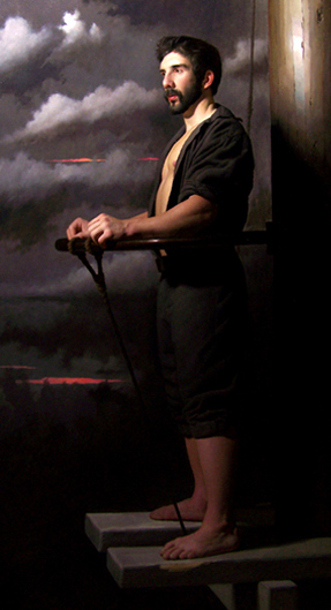
Captain Thomas Lord Cochrane, 10th Earl of Dondonald (pictured above in heroic stance and tiny slippers that make my feet hurt) was not only a person envied by naval officers on both sides of the Atlantic but also a man with the second best name in Royal Navy history. The first, of course, belonging to his contemporary Admiral Sir Richard Cockburn.

Cochrane, who despite his title came from a down-at-heel family, went to sea young and spent a year "before the mast" in punishment for an infraction that may or may not have involved hiding a girl aboard ship when he was a Mid. He overcame this obstacle to promotion and by 1800 was given the command of a sloop of war named Speedy. If any of this is already sounding familiar to readers of Patrick O'Brian's Aubrey/Maturin novels, it should. O'Brian's inspiration for Jack "Master and Commander" Aubrey was undoubtedly Thomas Cochrane.

Cochrane later wrote of his experiences aboard Speedy in a pamphlet entitled Adventures Afloat. He not only included excerpts from his log but spiced up his narrative with a liberal seasoning of personal anecdote and opinion. If Cochrane really did write this thing (some historians are skeptical), he must have been a kick in person. He starts out with complaints about his first command, calling her "a burlesque on a vessel of war" and referring to her fourteen 4 pound cannons as a "species of gun little larger than a blunderbuss". Despite his disdain, Cochrane manages to sail the hell out of little Speedy.

The first cruise sets out from Port Mahon, a British Naval base in Spain, in May of 1800 and immediately sets to the work of taking French and Spanish prizes. He has been charged by Admiral Lord Keith, in charge of the Mediterranean at the time, to do so and Cochrane takes his work seriously. By August 3rd, according to the log documentation, Speedy had five prizes under her belt and the numbers continued to escalate.

Other officers, including Admiral Keith, took notice and Cochrane - never one to shy away from the limelight - enjoyed the rising of his star. He makes a point of saying that, during a stay at Leghorn port, Keith "... frequently invited me ashore to participate in the gaities of the place." Doubtless the ladies in particular appreciated this. Officers in the Mediterranean service frequently stationed their wives and daughters at ports like Gibraltar, Mahon and Leghorn in the hope of attracting a good catch among the unmarried Lieutenants and Post Captains. Cochrane, though, was not ready to swallow that hook.

Back at sea in October, Cochrane amasses more prizes, even taking a Spanish privateer full of wine off Carthagena, Spain, on Christmas Eve. By now, Cochrane writes that Speedy has become a target of Spanish men-of-war and he makes clear that a certain meeting with a very large frigate ended in a lucky escape rather than a cowardly avoidance - as some of his officers would say.

Continued success gets Cochrane an invite to a fancy dress ball held by French Royalists at Malta while Speedy is in port in January, 1801. Cochrane chooses to dress as a common British tar. As he puts it "... not even the marlinspike and the lump of grease in the hat being omitted." This brings him a brusque rebuke from the snotty French and a request that he leave the party, leading to fisty-cuffs and a challenge to a duel. Cochrane is unapologetic about the situation, and makes sure we understand that his gun did more damage to the Frenchman then the Frenchman's did to him. He does end the anecdote, though, a bit humbly: "It was a lesson to me in future never to do anything in frolic which might give even unintentional offense."

Cochrane is back at sea by February and this time he takes a prize in the port of Tunis under some questionable conditions. The ship is a Frenchman, at anchor in the neutral port and full of arms and munitions bound for Napoleon's army in Egypt. Cochrane decides to board her by night, takes the ship without much trouble and then works out a plan to avoid the officers and crew complaining to the Tunisian authorities. He effectively lets his prisoners escape by making boats available and turning a blind eye one evening. The Frenchmen, not wanting to be recaptured on shore, sail off into the dark and Cochrane has yet another impressive prize to take into Port Mahon.

Things get better - and worse - for our hero as spring turns into summer. But that part we'll save for tomorrow.