February 10, 1722: Bartholomew Roberts, known as "Black Bart", the reluctant pirate who was certainly one of the most successful freebooting captains of the Golden Age, meets his end aboard his ship Royal Fortune. Caught in a firefight with HMS Swallow, Roberts died on deck of wounds to his throat and chest from a blast of grapeshot. He was quickly buried at sea by his crew, still wearing a beautiful coat of crimson brocade.
Header: Captain Bartholomew Roberts by Edward Mortelmans c 1970 via IAG
Showing posts with label Bartholomew Roberts. Show all posts
Sunday, February 10, 2013
Sunday, April 22, 2012
Seafaring Sunday: Hanged by the Neck
April 22, 1722: The last living members of pirate Bartholomew Roberts' crew were hanged after trial at Cape Coast Fortress, Africa.
Header: Making Chase by Don Maitz
Saturday, April 21, 2012
Sailor Mouth Saturday: Seaman
This is a term seldom bestowed among seafaring men upon their associates, unless they are known to be pre-eminent in every duty of the thorough-paced tar; one who never issues a command which he is not competent to execute himself, and is deemed an authority on every matter relating to sea-craft.
Thus begins Admiral Smyth’s definition of the often improperly used word seaman in The Sailor’s Word Book. In the terms used by seasoned mariners, a seaman in a sailor’s sailor. Almost without fail he is an officer who has come up through the ranks, if not starting out there, he has at least spent time as a foremast jack where he learned to heave a lead and haul a cable like any other tar. In his capacity of command he has not lost the memory of those days and, indeed, continues to embrace the work of running a ship. He pushes on the capstan, reefs the sails and works the pumps alongside those he commands. He is sound in judgment; no flogging captain has ever been called a seaman. This type of commander runs a happy ship.
From the annals of history, the names of such captains tend to spring to mind more readily than those of a different nature. Horatio Nelson, James Cook and Thomas Cochrane are all premier examples when discussing the Royal Navy. On the other side of the Atlantic, John Paul Jones, Stephen Decatur and David Porter are names that only scratch the surface of such a list. Then too, perhaps to many’s surprise, there were such men among pirates and privateers: Bartholomew Roberts, for instance, was known as an artist, the word used in his era for an expert navigator, and a sober if initially reluctant captain. Woodes Rogers was a right seaman as well, and I would be remiss as an admirer and a descendant to go without including the Baratarians Dominique Youx and Renato Beluche.
In mentioning those last two names, which I always do fondly, the perhaps unfamiliar term seaman-gunner comes to mind. This is a man who has such thorough knowledge of guns and artillery that he is well qualified to both lead a gun crew and train men to the guns. As both men proved on Rodriguez canal that fateful week in 1814-1815, they were both veteran seamen-gunners.
Seamanship is, as Admiral Smyth advises:
The noble practical art of rigging and working a ship, and performing with effect all her various evolutions at sea.
Finally, albeit reluctantly, I must mention that to this day the seaman’s disgrace is another term for that worst case scenario known as a foul – now frequently spoken as fouled – anchor. And a shame it is, too.
Happy Saturday, Brethren; may you all, in your lifetimes or only shortly after, be remembered by your peers as able seaman.
Header: Crow’s Nest by Scott Waddell via American Gallery
Thus begins Admiral Smyth’s definition of the often improperly used word seaman in The Sailor’s Word Book. In the terms used by seasoned mariners, a seaman in a sailor’s sailor. Almost without fail he is an officer who has come up through the ranks, if not starting out there, he has at least spent time as a foremast jack where he learned to heave a lead and haul a cable like any other tar. In his capacity of command he has not lost the memory of those days and, indeed, continues to embrace the work of running a ship. He pushes on the capstan, reefs the sails and works the pumps alongside those he commands. He is sound in judgment; no flogging captain has ever been called a seaman. This type of commander runs a happy ship.
From the annals of history, the names of such captains tend to spring to mind more readily than those of a different nature. Horatio Nelson, James Cook and Thomas Cochrane are all premier examples when discussing the Royal Navy. On the other side of the Atlantic, John Paul Jones, Stephen Decatur and David Porter are names that only scratch the surface of such a list. Then too, perhaps to many’s surprise, there were such men among pirates and privateers: Bartholomew Roberts, for instance, was known as an artist, the word used in his era for an expert navigator, and a sober if initially reluctant captain. Woodes Rogers was a right seaman as well, and I would be remiss as an admirer and a descendant to go without including the Baratarians Dominique Youx and Renato Beluche.
In mentioning those last two names, which I always do fondly, the perhaps unfamiliar term seaman-gunner comes to mind. This is a man who has such thorough knowledge of guns and artillery that he is well qualified to both lead a gun crew and train men to the guns. As both men proved on Rodriguez canal that fateful week in 1814-1815, they were both veteran seamen-gunners.
Seamanship is, as Admiral Smyth advises:
The noble practical art of rigging and working a ship, and performing with effect all her various evolutions at sea.
Finally, albeit reluctantly, I must mention that to this day the seaman’s disgrace is another term for that worst case scenario known as a foul – now frequently spoken as fouled – anchor. And a shame it is, too.
Happy Saturday, Brethren; may you all, in your lifetimes or only shortly after, be remembered by your peers as able seaman.
Header: Crow’s Nest by Scott Waddell via American Gallery
Monday, March 26, 2012
People: The Curious Captain Condent
Christopher Condent is a name that gets tossed around a fair amount when discussing the Golden Age of Piracy. Condent, apparently another native of that great breeding ground of sailors, Devon, has his story told with the same consistency we find in tales of bigger names like Blackbeard, Roberts and Morgan. From Charles Ellms to Philip Gosse, all the high points in Condent’s life are hit consistently. Does this mean that they all occurred as they have come down to us? No, but it certainly makes them a bit more creditable.
In The Pirate’s Who’s Who, Philip Gosse does not give a date of birth for Condent. As he was quartermaster aboard a New York merchant when Governor Woodes Rogers sailed into New Providence in 1718, it is probably safe to place his natal year some time in the 1690s. It is a consistent point in Condent’s story, regardless of who is telling it, that his anonymous captain saw fit to hightail it out of the Bahamas when privateer-turned-pirate-hunter Rogers showed up. This is probably a good indication that the New York “merchant” was already a practicing pirate at the time.
According to Gosse and Ellms, the ship was not a happy one. A Native American aboard her had been mistreated by other crew members and, in his rage, decided to take his revenge by blowing up the ship. The sloop had a fair amount of black powder aboard – another good but not altogether telling indication of piratical activity. The injured sailor locked himself in the powder magazine with intent to ignite the powder and blow up the ship. Condent took it upon himself to curtail the man’s plans, jumping into the hold through a hatch and dispatching the malcontent with a pistol shot to the face.
The rest of the crew, still obviously harboring a grudge, hacked the man’s body to pieces. Both Goss and Ellms tell us that the gunner went so far as to remove the man’s heart from his chest cavity, boil or roast it and serve it up for supper. This consistently retold vignette has a curious ring of truth if for no other reason than it is never thoroughly explained. Why eat a man’s heart? The answer, one imagines, might be why not.
After this bloody episode morale seems to continue to flag aboard the merchant-cum-pirate. An English prize, Duke of York, is taken in the Atlantic and a dispute over something to do with it splits the crew down the middle. The captain and his faction take the prize and sail away, while the remaining crewmen elect Condent their new captain.
Condent sets a course for the Cape Verde Islands and manages to take a number of small ships from the “salt fleet”. Next he is cruising near the island of St. Jago where he takes a Dutch ship. He likes this vessel more than his old sloop and trades up, naming her Flying Dragon and hoisting a black flag decorated with three skulls and crossed bones.
Heading back to the New World, Condent begins cruising off Brazil, taking Portuguese ships and torturing their crews. His ruthlessness earns him a reputation but he is clever enough to continue taking prizes in the area by pretending to be a harmless and friendly English merchant. Eventually his tactics earn him a firefight with a Portuguese warship, and Gosse tells us that Flying Dragon is lucky to escape.
Condent sets a course for the Indian Ocean and arrives at the island of Johanna near Madagascar. Here he runs into the former crew of Captain John Halsey who died in 1716. These men were probably happy to join Condent, and Flying Dragon proceeded to take more than one East Indiaman, using the nearby Ile Sainte-Marie as a base of operations.
It appears that the greatest prize of Condent’s piratical career was a galley carrying the Viceroy of Goa. What became of the official is not mentioned, but Gosse indicates that Condent and company took their prize to Zanzibar where “they plundered her of a large amount of money.”
Back home on Sainte-Marie, Condent seems to have second thoughts about piracy. He pays off his men, some of whom chose to settle on the island. Condent and a few others petition the French Governor on Mauritius for a pardon. The Governor is amenable as long as the pirates will break up their ship when they arrive on his island. This they do and they are allowed to settle down. Christopher Condent, now on the straight and narrow, courts and marries the Governor’s sister-in-law.
“A few years later,” Gosse says in summing up his entry on Condent. “The captain and his wife left the island and sailed to France, settling at Saint Malo, where Condent drove a considerable trade as a merchant.”
A rare and curiously happy ending to the story of another brutal freebooter.
Header: Replica of Christopher Condent’s flag via Black Flag Trading Co.
In The Pirate’s Who’s Who, Philip Gosse does not give a date of birth for Condent. As he was quartermaster aboard a New York merchant when Governor Woodes Rogers sailed into New Providence in 1718, it is probably safe to place his natal year some time in the 1690s. It is a consistent point in Condent’s story, regardless of who is telling it, that his anonymous captain saw fit to hightail it out of the Bahamas when privateer-turned-pirate-hunter Rogers showed up. This is probably a good indication that the New York “merchant” was already a practicing pirate at the time.
According to Gosse and Ellms, the ship was not a happy one. A Native American aboard her had been mistreated by other crew members and, in his rage, decided to take his revenge by blowing up the ship. The sloop had a fair amount of black powder aboard – another good but not altogether telling indication of piratical activity. The injured sailor locked himself in the powder magazine with intent to ignite the powder and blow up the ship. Condent took it upon himself to curtail the man’s plans, jumping into the hold through a hatch and dispatching the malcontent with a pistol shot to the face.
The rest of the crew, still obviously harboring a grudge, hacked the man’s body to pieces. Both Goss and Ellms tell us that the gunner went so far as to remove the man’s heart from his chest cavity, boil or roast it and serve it up for supper. This consistently retold vignette has a curious ring of truth if for no other reason than it is never thoroughly explained. Why eat a man’s heart? The answer, one imagines, might be why not.
After this bloody episode morale seems to continue to flag aboard the merchant-cum-pirate. An English prize, Duke of York, is taken in the Atlantic and a dispute over something to do with it splits the crew down the middle. The captain and his faction take the prize and sail away, while the remaining crewmen elect Condent their new captain.
Condent sets a course for the Cape Verde Islands and manages to take a number of small ships from the “salt fleet”. Next he is cruising near the island of St. Jago where he takes a Dutch ship. He likes this vessel more than his old sloop and trades up, naming her Flying Dragon and hoisting a black flag decorated with three skulls and crossed bones.
Heading back to the New World, Condent begins cruising off Brazil, taking Portuguese ships and torturing their crews. His ruthlessness earns him a reputation but he is clever enough to continue taking prizes in the area by pretending to be a harmless and friendly English merchant. Eventually his tactics earn him a firefight with a Portuguese warship, and Gosse tells us that Flying Dragon is lucky to escape.
Condent sets a course for the Indian Ocean and arrives at the island of Johanna near Madagascar. Here he runs into the former crew of Captain John Halsey who died in 1716. These men were probably happy to join Condent, and Flying Dragon proceeded to take more than one East Indiaman, using the nearby Ile Sainte-Marie as a base of operations.
It appears that the greatest prize of Condent’s piratical career was a galley carrying the Viceroy of Goa. What became of the official is not mentioned, but Gosse indicates that Condent and company took their prize to Zanzibar where “they plundered her of a large amount of money.”
Back home on Sainte-Marie, Condent seems to have second thoughts about piracy. He pays off his men, some of whom chose to settle on the island. Condent and a few others petition the French Governor on Mauritius for a pardon. The Governor is amenable as long as the pirates will break up their ship when they arrive on his island. This they do and they are allowed to settle down. Christopher Condent, now on the straight and narrow, courts and marries the Governor’s sister-in-law.
“A few years later,” Gosse says in summing up his entry on Condent. “The captain and his wife left the island and sailed to France, settling at Saint Malo, where Condent drove a considerable trade as a merchant.”
A rare and curiously happy ending to the story of another brutal freebooter.
Header: Replica of Christopher Condent’s flag via Black Flag Trading Co.
Monday, March 19, 2012
The Pirates Own Book: When Charles Ellms Met Henry Avery
Most of the stories told of our favorite pirates have trouble at the beginning. No one is really sure where the gentleman rover in question came from. What is more certain is the grisly death met by the dread fellow; from Bartholomew Roberts to Jean Laffite, from Francois L’Olonnais to Thomas Tew, spilled blood and guts come before the end of the story. In other it must be said less frequent cases, the pirate in question fades from history never to be seen or heard from again. From Christopher Condent to that fiction about the Laffite brothers, they simply stop being pirates and “blend in”. Henry Avery was among those “lost to history”, but Charles Ellms tells us that was not at all the case.
In The Pirates Own Book, Ellms begins his chapter on Avery with the usual story of the Captain’s exceeding wealth and marriage to the Great Mogul’s daughter thanks to his capture of one of the ruler’s treasure ships. Ellms quickly sets us straight, however, by informing us that Avery was “… actually starving without a shilling” at the time of his death.
Ellms then launches into the usual routine. Avery was born in Devonshire, he tells us, and went to sea in merchant ships at an early age. Avery was mate aboard the vessel of Captain Gibson when, in 1715, he began to foment mutiny among his fellows. He clearly had the itch to go a-pirating and the rest of the crew, according to Ellms, was just as eager. Gibson was fond of the bottle and one night when he was sleeping off a drunk, Avery and his men cut the ship’s cable and headed out from Corunna in the West Indies. When Gibson awoke, Avery informed him that he had taken over the ship. “You must know that I am captain of this ship now, and this is my cabin, therefore you must walk out; I am bound for Madagascar, with a design of making my own fortune, and that of all the brave fellows joined with me.”
Gibson decides against joining Avery, and is set on shore with a small group of like-minded sailors.
Once in the waters around Madagascar, Avery recruits the captains of two armed sloops to join him in his pirating venture. They form a little flotilla and take a galley of the aforementioned Mogul in the Indian Ocean. The ship is bound for Mecca where the Mogul’s daughter is making a pilgrimage, and it is packed to the gunnels with more riches than can reasonably be imagined. As Ellms points out: “It is a well known fact that people of the east travel with great magnificence…”
Avery and his cohorts plunder the ship of all its wealth and the ship limped home to India where the Mogul immediately protested to the British government. “The noise which this made over all Europe,” Ellms says, “gave birth to the rumors that were circulating concerning Avery’s greatness.”
Meanwhile, Avery was duping the two captains of those sloops out of their share of the Mogul’s treasure. Through assurances of his own ship’s superior sailing and fighting power, he led these captains to understand that their booty would be better off aboard him. When they agreed and transferred their wealth, Avery sailed for the West Indies under cover of night, leaving the unfortunate captains behind.
Convincing his men that their wealth would now allow them to live like kings ashore, Avery first considered settling at New Providence. He then moved on to Boston but was concerned that he would not be able to sell the gems of the Great Mogul without raising suspicions. He sailed for Ireland and eventually ended up in Brideford, Devonshire, according to Ellms.
At this point, most historians agree that further information on what became of Avery is unattainable, but Charles begs to differ. In a wonderful plot twist – which the reader has to hope wasn’t true – he has Avery casting about Devonshire trying to sell his cache of diamonds. “When he unbosomed himself to [a speculator] and other pretended friends,” these men, posing as merchants, assured Avery that they could sell his treasure for the highest possible price. Leaving a deposit with former pirate, they took the diamonds and disappeared with no intention of returning. As Ellms so eloquently puts it: “… the merchants thus proving themselves as good pirates on land as [Avery] was at sea.”
The end of this story is poignant in the extreme. Avery sets out for Ireland in search of the con men. Having no luck, he is reduced to walking home to Brideford from Plymouth. “He had been there but a few days, when he fell sick and died; not being worth so much as would buy him a coffin!”
Thus the man once known as Long Ben and “the Arch Pyrate” ended up buried in a paupers’ field in Devonshire. Or so Charles Ellms tells us.
Header: Captain Avery receiving the three chests of Treasure on board his Ship from The Pirates Own Book
In The Pirates Own Book, Ellms begins his chapter on Avery with the usual story of the Captain’s exceeding wealth and marriage to the Great Mogul’s daughter thanks to his capture of one of the ruler’s treasure ships. Ellms quickly sets us straight, however, by informing us that Avery was “… actually starving without a shilling” at the time of his death.
Ellms then launches into the usual routine. Avery was born in Devonshire, he tells us, and went to sea in merchant ships at an early age. Avery was mate aboard the vessel of Captain Gibson when, in 1715, he began to foment mutiny among his fellows. He clearly had the itch to go a-pirating and the rest of the crew, according to Ellms, was just as eager. Gibson was fond of the bottle and one night when he was sleeping off a drunk, Avery and his men cut the ship’s cable and headed out from Corunna in the West Indies. When Gibson awoke, Avery informed him that he had taken over the ship. “You must know that I am captain of this ship now, and this is my cabin, therefore you must walk out; I am bound for Madagascar, with a design of making my own fortune, and that of all the brave fellows joined with me.”
Gibson decides against joining Avery, and is set on shore with a small group of like-minded sailors.
Once in the waters around Madagascar, Avery recruits the captains of two armed sloops to join him in his pirating venture. They form a little flotilla and take a galley of the aforementioned Mogul in the Indian Ocean. The ship is bound for Mecca where the Mogul’s daughter is making a pilgrimage, and it is packed to the gunnels with more riches than can reasonably be imagined. As Ellms points out: “It is a well known fact that people of the east travel with great magnificence…”
Avery and his cohorts plunder the ship of all its wealth and the ship limped home to India where the Mogul immediately protested to the British government. “The noise which this made over all Europe,” Ellms says, “gave birth to the rumors that were circulating concerning Avery’s greatness.”
Meanwhile, Avery was duping the two captains of those sloops out of their share of the Mogul’s treasure. Through assurances of his own ship’s superior sailing and fighting power, he led these captains to understand that their booty would be better off aboard him. When they agreed and transferred their wealth, Avery sailed for the West Indies under cover of night, leaving the unfortunate captains behind.
Convincing his men that their wealth would now allow them to live like kings ashore, Avery first considered settling at New Providence. He then moved on to Boston but was concerned that he would not be able to sell the gems of the Great Mogul without raising suspicions. He sailed for Ireland and eventually ended up in Brideford, Devonshire, according to Ellms.
At this point, most historians agree that further information on what became of Avery is unattainable, but Charles begs to differ. In a wonderful plot twist – which the reader has to hope wasn’t true – he has Avery casting about Devonshire trying to sell his cache of diamonds. “When he unbosomed himself to [a speculator] and other pretended friends,” these men, posing as merchants, assured Avery that they could sell his treasure for the highest possible price. Leaving a deposit with former pirate, they took the diamonds and disappeared with no intention of returning. As Ellms so eloquently puts it: “… the merchants thus proving themselves as good pirates on land as [Avery] was at sea.”
The end of this story is poignant in the extreme. Avery sets out for Ireland in search of the con men. Having no luck, he is reduced to walking home to Brideford from Plymouth. “He had been there but a few days, when he fell sick and died; not being worth so much as would buy him a coffin!”
Thus the man once known as Long Ben and “the Arch Pyrate” ended up buried in a paupers’ field in Devonshire. Or so Charles Ellms tells us.
Header: Captain Avery receiving the three chests of Treasure on board his Ship from The Pirates Own Book
Tuesday, March 13, 2012
People: A Buccaneer at Heart
The old saying about greatness can be applied to pirates, too. Some are born, some are made and some have the mantel thrust upon them. Today’s subject was neither alive during the Golden Age nor, in the end, much of a seaman. But his life bares all the earmarks of any raider, from Viking to buccaneer. And most of it was thrust upon him.
Lee Christmas was born at the end of an era in a place that was fading away. He came into the world in Livingston Parish, Louisiana in a plantation house on the Amite River, February 2, 1863. The world he was born into was doomed by changing attitudes and the rigors of war, and the Christmas family fell – had in fact already fallen – on hard times as Lee grew to manhood.
There does not seem to be anything of delusion in Lee’s approach to life, however. Far from mourning the wealth he might have inherited, Christmas as a young man went forth to find adventure, first on the water. He apprenticed with bargemen on the Mississippi and eventually graduated to operating a tug boat on Lake Pontchartrain. Never a strikingly handsome man, Christmas all the same was full of charm and a quirky sense of humor that either endeared him to his fellows or put them off, depending on the man. He was driven to succeed, and when the opportunity arose to get in on the ground floor with the Illinois Central Railroad, Lee jumped at the chance.
He became a brakeman and by the 1880s was instrumental in the building of railroad lines in Louisiana, Kentucky, Mississippi and Texas. He was a force in the booming railroad industry, and worked as an engineer aboard a train that ran regularly between Memphis and New Orleans, where he lived.
In 1891 everything changed in the worst possible way for Lee Christmas. Some sources, like Herman Deutsch in his book about Christmas, The Incredible Yanqui, claim that the hard-drinking Louisianan was hitting the sauce at the throttle. His employer, on the other hand, said Christmas had been on duty – and awake running his locomotive – for over two days straight. Either way, Lee fell asleep in his speeding train and hit another engine head-on.
When Christmas recovered from the awful accident he found he had been bared from returning to his job while the incident was “under investigation.” With no means of support and bills to pay, Christmas tramped around Texas and Louisiana doing odd jobs with his hands. At last, in 1894, he was called back by the railroad but just when he could see his life returning to normal his former employer threw him for another loop. The now-required company physical found Christmas to be color blind; the railroad would not rehire him.
Devastated to once again be without income, Christmas managed to hear about the new railroad systems in Central America. Banana plantations, most of which were connected in one way or another to the U.S. company then known as United Fruit, needed their produce transported to the coasts and supplies – including huge blocks of ice – brought back up the mountains. No one would turn away an experienced engineer for a little problem like color blindness. Christmas booked passage on a steamer out of New Orleans and arrived in Puerto Cortes, Honduras late in 1894.
Christmas settled into the routine of engineer fairly quickly. The tiny train on its rickety tracks was no where near the mighty engine he had once piloted, but the work was steady until a pivotal moment in Christmas’ life happened at a gorge known as the Laguna Trestle in the Honduran mountains. The date was April 14, 1897. Christmas’ train was flagged down by revolutionaries with guns who commandeered both engine and engineer. At first, it seems that Christmas had no intention of joining the revolutionaries but, when government forces arrived to do battle, Lee Christmas took the gun the men in his engine had given him and fought along side them. On that day, the man from the Amite River went from locomotive engineer to politician and warrior.
Christmas switched camps often; in 1899 he was working for the Honduran government but by1903 he was again on the side of rebel leader Manuel Bonilla. Christmas adopted a persona of careless ferocity; he continued to drink hard, made a name for himself in Honduran capital San Pedro Sula’s brothels and chewed glass.
When Bonilla tried to encroach into Nicaragua in 1907, Christmas found himself exiled to Guatemala. It was here that he met the United Fruit company’s Central American agent Samuel Zemurray, known – in some cases affectionately, in others sarcastically – as “El Amigo”. While the documentation is slim, it is generally assumed that Christmas was in some way involved with, and probably in the pay of, United Fruit and their bid to monopolize the banana plantations of the region.
From this point on, Christmas’ exploits, either with or without Bonilla, would be heavily armed with guns provided by Zemurray. The famous Battle of La Ceiba in January of 1911 saw Christmas battling Honduran government forces with the aid of U.S. Army Colt machine guns. He used the guns to support rebel infantry in such an innovative way that his tactics would be studied by European and American generals, and used to great success in World War I. Bonilla’s rebels won the day and he resumed control of the government. Christmas was a hero until 1913, when Bonilla’s death changed the political climate overnight. Christmas was again sent packing, this time to Nicaragua.
Lee dropped out of sight, but landed on his feet. For nearly eleven years he worked with Zemurray, manipulating governments and economies in Central America. Rumors swirled in the states and elsewhere that Christmas had become emperor of some banana republic or other or that he was fighting with Zapata in Mexico. One thing we know with certainty thanks to letters home to friends; he married a local girl, Ida Culotta, in Puerto Cortes in 1914.
Lee Christmas was not a healthy man, however. The ravages if a tough life and a tougher lifestyle took their toll. Sick with tuberculosis, Christmas returned home to New Orleans in the early 1920s. He died there on January 24, 1924. The memory of his fascinating life faded quickly as the 20th century pressed on, but his legacy remains in odd corners like this one. Lee Christmas’ life is the story of a man who, if born in the Great Age of Sail, would surely have given Morgan or Roberts a run for their money.
Header: Lee Christmas in cavalry fatigues courtesy of the Marion Samson Collection, University of Tennessee, Knoxville
Lee Christmas was born at the end of an era in a place that was fading away. He came into the world in Livingston Parish, Louisiana in a plantation house on the Amite River, February 2, 1863. The world he was born into was doomed by changing attitudes and the rigors of war, and the Christmas family fell – had in fact already fallen – on hard times as Lee grew to manhood.
There does not seem to be anything of delusion in Lee’s approach to life, however. Far from mourning the wealth he might have inherited, Christmas as a young man went forth to find adventure, first on the water. He apprenticed with bargemen on the Mississippi and eventually graduated to operating a tug boat on Lake Pontchartrain. Never a strikingly handsome man, Christmas all the same was full of charm and a quirky sense of humor that either endeared him to his fellows or put them off, depending on the man. He was driven to succeed, and when the opportunity arose to get in on the ground floor with the Illinois Central Railroad, Lee jumped at the chance.
He became a brakeman and by the 1880s was instrumental in the building of railroad lines in Louisiana, Kentucky, Mississippi and Texas. He was a force in the booming railroad industry, and worked as an engineer aboard a train that ran regularly between Memphis and New Orleans, where he lived.
In 1891 everything changed in the worst possible way for Lee Christmas. Some sources, like Herman Deutsch in his book about Christmas, The Incredible Yanqui, claim that the hard-drinking Louisianan was hitting the sauce at the throttle. His employer, on the other hand, said Christmas had been on duty – and awake running his locomotive – for over two days straight. Either way, Lee fell asleep in his speeding train and hit another engine head-on.
When Christmas recovered from the awful accident he found he had been bared from returning to his job while the incident was “under investigation.” With no means of support and bills to pay, Christmas tramped around Texas and Louisiana doing odd jobs with his hands. At last, in 1894, he was called back by the railroad but just when he could see his life returning to normal his former employer threw him for another loop. The now-required company physical found Christmas to be color blind; the railroad would not rehire him.
Devastated to once again be without income, Christmas managed to hear about the new railroad systems in Central America. Banana plantations, most of which were connected in one way or another to the U.S. company then known as United Fruit, needed their produce transported to the coasts and supplies – including huge blocks of ice – brought back up the mountains. No one would turn away an experienced engineer for a little problem like color blindness. Christmas booked passage on a steamer out of New Orleans and arrived in Puerto Cortes, Honduras late in 1894.
Christmas settled into the routine of engineer fairly quickly. The tiny train on its rickety tracks was no where near the mighty engine he had once piloted, but the work was steady until a pivotal moment in Christmas’ life happened at a gorge known as the Laguna Trestle in the Honduran mountains. The date was April 14, 1897. Christmas’ train was flagged down by revolutionaries with guns who commandeered both engine and engineer. At first, it seems that Christmas had no intention of joining the revolutionaries but, when government forces arrived to do battle, Lee Christmas took the gun the men in his engine had given him and fought along side them. On that day, the man from the Amite River went from locomotive engineer to politician and warrior.
Christmas switched camps often; in 1899 he was working for the Honduran government but by1903 he was again on the side of rebel leader Manuel Bonilla. Christmas adopted a persona of careless ferocity; he continued to drink hard, made a name for himself in Honduran capital San Pedro Sula’s brothels and chewed glass.
When Bonilla tried to encroach into Nicaragua in 1907, Christmas found himself exiled to Guatemala. It was here that he met the United Fruit company’s Central American agent Samuel Zemurray, known – in some cases affectionately, in others sarcastically – as “El Amigo”. While the documentation is slim, it is generally assumed that Christmas was in some way involved with, and probably in the pay of, United Fruit and their bid to monopolize the banana plantations of the region.
From this point on, Christmas’ exploits, either with or without Bonilla, would be heavily armed with guns provided by Zemurray. The famous Battle of La Ceiba in January of 1911 saw Christmas battling Honduran government forces with the aid of U.S. Army Colt machine guns. He used the guns to support rebel infantry in such an innovative way that his tactics would be studied by European and American generals, and used to great success in World War I. Bonilla’s rebels won the day and he resumed control of the government. Christmas was a hero until 1913, when Bonilla’s death changed the political climate overnight. Christmas was again sent packing, this time to Nicaragua.
Lee dropped out of sight, but landed on his feet. For nearly eleven years he worked with Zemurray, manipulating governments and economies in Central America. Rumors swirled in the states and elsewhere that Christmas had become emperor of some banana republic or other or that he was fighting with Zapata in Mexico. One thing we know with certainty thanks to letters home to friends; he married a local girl, Ida Culotta, in Puerto Cortes in 1914.
Lee Christmas was not a healthy man, however. The ravages if a tough life and a tougher lifestyle took their toll. Sick with tuberculosis, Christmas returned home to New Orleans in the early 1920s. He died there on January 24, 1924. The memory of his fascinating life faded quickly as the 20th century pressed on, but his legacy remains in odd corners like this one. Lee Christmas’ life is the story of a man who, if born in the Great Age of Sail, would surely have given Morgan or Roberts a run for their money.
Header: Lee Christmas in cavalry fatigues courtesy of the Marion Samson Collection, University of Tennessee, Knoxville
Friday, January 13, 2012
Booty: For Sale: One Pirate Ship
If you’re like me, you have dreamed of owning, and in particular sailing, a fully-rigged, accurate-to-every-detail replica of your favorite pirate ship. Some may wish for Drake’s Golden Hinde, others might long for Black Bart Roberts’ Revenge, Sam Bellamy’s Whydah or Blackbeard’s Queen Anne’s Revenge. Or is a privateer more to your liking; John Paul Jones’ Bonhomme Richard, or a handsome frigate like the dear Surprise perhaps? For me the dream will always be Renato Beluche’s brig General Bolivar, the quintessential Gulf privateer.
Dreams like this are a wonderful way to pass a quiet moment but, for most of us at least, they will remain as formless as the ether. For those of you who are in all seriousness, though, there is a ship in the style of Henry Morgan’s Oxford currently available for sale.
As this listing at Maritime Sales online indicates, the ship is a 90 foot, Santa Maria style galleon complete with kitchen, bathrooms, electricity and a diesel engine. It is outfitted as our seafaring ancestors could never have imagined. Her commission is out of Honduras and according to the listing she can comfortably float 78 hands; pirates not included.
Clearly this is the ultimate fantasy. Her lines are unfortunately wide and her below decks look more like a summer camp cabin than a proper place to hang a cot. I’d hate to be in one of those beds in a high sea; in fact, I’m sure no one would be in them for long. But that’s not the point. This is like owning a floating bed and breakfast, and it can all be yours for the reduced price of $750,000 U.S.
Something to contemplate on this, the first of three Friday 13s in 2012.
Header: Pirate ship via maritimesales.com (click the link above for more pictures)
Dreams like this are a wonderful way to pass a quiet moment but, for most of us at least, they will remain as formless as the ether. For those of you who are in all seriousness, though, there is a ship in the style of Henry Morgan’s Oxford currently available for sale.
As this listing at Maritime Sales online indicates, the ship is a 90 foot, Santa Maria style galleon complete with kitchen, bathrooms, electricity and a diesel engine. It is outfitted as our seafaring ancestors could never have imagined. Her commission is out of Honduras and according to the listing she can comfortably float 78 hands; pirates not included.
Clearly this is the ultimate fantasy. Her lines are unfortunately wide and her below decks look more like a summer camp cabin than a proper place to hang a cot. I’d hate to be in one of those beds in a high sea; in fact, I’m sure no one would be in them for long. But that’s not the point. This is like owning a floating bed and breakfast, and it can all be yours for the reduced price of $750,000 U.S.
Something to contemplate on this, the first of three Friday 13s in 2012.
Header: Pirate ship via maritimesales.com (click the link above for more pictures)
Monday, September 12, 2011
History: In the Cards
The British Museum has a curiously ordinary looking pack of playing cards on display in person and on their website (the picture above is from the latter). They were acquired in the Philippines by a Royal Navy officer named Edward Belcher some time in the 1840s. According to Belcher, he confiscated them from a pirate ship he had engaged and successfully defeated.
Belcher, a fascinating individual who really should be the subject of his own post, joined the Royal Navy in 1812 when he was a lad of twelve. He was quite successful and saw the world aboard ship, exploring such diverse places as the Canadian Arctic and the Great South Sea. He was particularly active off the coasts of China, Japan and the Philippines where he zealously – some historians claim over-zealously – tried to stamp out the rampant piracy that had become an institution by the time he arrived in those waters.
Cards, like dice, were a favorite game for many seamen. They were easy to carry and to learn how to play; gambling with them was easy too. Most pirate articles in the West forbade gambling at sea but that doesn’t necessarily mean it didn’t go on. Many famous names in piracy, from Bartholomew Roberts to Blackbeard to Cheng I Sao, were reportedly inveterate gamblers.
Belcher did not say why he confiscated the cards and what he actually did with them – perhaps he was a gambling man himself? Regardless, they now reside in the British Museum for the enjoyment of visitors from all over the world. They’re quite lovely, too, and just one of those many seemingly mundane objects that tie us to our collective piratical past.
Belcher, a fascinating individual who really should be the subject of his own post, joined the Royal Navy in 1812 when he was a lad of twelve. He was quite successful and saw the world aboard ship, exploring such diverse places as the Canadian Arctic and the Great South Sea. He was particularly active off the coasts of China, Japan and the Philippines where he zealously – some historians claim over-zealously – tried to stamp out the rampant piracy that had become an institution by the time he arrived in those waters.
Cards, like dice, were a favorite game for many seamen. They were easy to carry and to learn how to play; gambling with them was easy too. Most pirate articles in the West forbade gambling at sea but that doesn’t necessarily mean it didn’t go on. Many famous names in piracy, from Bartholomew Roberts to Blackbeard to Cheng I Sao, were reportedly inveterate gamblers.
Belcher did not say why he confiscated the cards and what he actually did with them – perhaps he was a gambling man himself? Regardless, they now reside in the British Museum for the enjoyment of visitors from all over the world. They’re quite lovely, too, and just one of those many seemingly mundane objects that tie us to our collective piratical past.
Friday, September 9, 2011
Booty: Pyrate Creep
State Fairs are one of the few things that have survived in our highly gadget oriented “I’d rather text you than look at you” world. People still go and slog around in unbearable heat or drenching rain to see farm animals, eat food what only tastes good at a fair and see live shows. While State Fairs seem to have been a hold out for many years, it looks like “performing pirate creep” – as I like to call it – has finally hit the hay bails.
Seeing this article in the Anchorage Daily News last Saturday quite literally brought that home. Evidently the troupe known as “Pirates for Hire” was engaged to entertain Alaskans for the two weeks and three days that our fair was up and running in Palmer. For those of you unfamiliar, Palmer is next door to Wasilla which is where then Mayor Palin married a couple at the local Wal-Mart. As you can doubtless tell by the picture at the header (from their website) “Pirates for Hire” hits all the high notes of our now popular pirate tropes; it’s Disney’s “Jack Sparrow and Friendz” right there in front of you.
While the article does point out that “Pirates for Hire” began doing live shows prior to the release of the original Pirates of the Caribbean movie in 1999, it sure looks to me like they’ve hitched their yoke to that cash cow. And more power to ‘em; even fake pirates have to pay the bills.
That said, all this business of Pyrates in (fill in the blank) is fun but it hardly lends itself to keeping our ancestors’ memories alive. I’m referring here to all pirates, from black hearts like Francois L’Olonnais to descent men like Renato Beluche and everyone in between. None of them were saints but a lot of what was interesting about them is lost in strings of beads and eye makeup. Not to mention some sub-par fencing. At some point our culture – and if you live in the Americas you probably have an ancestor who was touched in some way by pirates and/or privateers – substituted historical pirates with party entertainers. As I noted it is great fun, but there is a lot lost in translation.
What’s the alternative, you ask? I would offer three I’m familiar with, which is only barely scratching the surface. First, the Historic Seaport ships Lady Washington and Hawaiian Chieftain who put on mock pirate battles with great authenticity up and down the west coast. Not only are they teaching the ins and outs of daily life at sea, they’re keeping alive the ancient art of seafaring with wind and sail. Then there is my mate Blue Lou Logan, who offers story telling and history lessons all rolled into one, with no need to mention Jack Sparrow or Elizabeth Swann even once. And why should he when we’ve Bartholomew Roberts and Grace O’Malley just as a start? Last but by no means least, there is the generous and knowledgable Captain Swallow. The good Captain is one of my oldest and dearest piratical friends. He and his mates at NOLA Pyrate Week keep the memory of all our histories alive, and for that I cannot thank them enough!
So go enjoy the shows, Brethren. Then poke around your area for some real pirate history and share that with the little freebooters in your lives. Lost history is rarely regained; let's see to it that the wonder of this history never has to be found again.
Seeing this article in the Anchorage Daily News last Saturday quite literally brought that home. Evidently the troupe known as “Pirates for Hire” was engaged to entertain Alaskans for the two weeks and three days that our fair was up and running in Palmer. For those of you unfamiliar, Palmer is next door to Wasilla which is where then Mayor Palin married a couple at the local Wal-Mart. As you can doubtless tell by the picture at the header (from their website) “Pirates for Hire” hits all the high notes of our now popular pirate tropes; it’s Disney’s “Jack Sparrow and Friendz” right there in front of you.
While the article does point out that “Pirates for Hire” began doing live shows prior to the release of the original Pirates of the Caribbean movie in 1999, it sure looks to me like they’ve hitched their yoke to that cash cow. And more power to ‘em; even fake pirates have to pay the bills.
That said, all this business of Pyrates in (fill in the blank) is fun but it hardly lends itself to keeping our ancestors’ memories alive. I’m referring here to all pirates, from black hearts like Francois L’Olonnais to descent men like Renato Beluche and everyone in between. None of them were saints but a lot of what was interesting about them is lost in strings of beads and eye makeup. Not to mention some sub-par fencing. At some point our culture – and if you live in the Americas you probably have an ancestor who was touched in some way by pirates and/or privateers – substituted historical pirates with party entertainers. As I noted it is great fun, but there is a lot lost in translation.
What’s the alternative, you ask? I would offer three I’m familiar with, which is only barely scratching the surface. First, the Historic Seaport ships Lady Washington and Hawaiian Chieftain who put on mock pirate battles with great authenticity up and down the west coast. Not only are they teaching the ins and outs of daily life at sea, they’re keeping alive the ancient art of seafaring with wind and sail. Then there is my mate Blue Lou Logan, who offers story telling and history lessons all rolled into one, with no need to mention Jack Sparrow or Elizabeth Swann even once. And why should he when we’ve Bartholomew Roberts and Grace O’Malley just as a start? Last but by no means least, there is the generous and knowledgable Captain Swallow. The good Captain is one of my oldest and dearest piratical friends. He and his mates at NOLA Pyrate Week keep the memory of all our histories alive, and for that I cannot thank them enough!
So go enjoy the shows, Brethren. Then poke around your area for some real pirate history and share that with the little freebooters in your lives. Lost history is rarely regained; let's see to it that the wonder of this history never has to be found again.
Thursday, September 1, 2011
People: Miss Nanny
Today's pirate is a classic child of the Golden Age. He has virtually no origin story – as is so very common – and his name first hits the piratical record in 1720 when he is among the crew of a fishing vessel. Most writers agree that he was probably around the age of 21 or 22 at the time and he would quite literally find a “short life but a merry one” from then on.
The ship upon which John Walden served was called the Blessing and she was taken without resistance off Newfoundland by that famous freebooter Bartholomew Roberts. Roberts, who coined the charming phrase about short and merry lives at sea, was fond of taking men aboard him but only if they were willing to go a pirating. As we’ve discussed on more than one occasion hear at Triple P, Roberts was a fair and sober captain whose one vice seemed to be fashion and jewels. His straight forward, honest attitude probably appealed to men worn out from hard work at scant pay on merchant and fishing vessels; of course the huge, diamond and ruby encrusted cross dangling around Black Bart’s neck was probably some encouragement as well.
Walden joined the crew of Roberts’ Royal Fortune and clearly became something of a focus for the other men. Though few of the doubtless innumerable nicknames shared among pirates have come down to us in the histories, we know that Walden was known to his fellows as “Miss Nanny” (or Nanney). The reason for this moniker has been the source of more than one assumption by modern scholars, but we’ll have a look at that in a minute.
A seemingly capable sailor, Walden was also known for his hot temper and rash action. His fighting skills were more than adequate and he is mentioned in court records as being part of almost all of Roberts’ boarding parties. He was also said to be a brutal man. One fellow pirate alleged under interrogation that Walden had set fire to a ship in which a number of Africans were still in chains, burning the unfortunates alive. Whether or not this story was true, or just an attempt to deflect blame under scrutiny, is still a mystery.
The most famous tale told of Walden concerns the taking of the merchant vessel King Solomon in January of 1722. Royal Fortune met her off Africa’s Cape Appolonia and demanded she heave to and strike. Her captain, a Welshman named Traherne, instead fired upon the pirates while trying to warp his ship out of range with anchor, cable and capstan. This only infuriated Roberts, who seethed to the point of boarding the merchant once she surrendered. “What were you thinking?” he asked the Welshman. “Did you not know you faced the dreadful Roberts?”
At this point Walden raised his boarding axe and cut King Solomon’s anchor cable. “Captain,” he asked Traherne. “What signifies this trouble of yo-hoping and straining in hot weather? There are plenty more anchors in London. Besides which, your ship will surely be burned.”
If the story is true it shows Walden’s place of prominence in Roberts’ eyes. In time of battle, a pirate captain had unquestionable authority. To speak so freely in such a situation – and throw away a potentially valuable piece of equipment without Roberts’ order – Walden clearly felt comfortable in his position aboard ship.
Comfort did not save John Walden from the fate of his mates, however. Royal Fortune famously met HMS Swallow captained by pirate hunter Cholaner Ogle in February of 1722. Roberts was killed by a blast of grapeshot and, seemingly losing their will with their captain, the Royal Fortunes surrendered after tossing Roberts’ lifeless body into the sea. Some 210 plus men were taken in chains to Cape Corso on the West African coast where they were subjected to interrogations, quick trials and hanging. John Walden went to his death in the hot African sun at the stunningly youthful age of about 24.
No mention of what some modern sources now speculate about Walden came out in the course of those trials, though his temper and brutality did. Walden’s nickname and his apparent closeness to Bartholomew Roberts have led to some researchers stating that he was a homosexual and indeed Black Bart’s lover. While homosexual pirates and privateers were certainly no less present than they were in the general population at any given time, the theory has yet to be proven. As Terry Breverton says in his book Black Bart Roberts:
One noted writer on pirates believes that Miss Nanny was an 18th century term for a homosexual, but this author can find no such reference. The writer uses this to make the connection that Walden was Roberts’ lover, but again there is nothing to prove the allegation. Surely this ‘fact’ would have been noted in the interrogation and trial transcripts of over 200 men if it was the case. To this author, it seems that Roberts was asexual if anything.
Why Walden was called Miss Nanny is perhaps the most tantalizing mystery of all the things we don't know about him. Was he indeed gay? Did he have a “motherly” quality or was he the ship’s ersatz surgeon? Or did he simply have an affinity for the ship’s goat, which I must add opens up a potentially off-putting can of worms? Clearly we will never know for sure but then that’s part of the joy of this pursuit; there is always more to learn.
Header: Illustration by Howard Pyle c 1911 from his Book of Pirates
The ship upon which John Walden served was called the Blessing and she was taken without resistance off Newfoundland by that famous freebooter Bartholomew Roberts. Roberts, who coined the charming phrase about short and merry lives at sea, was fond of taking men aboard him but only if they were willing to go a pirating. As we’ve discussed on more than one occasion hear at Triple P, Roberts was a fair and sober captain whose one vice seemed to be fashion and jewels. His straight forward, honest attitude probably appealed to men worn out from hard work at scant pay on merchant and fishing vessels; of course the huge, diamond and ruby encrusted cross dangling around Black Bart’s neck was probably some encouragement as well.
Walden joined the crew of Roberts’ Royal Fortune and clearly became something of a focus for the other men. Though few of the doubtless innumerable nicknames shared among pirates have come down to us in the histories, we know that Walden was known to his fellows as “Miss Nanny” (or Nanney). The reason for this moniker has been the source of more than one assumption by modern scholars, but we’ll have a look at that in a minute.
A seemingly capable sailor, Walden was also known for his hot temper and rash action. His fighting skills were more than adequate and he is mentioned in court records as being part of almost all of Roberts’ boarding parties. He was also said to be a brutal man. One fellow pirate alleged under interrogation that Walden had set fire to a ship in which a number of Africans were still in chains, burning the unfortunates alive. Whether or not this story was true, or just an attempt to deflect blame under scrutiny, is still a mystery.
The most famous tale told of Walden concerns the taking of the merchant vessel King Solomon in January of 1722. Royal Fortune met her off Africa’s Cape Appolonia and demanded she heave to and strike. Her captain, a Welshman named Traherne, instead fired upon the pirates while trying to warp his ship out of range with anchor, cable and capstan. This only infuriated Roberts, who seethed to the point of boarding the merchant once she surrendered. “What were you thinking?” he asked the Welshman. “Did you not know you faced the dreadful Roberts?”
At this point Walden raised his boarding axe and cut King Solomon’s anchor cable. “Captain,” he asked Traherne. “What signifies this trouble of yo-hoping and straining in hot weather? There are plenty more anchors in London. Besides which, your ship will surely be burned.”
If the story is true it shows Walden’s place of prominence in Roberts’ eyes. In time of battle, a pirate captain had unquestionable authority. To speak so freely in such a situation – and throw away a potentially valuable piece of equipment without Roberts’ order – Walden clearly felt comfortable in his position aboard ship.
Comfort did not save John Walden from the fate of his mates, however. Royal Fortune famously met HMS Swallow captained by pirate hunter Cholaner Ogle in February of 1722. Roberts was killed by a blast of grapeshot and, seemingly losing their will with their captain, the Royal Fortunes surrendered after tossing Roberts’ lifeless body into the sea. Some 210 plus men were taken in chains to Cape Corso on the West African coast where they were subjected to interrogations, quick trials and hanging. John Walden went to his death in the hot African sun at the stunningly youthful age of about 24.
No mention of what some modern sources now speculate about Walden came out in the course of those trials, though his temper and brutality did. Walden’s nickname and his apparent closeness to Bartholomew Roberts have led to some researchers stating that he was a homosexual and indeed Black Bart’s lover. While homosexual pirates and privateers were certainly no less present than they were in the general population at any given time, the theory has yet to be proven. As Terry Breverton says in his book Black Bart Roberts:
One noted writer on pirates believes that Miss Nanny was an 18th century term for a homosexual, but this author can find no such reference. The writer uses this to make the connection that Walden was Roberts’ lover, but again there is nothing to prove the allegation. Surely this ‘fact’ would have been noted in the interrogation and trial transcripts of over 200 men if it was the case. To this author, it seems that Roberts was asexual if anything.
Why Walden was called Miss Nanny is perhaps the most tantalizing mystery of all the things we don't know about him. Was he indeed gay? Did he have a “motherly” quality or was he the ship’s ersatz surgeon? Or did he simply have an affinity for the ship’s goat, which I must add opens up a potentially off-putting can of worms? Clearly we will never know for sure but then that’s part of the joy of this pursuit; there is always more to learn.
Header: Illustration by Howard Pyle c 1911 from his Book of Pirates
Friday, August 26, 2011
Booty: Terrifying Pirates
Last Friday, much to my surprise and delight, the good folks at Cracked.com produce an article entitled the “The 7 Most Terrifying Pirates from History”. The title in and of itself has a wry humor to it: “pirates from history” rather than “historical pirates” makes it sound rather like History offers these guys at her restaurant, probably under the seafood portion of the menu. But, rereading that sentence, that may just be my own warped sense of humor coming through.
The article includes such familiar-to-the-Brethren favorites as Bartholomew Roberts, Blackbeard and Benjamin Hornigold and hits the usual “high notes” as far as what each man achieved in the way of a blood soaked “short life but merry one.” Some curiosities do jump out to those who have a particular interest in piratical scholarship, however.
It is gratifying to see both Francois L’Olonnais and Jean “Lafitte” (misspelled; again) on the list. Even a casual Cracked reader will know that labeling not just one but two Frenchmen “terrifying” was probably a painful exercise for their writers. I personally would have ranked L’Olonnais much higher, if it were up to me. The crazy adds to the terrifying exponentially. I also salute Cracked for including William Dampier; he, much like Hornigold, rarely gets the press he deserves.
The surprising addition of Stephen Decatur jumped out at me immediately as well. Though undeniably terrifying to his enemies, the Hero of both Barbary Wars would surely have bristled at being called a “pirate” which, in all fairness, he was not.
Not surprisingly there is the usual sloppy failure to mention either Uruj or Pierre, the equally important brothers of Khair ad-Din Barbarossa and Jean Laffite.
But that’s all splitting hairs. The point is the funny, after all, and the post certainly brings that. Then too, their choice of a certain familiar site for at least some of their research gets them extra credit on this assignment. Happy Friday, Brethren!
Header: Dead Men Tell No Tales by Howard Pyle
The article includes such familiar-to-the-Brethren favorites as Bartholomew Roberts, Blackbeard and Benjamin Hornigold and hits the usual “high notes” as far as what each man achieved in the way of a blood soaked “short life but merry one.” Some curiosities do jump out to those who have a particular interest in piratical scholarship, however.
It is gratifying to see both Francois L’Olonnais and Jean “Lafitte” (misspelled; again) on the list. Even a casual Cracked reader will know that labeling not just one but two Frenchmen “terrifying” was probably a painful exercise for their writers. I personally would have ranked L’Olonnais much higher, if it were up to me. The crazy adds to the terrifying exponentially. I also salute Cracked for including William Dampier; he, much like Hornigold, rarely gets the press he deserves.
The surprising addition of Stephen Decatur jumped out at me immediately as well. Though undeniably terrifying to his enemies, the Hero of both Barbary Wars would surely have bristled at being called a “pirate” which, in all fairness, he was not.
Not surprisingly there is the usual sloppy failure to mention either Uruj or Pierre, the equally important brothers of Khair ad-Din Barbarossa and Jean Laffite.
But that’s all splitting hairs. The point is the funny, after all, and the post certainly brings that. Then too, their choice of a certain familiar site for at least some of their research gets them extra credit on this assignment. Happy Friday, Brethren!
Header: Dead Men Tell No Tales by Howard Pyle
Thursday, April 28, 2011
People: Perpetual Sidekick
The name Olivier La Bouche comes up in stories of more familiar pirates like the name of an actor who consistently plays the wingman. Howell Davis, Sam Bellamy and Bartholomew Roberts are all said to have sailed with La Bouche. After a while, it’s only natural for the curious student of piratical history to wonder about the Frenchman’s story in and of itself. Today, then, I offer what I could piece together.
Some authorities claim that La Bouche was born in France and went to sea early in life. These theories point to a birthplace on the Bay of Biscay, such as La Rochelle, while the minority put the La Bouche family in Saint-Mayo on the Channel. Judging from the dates of known events in his career, however, it is possible that Olivier (or Oliver) La Bouche may have been a native of Saint Domingue, now Haiti. This would have made him a potential son of the original boucaniers, born to be a pirate. Regardless, La Bouche was almost certainly born some time in the 1680s and at sea by the first decade of the 18th century.
We first hear of La Bouche in 1716. By this time he is captaining his own vessel when he meets up with Sam Bellamy. Bellamy, of Whydah fame, had been elected captain of the sloop Mary Anne after her former commander, Benjamin Hornigold, had been marooned by his crew for refusing to attack British ships. La Bouche, who seems to just mysteriously appear in all the stories told of him, hails Bellamy in the fall of 1716 and the two captains decide to sail in company. Whether or not they were familiar with one another prior to meeting is never revealed, but they cruised together with some success until February or March of 1717 when their ships were separated by a storm.
All these exploits took place in the Caribbean and it may be that La Bouche was using one of the French held islands such as Saint Domingue, Guadalupe or St. Kitts as a base. Whatever the case, the captain seems to have set his sights on the slave trade because we next hear of him in 1718 off the coast of Gambia in West Africa. Here La Bouche attacked Buck, the brig of pirate-masquerading-as-slaver Howell Davis. The two captains fired broadsides until both, according to legend, raised their black flags. Recognizing each other as brothers-in-arms, the ships hoisted white flags and the crews settled in to make merry and enjoy the barrels of wine taken from a recent prize. La Bouche informed Davis he was hunting for a new ship and Davis suggested they form a partnership, offering the next prize taken to La Bouche. The agreement was sealed, and the ships began to cruise the African coast.
Perhaps curiously, one of the few details that makes it into every retelling of this story is the ethnicity of La Bouche’s crew. Invariably, although there is no description of La Bouche or even a mention of his ship’s name, historians write that the Frenchman’s crew was half French and half African (with older sources using “negro”). Obviously this is a salient point, or it was at one time, since it comes up so consistently. For me it raises more than one question. Were the black crewmen free or slaves? If they were free men – as I would speculate they were – how did they feel about their French captain capturing slavers and selling the people within for a profit? The list of related issues could go on and on. As usual, history creates more puzzles than it solves.
The next ship La Bouche and Davis met was another freebooter, this one captained by Thomas Cocklyn. The three commanders agreed to sail together with Davis in charge of their flotilla. They captured the English slaver Bird and her captain, William Snelgrave, left a written account of his experiences published in A New Account of Some Parts of Guinea and the Slave Trade in 1734. Snelgrave basically rates the raiders and their crews on a 1 to 10 cruelty scale, giving Cocklyn and his men a 10 for absolute sadism, Davis’ crew a 1 for good nature and putting La Bouche and his multinational seaman firmly in the middle.
The pirate captains began to disagree more and more frequently as time went on. By the end of 1719, they had gone their separate ways but not before capturing the ship Princess out of London. Her second mate, a sober scholar but snappy dresser, would soon become the infamous Bartholomew Roberts upon the untimely death of Davis.
It seems La Bouche continued to cruise the African coast for he is next documented in 1721 at the island of La Reunion where he is now in company with John Taylor. Here the two pirates happened upon the galleon of the Viceroy of Goa, in harbor for repairs after a storm. She was a virtual treasure ship and La Bouche and Taylor descended on her like ants on a sugar loaf. According to documentation the gold, silver and gems stripped from the ship were worth well over 100 million in modern dollars. Each sailor – approximately 200 in all – received a bag of 40 loose diamonds and La Bouche personally carried away a solid gold cross so heavy that it took three men to lift it. The haul was the stuff of legend, prompting La Bouche to consider retirement or so it seems.
Olivier La Bouche parted with Taylor in December of 1721 but what became of him thereafter is pure speculation. One story says he settled down in the pirate colony at Isle Saint-Mary off Madagascar, living comfortably with a local woman until his natural death. Another says the authorities at La Reunion caught up with the Frenchman and hanged him when they discovered he still owned that enormous gold cross.
Even La Bouche’s name is scrambled like so much gibberish in various stories. In some he is Le Bouche, which is doubtless incorrect. Bouche in French means mouth or muzzle of a gun and is a feminine noun; “la” would be the only prefix possible. In others he is Le Bouse or de le Bouse. Since bouse translates as dung, let’s hope not. Wikipedia tells us authoritatively that Olivier La Bouche was in fact Olivier Le Vasseur, a name I can find in no other source and one which seems to confuse La Bouche with the Tortuga buccaneer Jean Le Vasseur who built the fortress at Basse-Terre. The article proceeds to tell stories similar to what I have recounted with added piratical set-pieces such as an eye patch and an encoded map to “buried treasure”. Finally, a researcher from Louisiana once told me that La Bouche was an alias for Beluche, and Olivier was a relative – possibly even a brother – of my ancestor Charles Beluche. This grandfather to the famous Renato Beluche was born near the Bay of Biscay around 1697 but that’s probably where any similarity, much less relation, to Olivier La Bouche ends.
Whatever the facts, La Bouche, the perpetual sidekick, will be remembered if only by association.
Header: Attack on a Galleon by Howard Pyle c 1905
Some authorities claim that La Bouche was born in France and went to sea early in life. These theories point to a birthplace on the Bay of Biscay, such as La Rochelle, while the minority put the La Bouche family in Saint-Mayo on the Channel. Judging from the dates of known events in his career, however, it is possible that Olivier (or Oliver) La Bouche may have been a native of Saint Domingue, now Haiti. This would have made him a potential son of the original boucaniers, born to be a pirate. Regardless, La Bouche was almost certainly born some time in the 1680s and at sea by the first decade of the 18th century.
We first hear of La Bouche in 1716. By this time he is captaining his own vessel when he meets up with Sam Bellamy. Bellamy, of Whydah fame, had been elected captain of the sloop Mary Anne after her former commander, Benjamin Hornigold, had been marooned by his crew for refusing to attack British ships. La Bouche, who seems to just mysteriously appear in all the stories told of him, hails Bellamy in the fall of 1716 and the two captains decide to sail in company. Whether or not they were familiar with one another prior to meeting is never revealed, but they cruised together with some success until February or March of 1717 when their ships were separated by a storm.
All these exploits took place in the Caribbean and it may be that La Bouche was using one of the French held islands such as Saint Domingue, Guadalupe or St. Kitts as a base. Whatever the case, the captain seems to have set his sights on the slave trade because we next hear of him in 1718 off the coast of Gambia in West Africa. Here La Bouche attacked Buck, the brig of pirate-masquerading-as-slaver Howell Davis. The two captains fired broadsides until both, according to legend, raised their black flags. Recognizing each other as brothers-in-arms, the ships hoisted white flags and the crews settled in to make merry and enjoy the barrels of wine taken from a recent prize. La Bouche informed Davis he was hunting for a new ship and Davis suggested they form a partnership, offering the next prize taken to La Bouche. The agreement was sealed, and the ships began to cruise the African coast.
Perhaps curiously, one of the few details that makes it into every retelling of this story is the ethnicity of La Bouche’s crew. Invariably, although there is no description of La Bouche or even a mention of his ship’s name, historians write that the Frenchman’s crew was half French and half African (with older sources using “negro”). Obviously this is a salient point, or it was at one time, since it comes up so consistently. For me it raises more than one question. Were the black crewmen free or slaves? If they were free men – as I would speculate they were – how did they feel about their French captain capturing slavers and selling the people within for a profit? The list of related issues could go on and on. As usual, history creates more puzzles than it solves.
The next ship La Bouche and Davis met was another freebooter, this one captained by Thomas Cocklyn. The three commanders agreed to sail together with Davis in charge of their flotilla. They captured the English slaver Bird and her captain, William Snelgrave, left a written account of his experiences published in A New Account of Some Parts of Guinea and the Slave Trade in 1734. Snelgrave basically rates the raiders and their crews on a 1 to 10 cruelty scale, giving Cocklyn and his men a 10 for absolute sadism, Davis’ crew a 1 for good nature and putting La Bouche and his multinational seaman firmly in the middle.
The pirate captains began to disagree more and more frequently as time went on. By the end of 1719, they had gone their separate ways but not before capturing the ship Princess out of London. Her second mate, a sober scholar but snappy dresser, would soon become the infamous Bartholomew Roberts upon the untimely death of Davis.
It seems La Bouche continued to cruise the African coast for he is next documented in 1721 at the island of La Reunion where he is now in company with John Taylor. Here the two pirates happened upon the galleon of the Viceroy of Goa, in harbor for repairs after a storm. She was a virtual treasure ship and La Bouche and Taylor descended on her like ants on a sugar loaf. According to documentation the gold, silver and gems stripped from the ship were worth well over 100 million in modern dollars. Each sailor – approximately 200 in all – received a bag of 40 loose diamonds and La Bouche personally carried away a solid gold cross so heavy that it took three men to lift it. The haul was the stuff of legend, prompting La Bouche to consider retirement or so it seems.
Olivier La Bouche parted with Taylor in December of 1721 but what became of him thereafter is pure speculation. One story says he settled down in the pirate colony at Isle Saint-Mary off Madagascar, living comfortably with a local woman until his natural death. Another says the authorities at La Reunion caught up with the Frenchman and hanged him when they discovered he still owned that enormous gold cross.
Even La Bouche’s name is scrambled like so much gibberish in various stories. In some he is Le Bouche, which is doubtless incorrect. Bouche in French means mouth or muzzle of a gun and is a feminine noun; “la” would be the only prefix possible. In others he is Le Bouse or de le Bouse. Since bouse translates as dung, let’s hope not. Wikipedia tells us authoritatively that Olivier La Bouche was in fact Olivier Le Vasseur, a name I can find in no other source and one which seems to confuse La Bouche with the Tortuga buccaneer Jean Le Vasseur who built the fortress at Basse-Terre. The article proceeds to tell stories similar to what I have recounted with added piratical set-pieces such as an eye patch and an encoded map to “buried treasure”. Finally, a researcher from Louisiana once told me that La Bouche was an alias for Beluche, and Olivier was a relative – possibly even a brother – of my ancestor Charles Beluche. This grandfather to the famous Renato Beluche was born near the Bay of Biscay around 1697 but that’s probably where any similarity, much less relation, to Olivier La Bouche ends.
Whatever the facts, La Bouche, the perpetual sidekick, will be remembered if only by association.
Header: Attack on a Galleon by Howard Pyle c 1905
Thursday, March 24, 2011
The Pirates Own Book: The Dread Pirate Davis
One of the most endearing things about Charles Ellms is his certainty in his facts. As a writer, he is solid, even emphatic, about every story he tells. The tales in his The Pirates Own Book are one hundred percent true if you base that statement solely on the sincerity of the writing. Even the fact that the book is over 150 years old does not cloud his certitude. Given all that, it is at least a little bit of a let down to find out that Ellms’ information is, for the most part, flawed.Those flaws come across most clearly in chapters about pirates whose careers we are most familiar with. Take, as an example, Howell Davis. This Golden Age of Piracy freebooter is probably most famous for mentoring one of the most successful pirates of all time: Bartholomew Roberts. Davis was, by all accounts, an intelligent opportunist who liked to masquerade as a legitimate privateer or pirate hunter to get into the good graces of local authorities. Unfortunately though, he tried this trick once too often and got burned. Let’s look at the chronology of this short but merry life as Ellms lays it out, and then backtrack a little.
According to Ellms, Davis came out of Monmouthshire and was “… from a boy, trained to the sea”. He had his first brush with freebooting aboard the merchant sloop Cadogan when she was captured by pirates. The raiders killed Cadogan’s captain and installed Davis in his place. Though Davis would later claim to have been forced into piracy, it was the crew of his new command that rebelled against the idea. Arriving in Barbados with the ship’s cargo in tact, the crew ratted out Davis to the authorities saying he tried to exhort them to piracy. Davis was jailed but was later “… discharged without trial.”
Davis made for New Providence, which he had heard was a hotbed of piracy. He was a day late and a dollar short, however. By the time he arrived new Governor Woodes Rogers had rounded up any wayward pirates who would not accept the King’s pardon. Undaunted, Davis signed aboard Rogers’ own Buck as an able seamen. Once he found that a number of his mates were former pirates, he instigated a mutiny, set those who did not care to join him aboard a companion sloop and made for Martinique. Davis was duly elected captain and, after “… a short and appropriate speech” which was a rousing “… proclamation of war with the whole world” the men set out a-pirating.
As is typical with Ellms, a laundry list of engagements and prizes commences in the prose. Davis trades up to larger and larger ships with more and more guns, eventually captaining a flagship he named King James that could easily pass for an English sloop-of-war. He then crosses the Atlantic to the West African coast, planning raids on the wealthy forts of the Portuguese.
Several of the raids come off literally without a hitch. The general MO has Davis and a few of his officers dressing as gentlemen and going ashore to present themselves to the local Governor. Once the dignitary is comfortable that Davis is legitimate – either as privateer or pirate hunter – the wine begins to flow. Davis sends a signal to his men, the fort is captured with little resistance, and an orgy of pillaging and rapine ensues.
This general pattern continues until, after meeting up with an English pirate named Cochlyn and a French corsair named La Boise, Davis reveals his plans to attack the large fort at Sierra Leon. The two other pirates want no part of the scheme and sail off. After some entanglements, including the taking of the ship that would become Bartholomew Roberts’ Rover, Davis sets his sights on the Isle of Princes. Here he takes a French ship in the bay of Acra, claiming she was suspected of piracy and then sends his respects to the local Governor. This time, however, he invites the man and his retinue to dine aboard his ship.
The change in approach did not serve Davis well. Ellms tells us that a slave from the captured Frenchman manages to jump ship, swim to shore and worn the Governor of Davis’ plans to clap him in chains and hold him for ransom. When the Governor does not appear for dinner, the decision is made to attack the fort outright. The pirates storm the walls with Davis leading them but the Portuguese are ready for the attack. Davis is stuck, “… mortally wounded by a musket ball in his belly.” His men, confused and disheartened, drag their commander and the others who have been wounded back their ship. Meanwhile the Portuguese continue to pursue them, firing muskets as the pirates attempt to reboard their vessel.
In the end, Davis dies and his men sail away. As Ellms so eloquently ends this chapter:
And those on board, who expected to hoist in treasure had to receive naught but their wounded comrades and dead commander.
At no point does Ellms mention young Bartholomew Roberts, perhaps because Roberts is curiously altogether missing from The Pirates Own Book. Aside from that omission, the most glaring fiction in the chapter is the dramatic death of Howell Davis.
The pirate, who is thought to have been born in Wales, was indeed killed by the Governor of Principe’s men but he did not go down valiantly leading his men in battle. In fact he was ambushed and ingloriously slaughtered while out on the town with a few of his crew. This miserable death of someone he obviously admired so enraged Roberts that, once he was elected captain by his mates, he bombarded the capital of Principe. He sailed away without a scratch, leaving devastation and death behind him. As so often happens, the truth is more exciting and grisly than fiction.
Header: Retreat of the Pirates and Death of Captain Davis from The Pirates Own Book
Monday, March 7, 2011
History: Cais do Valongo
Brazil has a long history of slave trading. The vast plantations that cut a living out of the verdant jungle north and south of the Amazon River needed human labor to create them, cultivate them and keep them running. Though native populations were exploited to some degree – anyone who has seen the movie The Mission has an idea of how that was handled – the vast majority of agricultural labor was done by enslaved Africans.The wealth inherent in the slave trade meant that its history is forever entangled with the history of piracy and privateering. Because Brazil continued to import Africans to the New World after other slave-exploiting economies, like that of the U.S. and Mexico, had put embargoes on the trade, her ports and the seas outside them became targets for the opportunistic freebooters. Bartholomew Roberts routinely captured slavers off the west coast of Africa and then brought them to Brazil for the sale of their cargo at a tidy profit. If he was lucky he might even be able to sell the ship he appropriated. Later, in the heyday of the privateers, the Brazilian coast was a great hunting ground. Just as Roberts had off the coast of Africa, men like William Mitchell and Louis Aury would take a slave ship headed for Brazil and divert her to the Gulf Coast of Mexico, Texas or Louisiana for the sale of the unfortunate people she carried.
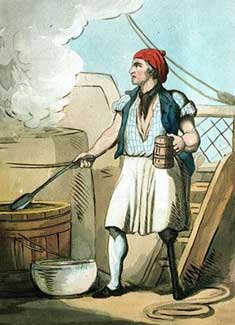
The history is both rich and disgusting. Slavery made the New World a more culturally diverse place for adding the unwilling immigrants to the mix. It also created a permanent stain on the otherwise forward thinking intentions of all of our founding fathers. For me personally, it is telling that Bolivar’s revolution was the first widespread uprising in the New World to include freedom for both African and Native slaves as an unquestioned tenant of its mission. And historical slave trading by buccaneers, pirates and privateers certainly takes a bit of the “heroic” and “egalitarian” wind out of their sails. Forgetting an injustice only makes it possible to repeat it – in fact slavery is a very real horror all over the world even as I write – and so a new archaeological find in Rio de Janeiro can only add to our knowledge of a practice that makes most of us uncomfortable at best.
The Cais do Valongo, or the Valongo wharf, was one of the largest intake ports for African slaves in Brazil. For over two hundred years people were off-loaded from ships and taken to holding houses where they were washed, fed and shaved before being exposed at local auctions. Once purchased, most would be marched to the interior and their new home on a sugar, cotton or – most likely – coffee plantation. The practice, which began in the later half of the 16th century, continued until Brazil officially banned slavery in 1888.
This article from Guardian UK tells us that what may have been the hub of the wharf was unearthed in the process of giving the Rio de Janeiro port a face lift in preparation for the 2016 Olympics. It includes information on the ongoing recovery and hoped for preservation of historical finds that include the possible slave-trade wharf as well as the Empress’ wharf, which was built on or near Valongo in the 1840s to welcome Brazil’s future Empress Teresa Cristina, and a 19th century sewer system. Archaeologist Tania Andrade Lima, who has been looking for Valongo for the National Museum, is hopeful that the find is authentic and that it will be possible to “integrate the finds into the new ports design”.
Rio’s mayor, Eduardo Paes, is quoted as saying “These are our Roman ruins,” and I think that speaks volumes. Rome was a master slaver, unrivalled before or since. As a person of mixed race and multicultural heritage I hope that none of what we as humans have done to one another, good or evil, will be forgotten. That way we can continue to do what is right, and never again build a Cais do Valongo anywhere in the world.
Header: Rugendas Slave Market, Brazil, via Virginia.edu
Tuesday, January 11, 2011
Tools Of The Trade: What's For Dinner
The Sailors Word Book defines “salmagundi” as “A savoury sea dish, made of slices of cured fish and onions”. Dean King in A Sea of Words says the dish may also be known as “solomongundy” or “solomon gundy” and is “A dish made of chopped meat, anchovies, eggs, and onions with oil and spices. At sea, more often boiled salted or cured fish and onions.” This is the dish as it was known in the Royal Navy and the U.S. Navy as well.On the freebooting side, salmagundi was a favorite of the largely French boucaniers of Tortuga and beyond. Through the hybridization of piracy, with men of all nations and creeds working together for the common goal of a prize, what was once known to these Frenchmen as salemine or salmigondis became salmagundi and, in its truly Anglicized form, Solomon Gundy or Grundy. This individual was, by the mid-19th century, thought of as an actual person who served as a cook in the Royal Navy and invented the dish.
In fact the history of the salmagundi is far broader than one man’s life could encompass. It probably started as a stew in southern and southeastern France where leftover or hard to prepare parts of animals would be tossed into liquid to simmer for long periods of time along with any spices and vegetables that might be handy. Bread may have been added as a thickener and/or used as a serving dish. The closer to the coast one got, the more likely fish and shellfish would be included. Much like bouillabaisse and its North American cousin gumbo in their original forms, salmagundi’s long, slow cooking and the addition of strong spices would make cuts of meat and fish which would be nearly inedible roasted quite appetizing.
A list of famous pirates and privateers who enjoyed salmagundi, at sea and by land, would be prohibitive but here are a few highlights. It is known that Henry Morgan appreciated the stew, which was often made with turtle in the age of buccaneers. Blackbeard certainly enjoyed it, serving it to the Governor of Virginia at one point as an exotic first course. Bartholomew Roberts was allegedly breakfasting on salmagundi the morning his ship was overtaken by the British in 1722. Renato Beluche wrote to his future wife of being served a gumbo-like salmagundi over rice while he was in Aux Cayes, Haiti in 1819.
Recipes for this dish abound but I’ve had a devil of a time trying to find one that fits the old mode. In all honesty, one could probably simply start from scratch and throw whatever leftovers, vegetables and spices were handy into a pot of stock to await the outcome. While I love to cook, I am in no way that adventurous and so I will offer you a tested recipe for a latter day type of salmagundi.
This comes from Anne C. Grossman and her daughter Lisa G. Thomas and is in their book Lobscouse & Spotted Dog: Which It’s a Gastronomic Companion to the Aubrey/Maturin Novels. The recipe is one of four featured in Hannah Glasse’s 1747 volume The Art of Cookery Made Plain and Easy. This is no longer the rough boucanier stew. It has morphed into a kind of chopped salad complete with flowers for garnish that would look beautiful in the center of a summer buffet. The transformation clearly speaks to the ancient age of the original recipes.
1 head romaine lettuce cut in thin strips
8 hard boiled eggs
1 pound boneless breast of chicken cooked and cut in thin strips
1 pound smoked ham cut in thin strips
2 pickled cucumbers, peeled and thinly sliced
3 ribs celery, thinly sliced
3 shallots, peeled and thinly sliced
2 tbsps nonpareil capers
2 tbsps chopped, fresh parsley
½ pound snap peas or French beans, blanched
1 2 oz can flat anchovy fillets
6 tbsps olive oil
1 tbsp vinegar
1 tbsp lemon juice
½ tsp dry mustard
Salt and pepper
Nasturtium blossoms for garnish
Line a large serving dish with the lettuce. Chop the egg yolks and whites separately. Arrange the meats, vegetables, anchovies, yolks, whites and herbs in “pleasing and fanciful groupings”.
Combine the oil, vinegar, lemon juice, and mustard and mix vigorously. Add salt and pepper to taste. Pour the dressing over the dish. Garnish with the nasturtium flowers.
From buccaneer’s cauldron to Admiral’s table, salmagundi has been all over the world and back again. Regardless of whether you try a stew of your own or venture into salad territory, bon chance et bon appetite. For myself, I’ll stick with gumbo.
Header: 19th century engraving of a ship’s cook
Wednesday, December 22, 2010
History: Success And Failure
Bartholomew Roberts was certainly one of the most successful pirates of the Golden Age. At least as far as volume of ships and booty taken. He was an anomaly among his fellows as well: a religious individual who always had his Bible with him, he was also very fond of the wealth he accumulated on the high seas. On the day he died he was notoriously wearing a cloth-of-gold suit cut to the most fashionable lines, a huge tricorn hat of satin with crimson feathers and a thick gold chain from which was suspended a huge cross encrusted with rubies and diamonds. He shunned alcohol, but he had no qualms about shooting and slicing a merchantman’s crew. Most notably he was originally a prisoner aboard the pirate ship of Howell Davis. When Davis was killed through treachery on Sierra Leone, Roberts – probably very much to his surprise – was elected Captain and his first act was to cut a bloody swath through the African island to revenge Davis. A man of surprising contradictions indeed.Roberts did not always stray from convention, though. He followed the habit of pirate captains of his day and established a set of Articles for the crew of his flagship, Royal Fortune. These were written down and sworn to – on the Captain’s Bible – some time in 1720. They are the most detailed set of Ship’s Articles extant and it is interesting to note that every crew member signed the document. So much for pirate illiteracy.
I Every Man has a Vote in Affairs of the moment; has equal Title to the fresh Provisions or strong Liquors at any time seized, and may use them at Pleasure unless scarcity make it necessary for the Good of all to vote a Retrenchment.
II Every Man to be called fairly in turn by List on board of prizes, because, over and above their proper Shares, they were on these Occasions allowed a Shift of Clothes. But if they defrauded the Company to the value of a dollar, in plate, jewels or money, Marooning was their punishment. If the Robbery was only betwixt one another, they contented themselves with slitting the Ears and Nose of him that were Guilty and set him on Shore, not in an uninhabited place, but somewhere where he was sure to encounter Hardships.
III No Person to Game at cards or dice for Money.
IV The Lights to be put out at eight a-Clock at Night. If any of the crew, after that Hour, still remained inclined for Drinking, they were to do it on the open Deck.
V To Keep their Piece, Pistols and Cutlass clean and fit for service.
VI No Boy or Woman to be allowed among them. If any Man were found seducing any of the latter sex, and carried her to Sea disguised, he was to suffer Death.
VII To Desert the Ship or their Quarters in Battle, was punished with Death or Marooning.
VIII No striking one another on board, but every Man’s quarrels to be ended on shore at Sword or Pistol thus: the Quartermaster of the Ship, when the parties will not come to any Reconciliation, accompanies them on Shore with what assistance he thinks proper and turns the Disputants back to back, at so many Paces Distance. At the Word of Command, they turn and fire immediately or else the Piece is knocked out of their Hands. If both miss, they come to the Cutlasses and then he is declared Victor who draws the first blood.
IX No Man to talk of breaking up their Way of Living till each had a share of 1,000. If in order to this, any Man shall lose a Limb or become Lame in their Service, he was to have 800 pieces of eight out of the public Stock, and for lesser Hurts proportionably.
X The Captain and the Quartermaster to receive two Shares of a Prize. The Master, Boatswain and Gunner, one Share and a half, and other Officers one and a quarter.
XII The Musicians to have rest on the Sabbath Day, but the other six days and nights none without special Favor.
As history tells us, no amount of careful documentation or number of signatures could guarantee health or success. Roberts complained in his log of his men’s gambling and almost continuous drinking and the latter came back to bite them all. When Royal Fortune met the pirate hunting HMS Swallow in 1722, Roberts’ crew was so drunk to a man that they could not even run out their guns. Roberts was killed by grapeshot from Swallow’s cannon, and the crewmen that were not killed in the engagement were eventually tried and hanged.
Header: Engraving of Bartholomew Roberts from a 19th century copy of Captain Charles Johnson’s General History of Pyrates, from which these articles are quoted
Monday, November 29, 2010
People: The Orkney Pirate
John Gow is a name that one hears frequently in the “annals of piracy”. Despite a few distinctions that line him up with some of the more colorful and well documented pirates of the Golden Age, Bartholomew Roberts and William Kidd most notably, there is very little documentation about Gow himself. Aside, that is, from his rather hideous death.The place and date of Gow’s birth are the first things up for debate. Some researchers simply go with “unknown” while others state where and when. The general consensus is that he was born in the later part of the 1690s and the port city of Stromness, Orkney seems proud to claim him as a native son. Gow’s education is also a mystery. There are writers who mention him having “school mates” which would lead one to believe he actually went to school. The area he grew up in and his family’s station in a highly class oriented society puts that theory on wobbly legs as well. What is certain is that Gow went to sea at a young age.
By the summer of 1724, Gow was on the books of the merchant vessel Caroline as Second Lieutenant. Her home port was listed as Dunkirk and her Captain was a Frenchman named Ferneau or Furneaux who seems to have followed the general pattern of merchant captains of the era. He shipped a surprisingly small crew, put in light and at least partially rotten stores and kept his people hard at work to meet delivery deadlines. By fall, things aboard Caroline were anything but pleasant. As the crew began to mutter about mutiny over their salt horse, Ferneau doled out pistols to his Lieutenants for protection against the men.
After delivering cargo in November, Caroline lay at anchor off Vera Cruz when the discontent among her crew came to a head. Late on the evening of the 3rd, crewmen slit the throats of the First Lieutenant, Master and ship’s doctor while they lay asleep. The doctor managed to stagger up on deck and sound the alarm before being thrown overboard. Captain Ferneau came up to see what was amiss and was shot in the face by John Gow. Though certain writers spend a lot of words arguing that Gow was more or less drawn into the mutiny against his better judgment, three facts tend to argue against that scenario. The first is that Gow killed his Captain, the second is that Gow was elected commander by the mutineers and the third is that Gow led his men straight into prize taking. It could easily be argued that Gow led the mutiny himself and perhaps even proposed turning pirate thereafter.
On November 18th Caroline, now renamed Revenge, took a small fishing or merchant vessel off Cape St. Vincent. Everything – including men – was commandeered and Gow had the prize scuttled. Thus began a series of progressively larger vessels taken, boarded, ransacked for plunder and then sunk by Gow aboard Revenge. The Bay of Biscay was a particular favorite hunting ground and within two months the French Navy was hot on the trail of the pirate ship Revenge.
Knowing the political situation between Britain and France, Gow turned his ship home to Orkney where he figured the French would not follow. His hunch paid off. Revenge – again renamed, this time as George – masqueraded as a merchant and dropped anchor in the port of Hamnavoe in January of 1725. Gow went ashore as Mr. Smith, owner but not captain of George, and spent money like landed gentry. The authorities began to take note of this odd behavior when a member of Gow’s crew deserted to another merchant vessel and told the bloody tale of the former Caroline’s exploits.
Gow weighed anchor and began to cruise the local coast, raiding wealthy homes rather than taking prizes on the water. The authorities issued warrants against Gow and his men after they plundered the country home of Robert Honeyman of Gramersay taking away plate and linen and scaring if not actually accosting the gentleman’s wife and daughter. This ill advised act was followed by the kidnapping and brutalization of two girls from the village of Cava. Gow then planned another land raid, seemingly without thought of repercussion, but this time his luck ran out.
Revenge grounded within sight of Gow’s target, Carrick House, and the King’s guards rushed in to take the ship. Gow escaped with some of his crew, but they were hunted down, put in chains and shipped to London’s Marshalsea Prison. Most of the prisoners confessed their crimes out right and all pointed to Gow as their commander. For his part, John Gow refused to plead guilty or not guilty. In the legal jargon of the era, this meant that the courts could not mount a trial against Gow. The only recourse was torture.
The thumbscrews were used first to no effect. Apparently years at sea hardened a man to certain discomforts. When the bailiff became frustrated and threatened Gow with the torture of pressing – being laid out naked on a stone floor with a board the size of a door on top of one whereon progressively heavier weights would be piled until one died – the pirate cracked. Hanging must have seemed far more attractive than days of misery under the press board. Gow pleaded not guilty.
The outcome of the subsequent trial at the Old Bailey was a foregone conclusion. Gow and his men were found guilty and sentenced to hang on June 11, 1725. Gow must still have had a few coins in his pockets because he paid off the executioner to have a man hang on his legs while he dangled at the end of the rope to ensure a quicker, death. The plan backfired when the rope broke. Gow, dazed and purple, was herded back up the gallows, fitted with a new noose and hung again, this time without benefit of added weight. He reportedly continued to kick for some eight minutes.
Gow’s body was tarred, gibbeted and displayed on the banks of the Thames for over a year. A romantic story sprang up during that time that Gow’s lady love from Stromness sailed and then walked to London. There she found her intended’s body and touched its hand in order to release herself from the promise they had made to marry at the so called Odin Stone near Stenness, Orkney. What became of the lady, whose name is given as Helena Gordon, is unknown.
John Gow’s short and decidedly brutal career is not terribly unusual in the big scheme of piratical events. But his name is remembered and, in large part thanks to Sir Walter Scott’s poem The Pirate in which Gow becomes the elegant Captain Cleveland, his legend lives on.
Header: John Gow, Pirate, from a copy of Johnson’s “History of Pyrates"
Thursday, November 18, 2010
Tools Of The Trade: The Buccaneers Gun
They name the musket their gun and have used it with great ingenuity to make up for their lack of resources.Thus wrote Triple P’s house physician Alexander Exquemelin of the famous boucaniers of Tortuga. They were, said the Doctor in his eye-witness accounts, reliably efficient marksman who could be compared to “… the finest of the French Musketeers”. This is a statement not to be taken lightly when one considers the facts surrounding it. First, the flintlock musket, with its long barrel, smooth bore and uneven shot, is ungainly and ill suited to accuracy in the eyes of modern marksmen. Second, the French Musketeers had a reputation in their day comparable in many ways to modern special ops snipers.
So what was the draw of the musket for men who roved the sea and land looking for plunder and rarely settling in to one place? The answer to that question is surprisingly complex and yet perfectly logical. But it does require a familiarity with the weapon and its uses.
The long musket was the son of the matchlock. Aside from line-up-and-fire-on-command military actions based on land there was really nothing the matchlock could do. With its slow loading and lit match waving dangerously off to the side of the gun itself, the matchlock was always a fire or even explosion waiting to happen. Particularly aboard a close-packed ship made of wood and smeared with combustibles like tar and tallow, the matchlock was beyond impractical. All that changed with the simple but profoundly brilliant mechanism of the striking flint.
A flintlock musket had the advantage of being easy to carry first and relatively inexpensive second. Though cannon can do tremendous damage on land and at sea they are hard to come by and even harder to steal. Then too not all buccaneering ships – some of which were no more than simple canoes – could carry cannon. But a pirogue manned with ten superior boucaniers marksmen could inflict a lot of damage on the men aboard a much larger prize. And that even before the prize knew what was upon them.
The musket Exquemelin and his mates dubbed the fusil boucanier, or buccaneer gun, was originally of French or Dutch origin. By the time of Exquemelin’s writings in the late 17th century, this specific type of musket was in use throughout the New World with the notable exception of Spanish territories. On average the gun was about four and a half feet long with a smooth bore and fittings made of brass or more infrequently iron. It resembled the hunting guns favored in Europe but not the blunderbusses so familiar to American children from Pilgrim themed cartoons. At first glance the musket would appear to modern eyes like an unusually long rifle with very fancy fittings.
The musket had a front sight but no rear sight and the best marksman would use a rest of some kind – a fence or tree crotch or the rail of their ship – when firing. The caliber of the gun was not set but based on the bores of guns still in existence ranged from .73 to .78. It is worth noting that there are no examples of the fusil boucanier proper available today, so all of this is well informed speculation. Loading was a complicated process that will need an entire post of its own but contemporary reports and modern research indicated that an accomplished buccaneer could potentially complete the task within twenty to thirty seconds. Effective deadly range in the hands of the same man would be approximately 200 yards but up to 300 yards the ball (or balls, frequently the muskets were double or triple loaded) could cause serious though not necessarily life-threatening injury.
With all this in mind the answer to the initial question seems a bit clearer. The musket was relatively easy to carry. In fact, on Morgan’s march across the Isthmus of Panama many of his men, particularly the French boucaniers from San Domingue, carried two or three at a time. Not surprisingly these were Morgan’s go-to marksmen who equalized battles and fed their fellows when game or cattle were available with their beloved muskets. This weapon was also easy to come by. They were relatively affordable and it goes without saying that taking them from a prize or off a fallen foe or comrade was easy work. The guns were surprisingly accurate in the hands of a seasoned marksman. Even aboard small vessels, as long as the musket was double loaded, a good shooter could hit a man somewhere in his torso three shots out of six at a reasonable distance.
Of course the muskets had their drawbacks. They had to be kept meticulously clean and oiled to avoid the ubiquitous rust that dogged all metal items in the tropics and particularly at sea. Interestingly, the buccaneers routinely allowed their muskets’ brass fittings to tarnish, presumably to cut down on any tell tale glint that might give them away in an ambush situation. Then, too, there was the issue of firing with a fouled barrel. Even dry black powder would build up in the barrel of a musket with each firing and eventually the marksman would have to take a moment to scour his barrel with linen or tow wrapped around the ramrod and soaked with any available fluid (yeah; any available fluid). Failure to do so could result in a jammed ball and the potential ruin of the weapon.
For a superior and detailed discussion of the particulars of buccaneer muskets, see Benerson Little’s book The Sea Rovers Practice, which your humble hostess consults quite frequently. Little, a former Navy SEAL, has done tests with guns comparable to these muskets both on land and afloat, and his findings are well worth the time of any researcher, novelist, enthusiast or re-enactor. Plus the book is a very enjoyable read; find it here.
The days of the flintlock mechanism, and the muskets it informed, continued into the pre-modern era. Infamous pirates like Roberts and Blackbeard were good with their muskets and, at least in the case of Edward Teach, died at the point of the same weapon. And of course it was the need for rifle flints that first drew Andrew Jackson into the confidence of that “hellish banditi”, Jean Laffite. Despite what Hollywood might have you believe, your average freebooter was probably better with a buccaneer gun than he ever was with a sword.
Header: The Buccaneer by Howard Pyle
Tuesday, July 20, 2010
History: The Middle Passage
Growing up in the United States and going to public schools, there were some things that were given as far as your education no matter where you lived. We moved a fair amount when I was young so I know this for fact. Even though math and spelling may have been taught differently in Seattle than they were in L.A., history was largely set in stone. The issue of American enslavement of Africans was particularly unassailable: it was a national sin, almost specific to the U.S. and bred of the infamous Triangle Trade: rum, slaves, molasses. The individual humans packed like boxes into slave ships were passive victims. The slavers were slavering sadists who took every advantage through the middle passage. And that was how it was, children.I'm not here to apologize for slavery. It is a horror that humans have engaged in since probably before we were technically "human" and it diminishes us all. From Roman gladiatorial exhibitions to the killing fields of sugar cane to modern human trafficking, nothing good ever came out of slavery. But studying pirates and privateers has opened my eyes to the realities of humanity and economy as no amount of discussion in Mr. Peters' 8th grade history class ever could.
Although the initial hauling of humans from Africa to first the West Indies and a bit later the American Colonies was a gold mine for French and English merchants, it quickly became an economic nightmare for those who plied the Triangle. Indentured servitude was the first source of labor on Caribbean sugar plantations and it in itself was a bust. The Europeans dropped like flies due to heat, humidity and local diseases (malaria, yellow fever, etc.) that they had no immunity to. Then too they had by law to be allowed to walk away at the end of their indenture should they survive. Even if you didn't give them the land, money or livestock promised in their initial contract, it was still a loss for you as a plantation owner.
As the Spanish in South America discovered much earlier, Africans were far more able to survive the tropical environments and the hard work. And slavery didn't come with a time limit. By the late 1600s all the sugar plantations in the English West Indies were worked by African slaves. Barbados, as an example, counted upwards of 50,000 slaves in her population by 1680 (the European population at the time hovered around 20,000).
This discrepancy in numbers caused problems for white masters. Slave revolts were far more common than history books like to admit. Of course the most famous in the Caribbean was the San Domingue rebellion that made Haiti an independent nation. But elsewhere, less well known uprisings occurred. Over seventy rebellions have been documented in the British West Indies alone between 1685 and 1835. Some historians speculate that the reason colonies like Jamaica and Barbados did not follow the lead of the Americans and revolt against Britain was their abject need of the British Navy to help them keep their slaves in line and their butts safe.
The Andry plantation rebellion of 1811 occurred in Louisiana, north of New Orleans, and was led by a slave from San Domingue named Charles Deslondes. The slaves marched on the city but were stopped by sailors, army regulars and the city militia under Colonel George Ross. New Orleans was thrown into a panic. The Laffite brothers were blamed for the mini-massacre and the incident hurt their trade in human chattel.
Aboard the slave ships things were even harder for a merchant trying to make a buck. The ships coming from New England were always packed to the gunnels with goods for trade: rum first and foremost but also utensils, bolts of cloth, tallow, guns and gunpowder. These costly and easily sold articles made this type of shipping a prime target for both pirates and privateers. And the freebooters wanted the ships as well. Generally speaking they were well armed and under-manned. The first to keep down slave uprisings aboard ship and the second to make more room for cargo. Henry Avery, Bartholomew Roberts and Sam Bellamy - to name only a very few - made careers of taking slavers on their way to or along the African coast.
Then there was the loss of life that inevitably followed the unsanitary conditions aboard a slave ship. It was not unusual for half of the humans in the hold to be dead or too sick to bring a reasonable price by the time the West Indies were reached. Rebellions aboard ship did occur, particularly early in the passage, and the use of force of arms resulted in more loss of life and revenue. No wonder many merchants took what money they could in the Caribbean and went home without the storied molasses. They never completed the ominous Triangle, and fewer and fewer returned to Africa at all.
By the early 1800s, the importation of slaves to the U.S. was banned. The West Indies and Spanish nations continued the trade, though, so smuggling slaves into the U.S. continued as well. A slaver with relatively healthy cargo became a far more attractive prize. Pirates like Vicente Gambi and William Mitchell excelled at spotting them and bringing them in to Barataria for sale by the Laffites.
The whole history of the Atlantic slave trade is more diverse and more horrifying than our children are ever told in school. Maybe that's for the best but to me the stories as we know them now diminish the individuals involved. The slaves were far from passive victims, the merchants didn't always know what they were getting into and the pirates... Well; maybe they're the biggest stereotype of all.
Header painting: The Slave Ship by Joseph M.W. Turner
Sunday, June 6, 2010
Seafaring Sunday: Freebooting Fate
June 6, 1719: Pirate captain Howell Davis captures an innocuous merchant ship off the west coast of Africa. Aboard her is a gifted navigator; a Welshman named Bartholomew Roberts. While Davis dismisses most of the merchant's crew, he presses young Roberts into service aboard his flagship. No one could know at the time that only a few months later Davis would be dead ashore and Roberts would be elected by the crew as their new captain. The straight laced Welshman would go on to become one of the most successful raiders from Africa to the Caribbean.
Subscribe to:
Posts (Atom)