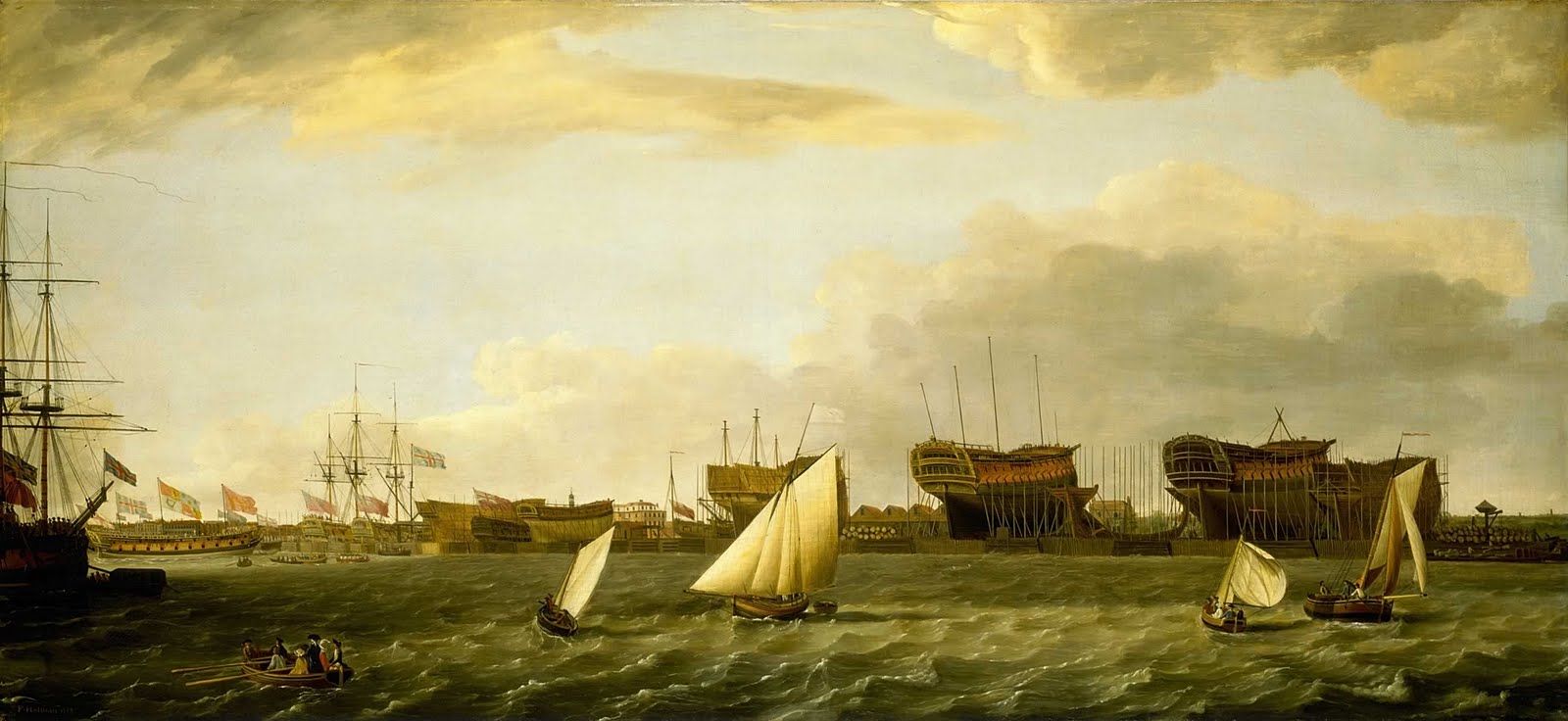
Showing posts with label Thames. Show all posts

Tuesday, March 27, 2012

History: Piracy Statutes of 1724 and Beyond Part Deux

Back in January we talked about the British statute against piracy issued by the Crown in 1724. As noted then, these laws have had a huge effect on the way piracy is dealt with – as a legal issue – around the world. Even into modern times the laws still apply, if slightly corrected for modern sensibilities (there can be no more hanging at the yardarm, for instance).


Though the laws when read through from beginning to end make perfect sense, there are contradictions. This is particularly true in the issue of when prize goods might be considered legally taken and when the taking of material from a ship is tantamount to theft. All this, of course, outside legally sanctioned privateering. Let us then look at the five paragraphs that deal with the taking of booty, and try to sort them out.

If Merchandize be delivered to a Master, to carry to one Port and he carries it to another, & sells and disposes of it, this is not Felony; but if, after unlading it at the first Port, he retakes it, it is Pyracy.

Here, the statute is taking into account natural and economic hardships. Bad weather might prevent a ship from dropping anchor in a designated port, driving her crew to put her in farther afield. If her cargo can be disposed of for a reasonable profit in this second port, nothing has been done wrong legal speaking. Likewise, if the buyer or buyers in the agreed upon port of sale are no longer able to make a transaction for the goods in a ship’s hold, her captain may legally move on and find a place where a deal can be done.

As often happened, though, goods could be moved from ship to ship and then retaken in an act of piracy. Also, a particularly rich cargo may prove too tempting for captain and crew, and a raid on land might be staged to take it back. Both would fall under the umbrella of piracy. What is not specifically addressed, perhaps curiously, is the simple act of running off with a cargo and selling it abroad. This may speak to the point of Britain’s wide reach as an Empire at the time the statutes were written more than anything else.

If a Pyrate attack a Ship, & the Master for Redemption gives his Oath to pay a Sum of Money, tho’ there be nothing taken, yet is it Pyracy by the Law Marine.

In this case the statute is addressing ransoms, either for goods, the ship itself, or passengers. Regardless of the item or person in question, demanding ransom on the high seas is the same as piracy under the law.

If a ship is riding at Anchor, & the Mariners all ashore, and a Pyrate attack her, and rob her, this is Pyracy.

As we have seen on more than one occasion, this point of the statute was often taken to extremes. A man – or woman for that matter – could hang simply for wading out into the filthy water of the Thames and stealing food from a boat. A loaf of bread in hand and muck on your bare feet suddenly turned you into a “dread pyrate.”

If a Man commit Pyracy upon the Subjects of any Prince, or Republick, (though in Amity with us), and brings the Goods into England, & sells them in a Market Overt, the same shall bind, and the Owners are for ever excluded.

Being that the ship or ships raided by a freebooting Englishman are not English, the Crown is willing to be a little wishy-washy on this point of piracy. The sale of goods is spoken of only in a “Market Overt”; a public, legal market. There is no mention of smuggling or black market trade. And although the Crown may prosecute for piracy, the “foreign” owners are “for ever excluded.”

If a Pyrate enters a Port of this Kingdom, and robs a Ship at Anchor there, it is not Pyracy, because not done Super Altum Mare; but is Robbery at common Law, because infra Corpus Comitatus. A Pardon of all Felonies does not extend to Pyracy, but the same ought to be especially named.

For the finale, and in legal jargon that would make any modern big name lawyer rub their hands together with glee, that “pyrate” who wandered out into the Thames is no longer a pirate, but a thief. Thus, he – or she – would have the option to pay with cash rather than their life. Here, the statutes protect the “gentlemen” pirates and smugglers in perhaps the most blatant way possible. Only a wealthy freebooter would have the kind of cash necessary to pay someone for finding, and arguing, this loophole. To mix metaphors and borrow from Hugo, the Jean Valjean who simply needed to feed his family would still find himself put to hard labor. And he would still be called a pirate for his trouble.

Header: Engraving of Henley on Thames c 1820

Tuesday, March 6, 2012

Women at Sea: Medieval England's Legal Stews

In Roman influenced countries of the Middle Ages such as Spain, France and Italy, prostitutes were considered a necessary evil. No doubt due to actual experience to some degree but also due to the legacy left by the Romans, the officials of these Latinate countries feared that men who did not have legal access to women would turn to rape and sodomy. This was probably overstating the case since most people have a moral compass that prevents them from doing violence and then, as now, homosexuality was a “born this way” issue more than an “any port in storm” sort of thing. That having been said, legalized prostitution in the form of regulated brothels was common on the Continent by 1300.


Not so in England, where the Roman ethic that kept women as prisoners of their fathers, brothers and husbands did not quite saturate into the soil. While women were not “free” per se they were certainly less restricted in society than they were in Europe. Legalized, regulated brothels were uncommon enough to be nonexistent in 1300. But that changed mid-century and, though the institutionalization of prostitution was not far reaching at the time, it did seem to have a very specific reason for appearing. The so called “stews” sprang up in port towns that welcomed and catered to the newly successful merchant Leagues such as the Hanseatic League and the Cinque Ports conglomerate. Sailors and merchants drove the trade in places like Southampton, Sandwich and especially Southwark across the Thames from London.

In Common Women, Prostitution and Sexuality in Medieval England, Ruth Mazo Karras makes a good argument for the influx of seamen of all kinds being the main reason for the opening of legal brothels in England. Authorities saw a chance to not only regulate a booming trade but to profit from that regulation as well. Southwark is a particularly interesting case as its two dozen or so stews were within the jurisdiction not of secular authorities but of the Bishop of Winchester, who technically owned the land upon which they were built.

This mixture of the sacred and the profane led to particular regulations within the so called Winchester liberty that did not necessarily apply in Southampton and Sandwich. The prostitutes were expected to live off the premises of the brothel but to nonetheless pay rent to the brothel keeper for a room and victuals. The keeper, who was called a “bawd” regardless of their gender, could collect an average of 14 pence per week from the girls according to Karras. As she points out:

[compare] the sixty shillings eight pence paid annually by each prostitute for her room to the twenty shillings per annum for tenements owned by Sir John Fastolf in Southwark.

And the ladies, at least on paper, still had to rent a place to sleep. This particular regulation was meant to ensure that the prostitutes made themselves scarce on holy days and Sundays, but it seems that this was not generally the case. The disregard paid by both prostitutes and bawds to this law meant that the Bishop could collect fines when it was broken; another hefty expense that the working girl had to pay via the bawd.

Regulations also existed to keep bawds and customers from doing violence to the prostitutes and to keep bawds from forcing women into prostitution, either by the threat of violence or debt or by out and out kidnapping. The latter seems to have happened with a frightening regularity that brings to mind the human trafficking extant in the modern sex trade. A specific complaint from the Court of Aldermen in London and quoted by Karras has a distinctly current feel:

John Barton, tailor, confessed that on Thursday last, in the highway coming from Our Lady of Willesden, he faithfully promised to one Joan Rawlyns… to bring her to a good and honest service in the city. Whereupon she, putting her trust and confidence in him, went with him throughout the city until he, unknown to her, brought her to the Stews side and there left her in a waterman’s house, and then went immediately to a bawd there and made covenant with her to set the said maiden with the said bawd

Essentially, Barton sold Rawlyns into prostitution. It was only through the sympathy of the unnamed waterman’s wife that Joan Rawlyns managed to escape becoming a sex slave.

This later example – the case came to court in 1517 and resulted in Barton’s conviction, imprisonment, pillorying and banishment – came at around the time that the legalized brothels were being reconsidered. Despite continued and increasing merchant trade, the Protestant Reformation in England seems to have disavowed the regulated sex trade. Henry VIII issued proclamations against the stews of Southwark. Though they decreased in number, their location in the Winchester liberties meant that they did not shut down all together.

Organized brothels, whether actually regulated or simply a house where prostitutes shared rooms, continued with different levels of acceptance in Southwark into the 19th century. From famous houses like the Holland’s Leaguer to forgotten sites of assignation, London would continue to have a place for the wayward sailor to find companionship with a “common woman”.

Header: A Medieval Stew from a contemporary manuscript via Historum History Forums

Monday, April 11, 2011

People: The Thames and Poetry

We've discussed London’s famous, and infamous, river Thames and the piracy that abounded during the hey day of the boatmen who rowed from one shore to another for a fee. This was during the reign of the Virgin Queen and James I and at one point in 1641 there were some 4,000 boatmen in the watermen’s union. Needless to say, not all of these were honest characters but some, at least, were ingenious, talented and quirky.


The man who lives up to all three of those qualities was born in Gloucester around 1580 and went by the name of John Taylor “the Water Poet”. According to one source he attended a grammar school in Gloucester until it was time to learn Latin, a language which the rough-hewn John never got the hang of. As a young man, Taylor first spent time in the 1590s aboard ship as a sailor, serving at the siege of Cadiz. Returning to London, he operated a scull on the Thames, taking passengers for a fee and then regaled his captive audiences with his poetry.

He was, in fact, an excellent poet and his topics ranged from current events to other poets to troubles on his familiar waters. In fact, he pulled the kind of thing that modern writers frequently do when they get a few minutes alone with a literary agent: he pitched his writing to wealthy passengers. Most of Taylor’s 150 publications were accomplished by subscription wherein Taylor would accumulate backers and pay for the printing of his work with their money. In one particularly famous case, some of the backers did not come through with their shares of the funding and received harsh criticism in verse from the injured poet.

Taylor published while continuing to work as a full-time waterman. On top of all this, he had a penchant for performing stunts that drew publicity to him personally and to his poetry. His The Penylesse Pilgrimage told the story of his adventures while walking from London to Edinburgh and back without any cash on hand. As the frontispiece read in part:

The Pennylesse Pilgrimage; or, the Moneylesse Perambulation of John Taylor, alias the Kings Magesties Water-Poet; How He Travailed on Foot from London to Edenborough in Scotland, Not carrying any Money To and Fro…

The poem was published by subscription in 1618; 4,500 copies in total. This was, incidentally, the subscription that saw about half of Taylor’s backers defaulting on their promised support.

Another stunt, performed the following year, saw Taylor making a scull entirely out of brown paper. Using two dried fish tied to canes as oars, Taylor rowed his friend Roger Bird down the river. The surprisingly seaworthy paper boat was kept afloat by inflated bull’s bladders and it made it from London to Queenborough, 40 miles total, without the least trouble, although the story goes that Bird prayed throughout the entire voyage. Taylor included a poem about the journey in what may be his most famous compendium, The Praise of Hempseed which you can find on the web here.

Taylor had an agile, brilliant mind that served him his entire life. He invented a language which he called Barmoodan and wrote Poem in the Utopian Tongue entirely in it. He is also credited as being the first to write down a palindrome that was actually called by that name: “Lewd did I live & evil did I dwel”. It makes Mark Twain’s “Yreka bakery” look a little weak. Taylor was also the clerk of the Watermen’s Guild during the “great dispute” of 1613. The Guild’s issue had to do with the theater guilds that moved their theaters from the south to the north bank of the Thames in 1612, depriving many boatmen of steady fares. Once again, Taylor put pen to paper and wrote The True Cause of the Watermen’s Suit Concerning Players to inform the public of his guild’s grievances.

Taylor left the Thames in 1622 to devote himself to writing, but events would not let him sit quietly by, pen in hand. He became a publican in Oxford and London under Cromwell and continued in that role until the 1640s, all the while writing. He died, probably well into his 70s, in 1653 and was eulogized by some of the great writers of his day. Ben Jonson, for instance, said that there would never be “… any verses in England equal to the Sculler’s”. High praise for a simple sailor, who wrote more because he loved to than for any real material gain.

Header: Contemporary engraving of John Taylor

Friday, February 11, 2011

Booty: Nancy Dawson

Music has always been an important part of the sailing experience. In the 17th, 18th and well into the 19th centuries, men and women brought their own music aboard ship. As noted in the side bar, freebooters prized their musicians as bringers of joy, celebration and relief of stress. Naval ships of all nations also kept musicians aboard, although informally. The songs they played and sang often reflected the plight of the seaman, over-worked, under-paid, far from home. But just as often the songs were about the fairer sex who was missed as much at sea as home cooking. One of these was a now famous air named after an actual woman.

Nancy Dawson was an actress and singer in London in the mid-1700s. That’s her at the header in a contemporary lithograph from around 1760. She made a name for herself with her strong, lovely voice but, as with so many of her sisters on stage, she became famous for her free and easy way with the gentlemen. Find more details on Miss Dawson here at The Duchess of Devonshire’s Gossip Guide to the 18th Century.

The eponymous song was a particular favorite with sailors and may even have originated dockside along the Thames. It is most often played on the fiddle and by 1800 there was a dance to accompany it known as “The Faithless Nancy Dawson”. The tune has not lost its beauty or charm over the last two hundred plus years by any means. It has been included in more than one movie soundtrack, most recently the “Traditional Medley” from Master and Commander (find that here on YouTube), so it is still familiar to many.

For those who know it and those who don’t, and as a special Friday treat, Triple P offers a piece of our seafaring heritage in song: Isham Monday delivers an enchanting rendition of “Nancy Dawson”. Enjoy!

Thursday, August 5, 2010

Women At Sea: On Ratcliffe Highway

Sailors and women of loose morals seem to go together in the popular imagination if not always in "real life". Of course there have been, are and will be happily married seamen, gay sailors and the celibate upon the waves. Generally speaking though, when we think of sailors on leave we think of a picture much like Thomas Rowlandson's "Sea Stores". The officer clearly negotiating best price (note the "jaunty" turn of the dirk at his waist), while the lady next to him stands silent with a smile and an upturned palm, waiting for his prize money before she and her friend promise anything.

Rowlandson is famous for pictures like this one not only because he was an astute observer of seaside life both in London and in Plymouth. There is also the fact that by the time Rowlandson was producing his work (the late 1700s and into the 19th century) the Royal Navy was setting the tone for just about everything seagoing in Europe. The scene above, dated around 1803, could have happened in Wapping, Brest, La Rochelle, Gibraltar, Port Mahon, Naples, New York or New Orleans. And the officer could just as easily be a pirate or privateer.

But what about the ladies themselves? The lens of Victorian moralizing has turned them into soiled doves, broken by some first encounter with a cad - probably a seaman himself - and from then on forced to ply the filthy trade of fallen women since the time of Magdalene. The problem with that scenario is the complete denial of these people as individuals, some of whom certainly chose to step out with sailing men and make their way. For the purpose of this post, we will keep to Rowlandson's backyard. The history is so vivid and interesting that it would be a shame to gloss over all the characters in the many ports of call known to navies and privateers. Whores, it seems, are destined for many a post here at Triple P.

Initial documentation of professional ladies hanging out near the docks of London turns up in the Medieval period. Even though it was illegal, the "stew girls" who usually lived near the city's gates would wander down to the Thames in their distinctive yellow wimples and pick up incoming sailors with the promise of a bath. The ladies were rounded up and kicked out of town occasionally but, since nature abhors a vacuum, more took their place seemingly overnight.

By the time of Elizabeth I the brothels, still at that point known as stews, had moved closer to the the river. These began to be pushed more and more toward the East End and the ladies in question were the favorites of the crews of sea dogs John Hawkins, Francis Drake and their ilk. The story goes that Drake himself had a favorite, kept in a cozy nest not far from the theatre district, who may have gone by the colorful name of Scarlet Jane possibly because of her red hair.

The punch houses that kept bawdy women were firmly established along Ratcliffe Highway by the mid-1600s. Here, the actual stories of individuals began to pour out like the tide. One of note was Damaris Page, whose name alone must have made her interesting. Pepys called Page "... the great bawd of seamen" and her colorful career spanned two marriages, prostitution, motherhood and brothel ownership. She kept a house in Ratcliffe for ordinary seaman and another in Rosemary Lane for naval officers and successful privateers. She was charged with bigamy after her second marriage but the case was dismissed. When she was charged with the murder of one of her girls, things got sticky. Damaris was found guilty of killing the woman while trying to abort an unwanted fetus with a fork; she was sentenced to hang. Page plead her belly and, found to be pregnant, she gave birth in jail. She was released from Newgate three years later. Damaris returned to the work of a madam and died in comfortable circumstances in 1669, still in her house on Ratcliffe Highway.

Many girls, rather than actually marrying, were simply considered the spouses of one or more sailors who turned over their prize money to their "wife" when they returned home from sea. The ladies often had small townhouses along the wharves and some may have had as many as three or four "husbands". Though Victorian writers frequently tell us that the men knew nothing of each other and the women had to keep up a precarious juggling act to ensure their ignorance, it seems, generally speaking, that was not the case. In contrast, there is documentation of ladies having more than one "husband" at home at any given time and no one being particularly put out by the arrangement.

By the 1750s, there was a place for more discrete connections to be made between sailors and women. Harris's List of Covent Garden Ladies gave men of the sea, usually officers judging from the prices listed, a literal directory of belles to choose from. The language of the advertisements often had a sea going flare. For instance, Miss Devonshire (perhaps a nom-de-guerre used as a nod to the famous Duchess?) is listed in 1788 as "... fair of complexion with cerulean eyes... fine teeth and a good figure". The listing goes on to euphemistically say that "... she is brave, that she is ever ready for an engagement, cares not how soon she comes to close quarters and loves to fight yard arm and yard arm, and be briskly boarded." Nothing is left to the imagination; we are told the lady's pubic hair is light brown and her price is 5 shillings.

Of course there were always the women who would entice sailors away from an ale house and steal anything not attached to the man's body without providing the promised sex. These were the storied ladies so often sung about in chanties wherein it was all a woman's fault that a poor lad had to return to the sea with nothing in his pockets but his hands. They were also the frequent focus of Victorian reformers, described as filthy, debauched and drunk.

Whatever the woman's condition, be she a simple "bawd" or a widow advertising on Harris's list to make ends meet, all of them were people who contributed in their own way to the life and livelihoods of seamen. More on this subject in the future. For now, Huzzah! for the ladies.

Tuesday, July 13, 2010

People: Once More Into The Thames

We've talked about piracy on the River Thames, that great artery that made London what she was and is, before. The freebooting on the waterway was always lucrative, but it seemed to come into it's own as England did. By 1600 there was a good deal of documentation at the Admiralty Court about the river men who turned a profit by stealth and theft. Some of these people have come down to us with names at the very least and some with an anecdote or two attached. Today then, Brethren, a few river pirates from the Golden Age of Thames-side highwaymen.

First is the tale of one Garret Scottle of Limehouse in what was becoming London's East End. Scottle was involved in one of the trades that fed the great machine of seafaring, as were most of the inhabitants of his neighborhood. What he did precisely is unknown but business was bad enough that he rounded up a few men and left a punch house late on December 20th of 1607 with no good intent in his mind. The men, five in all, rowed a dinghy downstream to Deptford where they came upon a launch at anchor. They boarded her and managed to take fifty pounds before abandoning their prey and their own boat for shore. The raid was so badly bungled, probably due to the inebriation of the perpetrators, that the men were caught within 24 hours. All but one, including our man Scottle, hanged for their crime.

This act of desperation shows the lengths to which people would go to make a shilling. Many of the documented piracies seem to have been committed by amateurs. The waterways were only marginally patrolled by the navy and no police force existed on land. The poignant case of Elizabetha Patrickson and her husband William is in the same vein. The couple waded out to the boat of one Henrico Marten, a lawyer. According to the indictment against them, the Patricksons took a "turkee" (linen and silk blend) woman's gown, a dagger and a cloth doublet amounting to the ridiculously small sum of fifteen pounds. Caught virtually in the act, Elizabetha and William were tortured into confession (probably by pressing or with the ingeniously miserable iron bands known as Skeffington's grieves) and eventually hanged. Clearly the Patricksons are more to be pitied than censored.

For the knowledgeable few, however, professional river piracy was almost a sure bet. With the lack of reliable law enforcement, a ruthless, capable man or woman could spend years pillaging on the Thames and never fear the noose. One such thorn in the Admiralty's side was a man known as Black Will. Described by one victim as "... a black fellow... who said he knew he should never be taken for he had used that trade... these twenty years." There are documented cases involving Black Will from 1608 until at least 1620. In some he is an African. In others he is an Englishman wearing a black coat or with his face blacked or both. Will may have been more than one man, but he surely was never brought to justice.

A second famous river pirate of the time was Dick of Dover. Like Black Will, there are many accounts of Dick over a similar period. Some documents assert he was a sailor named Richard Catro. Catro was questioned at the Admiralty but denied he was the famous pirate. After a freebooting escapade involving 150 pounds worth of cloth taken from a French merchant near Tilbury, Catro was arrested and sentenced to death. Later mention of Dick of Dover puts his actually execution in question. Or perhaps, as with Black Will, more than one pirate sported the moniker.

Thames river pirates carried on, to some degree unchecked, throughout the 17th and into the 18th century. Better patrols, by citizen groups and the navy, slowed but did not stop the thieves as the 19th century approached. The stories that have come down to us, though, are a wonderful snapshot of the human condition in all its forms.

Some are as amusing now as they must have been frightening then. I personally love the story of the Ratcliffe brigand who boarded ships wearing a metal helm shaped like a skull. And the tale of hapless Arthur Hale, who appeared in Admiralty Court wearing a pair of silk stockings from the cargo he claimed vehemently never to have seen, much less stolen.

Monday, April 12, 2010

History: Along The Thames

River piracy is as old as humans and boats. One has to imagine that there were rovers and raiders along the Tigris and the Nile before laws prohibiting their spoilage of other people's property had even been written. There are two rivers in the world, though, where a lot of documentation exists on the subject. One is the mighty Mississippi and the other, perhaps to no one's surprise, is the Thames.


Much of what is known about Thames "pirates" comes from the High Court of Admiralty which was situated in London. This meant that, more than the provincial rivers where acts of pillage may have been taken care of locally without a lot of writing things down, the rovers on the Thames, once caught, were tried, sometimes tortured and executed with all due ceremony. And documentation.

Many of these people would hardly fit the pirate mode in today's popular mindset. They were more like waterborne vagabonds and pickpockets. Some even eschewed their own craft all together and simply hiked up their breeches or skirts and waded out into the muck to ransack a vessel left empty and vulnerable. It wasn't a pretty life, obviously, and with the threat of torture and death dangling over one's head it was clearly a life pursued out of necessity. These men and women were probably not the egalitarian "all for one and one for all" sorts that we now imagine pirates to be. It's a surety they were looking out for themselves at all times.

Piracy on the Thames, defined as a crime committed on the river or it's estuaries up to the high water mark, is documented as far back as the early 13th century. In Survey of London, John Stow tells of a fleet sent into the river from London in 1216 to bring Thames pirates to justice. They succeeded in catching these perpetrators, Stow says, "...as well innumerable others that they drowned, which had robbed on the river Thames."

The problem continued to grow and really took off in Restoration London. As the city became wealthier and it's population began to burgeon, crime naturally increased. Communities, largely populated by sailors and those who made a living on the sailing trade, sprang up east of the city proper and became notorious dens of vice and crime. Places like Ratcliffe, Limehouse, Redruth and Wapping all fell under this general umbrella with many more besides. It was here that fashionable Londoners imagine the threat lurked, just waiting to take advantage of them as they took a wherry to the theater or the gambling house.

And this was probably the main crux of the pirate problem. The Thames was a far easier way to get around the city than any of it's narrow, filthy Medieval streets could possibly be. By the time Charles II was firmly back on the British throne, it is estimated that up to 2,000 "wherrymen" were ferrying people to and fro for a fee around Westminster and Southwark alone. There was lots of wealth on the river and a dishonest sculler or bargeman could easily take extra cash from unsuspecting passengers and then disappear into the night.

Such arrangements led to entire families getting into the business of stealing. A clever wherryman might have his family lie in wait and then, when the time was right, strip the unsuspecting customer of everything he or she owned, from wig to shoes. No wonder than that many wealthy people would not travel without a bodyguard, much like the ersatz celebrities of our own time.

The individual stories of Thames river pirates are sometimes shocking, sometimes poignant and sometimes down right amusing. Many of them, though, are truly owed their own post. We'll return to this issue again, but for now suffice it to say that life along the Thames wasn't always easy or fun. For the lucky few, though, it did pay handsomely.