Showing posts with label Elizabeth I. Show all posts

Sunday, May 5, 2013

Sunday Sea Stories

Since my time is limited right now, but my curiosity continues at a pace, I'll try to update the Brethren on stories from history and around the web on Sunday afternoon. Nothing fancy of course, but hopefully a good read or two to start off your week.

First up, the awesome paintings above are from this article over at the UK Telegraph entitled "Historical Figures for the 21st Century." Of course there's Nelson as above, a little heavier due to his modern fate as a desk jockey but with a splendid prosthetic arm. Whatever would Emma say? Also in the mix are Henry VIII looking vaguely like Gerard Butler, his daughter good Queen Bess and a surprisingly hipster Will Shakespeare. Who knew?

Next, this little winner from NBC News. A women's group thought they were hiring an pirate expert to speak on the Golden Age. Instead they got a victim of modern piracy with a harrowing tale of survival. But, being a good sport, he did stay to judge the pirate costume contest after his lecture.

While not particularly related to seafaring per ce, this article from the NYT's continuing series on the Civil War should be of interest to anyone with a fascination for history in general and women's history in particular. Entitled "Rape and Justice in the Civil War", the author discusses the Leiber Laws and their application to Southern women attacked by Union troops; both free and slave.

On a modern note, USS Anchorage arrived on Tuesday in hers and my home city, Anchorage, Alaska, for her commissioning today.

Also of interest: On May 3, 1810, George Gordon Lord Byron along with his friend and marine lieutenant Ekenhead of HMS Salsette swam across the Dardanelles Strait.

Today, May 5, in 1828 the American Seaman's Friend Society of New York City was established. Their mission: to supply books via "floating libraries" to U.S. Navy and Merchant ships at sea. Also on this day in 1861 the U.S. Naval Academy moved from Annapolis, Maryland to Newport, Rhode Island for the duration of the Civil War.

And so I will leave you with a quote: The real difference between civilized and savage man consists in the knowledge of knots and rope work. ~ A. Hyatt Verrill

Sunday, March 17, 2013

Seafaring Sunday: Sea Language

The sea language is not soon learned, much less understood, being only proper to him that has served his apprenticeship: because that, a boisterous sea and stormy weather will make a man not bred on it so sick, that it bereaves him of legs and stomach and courage, so much as to fight with his meat. And in such weather, when he hears a seaman cry starboard, or larboard, or to bid alooff, or flat a sheet, or haul home a cluing, he thinks he hears a barbarous speech, which he conceives not the meaning of.

~ from the Naval Tracts of Sir William Monson. Monson, who was from a landed family in Lincolnshire, ran away to sea in 1585 at the age of 16. He saw service in a privateer as one of Queen Elizabeth's sea dogs and was a lieutenant in the Charles when she joined the English fleet against the Spanish Armada. Monson retired in the 1630s with the rank of Vice-Admiral and settled in to write his now famous tracts. He died in 1643.

Header: English ships and the Spanish Armada by an unknown artist of the British School via Wikipedia

Saturday, February 23, 2013

Sailor Mouth Saturday: Victualler

When Henry VIII had the brilliant notion to establish the Royal Navy, ships were a bit different than they would be 300 years later in the glory days of Admiral Nelson. A fine carrack of war, like the iconic Mary Rose, was often filled to bursting with men and arms, leaving very little in the way of room for the food and water needed to keep those men in good working trim.

Enter the smaller, but equally important, companion ship that became known as the victualler. As Admiral Smyth notes in The Sailor's Word Book:

In the early age of the navy, each man-of-war had a victualler especially attached to her; as, in Henry VIII's reign, we find the Nicholas Draper, of 140 tons and 40 men, was victualler to the Trinity Sovereign; the Barbara of Greenwich to the Gabriel Royal, and so on.

The smaller ships, probably more closely resembling a Medieval cog than their larger companions, could ship supplies far out to sea allowing their man-of-war to focus on the important duties to hand.

The word victualler and victualling thus entered the parlance of the Royal Navy and in turn her American daughter. The same could not be said of the Latin-speaking navies, who relied more on a form of the word "provider"; le fournisseur in French, for instance.

Thus we find in the English speaking countries the victualling bill which was essentially the receipt kept at a customs house for provisions and stores provided to the quartermaster of a merchant ship after payment or bond had been received. The victualling book would have been kept aboard ship, generally by the purser, and would have been a log of incoming and outgoing provisions. This would have been inspected on a regular basis by the captain and/or owner to ensure that all was on the up-and-up, so to say.

In the navy, the victualling yards were a series of warehouses where provisions and other dry goods were stored for the stocking of naval vessels. These yards were generally located near naval dockyard such as Boston, New York, Baltimore, Charleston and New Orleans in early 19th century America, and Plymouth, Gosport, Gibraltar and Jamaica for the Royal Navy (to name only a few.)

And now that we have our victuals in, I'm away to sea Brethren. Fair winds for this Saturday and beyond; huzzah!

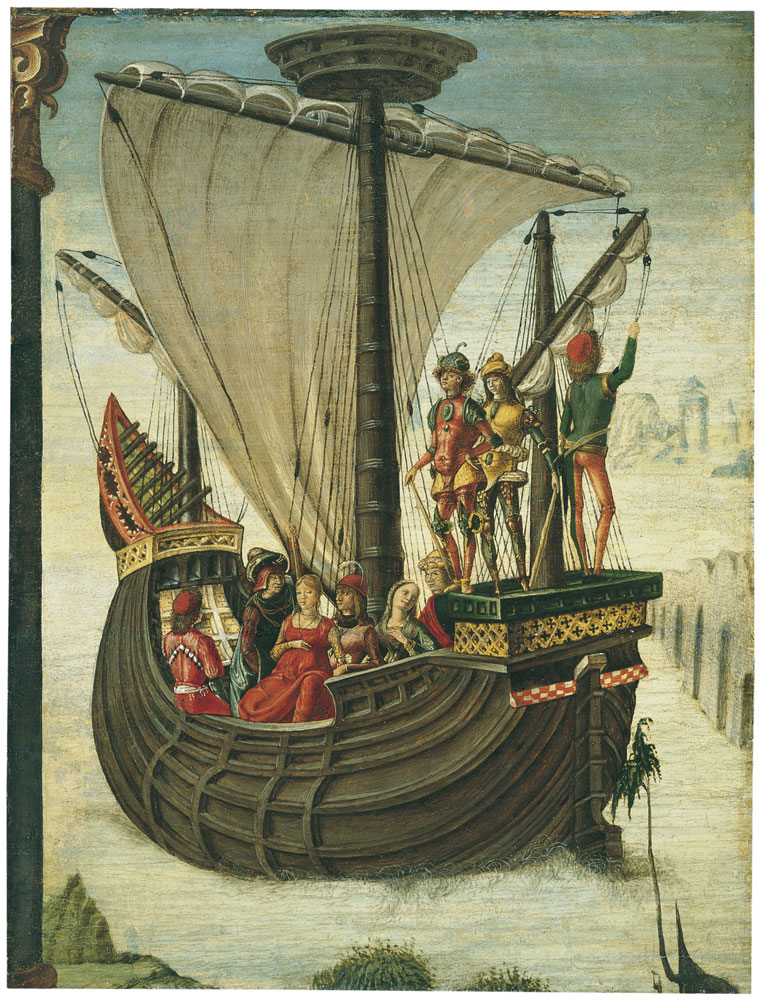
Header: The Argonauts Leaving Colchis by Ercole de Roberti c 1480 via Old Paint; a fanciful interpretation of a round ship, or cog

Saturday, December 15, 2012

Sailor Mouth Saturday: Corsair

We have made it to the middle of December, Brethren, and that means that for those of us in the Northern Hemisphere our time in darkness is soon to be redeemed by light. The Solstice is only six days away. It also means that chez Pauline is celebrating the 232nd birthday of my favorite uncle: Renato Beluche, corsair-extraordinaire. So, as a bit of a birthday present, I'm changing things up for this SMS and offering the definitions and etymologies of the key words used to mean a raider on the high seas. Not all mean "pirate" and some distinctions are subtle. Points we can be a little prickly about in my family.

Buccaneer: The general understanding is that the word is an anglicized version of the French boucanier, one who cooks things on the type of barbeque known in old San Domingue as a boucan. Admiral Smyth, in The Sailor's Word Book has this to say under his buccaneer entry:

A name given to certain piratical rovers, of various European nations, who formerly infested the coasts of Spanish America. They were originally inoffensive settlers in Hispaniola, but were inhumanly driven from their habitations by the jealous policy of the Spaniards; whence originated their implacable hatred to that nation.

Corsair: Also of French origin; corsaire means privateer in French. We know from their letters that many of the Laffite brothers' men referred to themselves as "corsairs." Renato Beluche certainly did. In a letter to a Venezuelan newspaper in 1822 he wrote: "General Padilla remembers that I was a corsair. And what is the matter with that?" Where the General had implied piracy on Beluche's part, the accused took onus and reminded the readers that he sailed under Bolivar's flag as a privateer. The term was also applied to pirates from Barbary shores.

Filibuster: This too began as a French word: filibustier meaning freebooter. In this sense, which originally meant a soldier of fortune, it was applied by the Spanish to the original buccaneers. By the early 19th century it had taken on a new meaning in North and South America. Filibusters were the secret groups of speculators formed, particularly along the Gulf Coast and most notably in New Orleans, to supply arms to South American rebellions for cash. Again the Laffites, Dominique Youx and Beluche were involved in a post-War of 1812 group of filibusters supplying small arms and cannon to Mexico.

Pirate: The Latin word pirata may have meant sea captain but the English word pirate is essentially the seagoing version of the land-based word highwayman. A pirate is a sea robber with no connection to cause or country - other than themselves and their ships.

Privateer: Admiral Smyth says it best:

Men-of-war equipped by individuals for cruising against the enemy; their commission is given by the admiralty, and revocable by the same authority. They have no property in any prize until it is legally condemned by a competent court.

The issue of proper libel by a court is the real sticking point in the difference between pirate and privateer. Letters of marque, like any other document, can be easily forged. But courts for condemning legal prizes are not so easily come by.

Sea-dog/Sea-wolf: These terms sprang up in England during the reign of Elizabeth I who used them to describe her sea captains - her favorite being Sir Francis Drake - who raided the Spanish Main. In that sense, another euphemism for privateer.

I believe that list covers the highlights fairly well. Happy Saturday, Brethren; may your commission stay valid, and the courts of libel smile upon every prize you bring in.

And Happy Birthday, Uncle Renato, you old corsaire you.

Header: Engraving from a painting of Renato Beluche by Francisco Capuleta now in the Museo Naval de Venezuela

Tuesday, August 21, 2012

Ships: Small but Mighty


On August 21st in the year of our Lord 1607, a group of Englishmen began construction on the first vessel built by Europeans in the New World. She would make her maiden voyage on the Kennebec River in what was then Massachusetts Territory and is now the sovereign state of Maine. Her builders would name her Virginia, after Elizabeth I, and her type would be recorded as a pinnace. Exactly what sort of pinnace, for there were several over the course of history, is open to debate. Two possibilities stand out in particular, so let us explore them both.

The first type of pinnace built by Europeans would probably be more recognizable to modern historians as a small galleon. This sturdy, useful vessel was originally built by the Dutch, who called her a pinas. These ships were used mostly for the merchant round from the British Isles, around the Iberian Peninsula into the Mediterranean and back. You can see a modern replica here.

According to the Chatham Dockyard website, the first pinnace of the galleon class built in England was named Sunne and launched in 1586. Shipwrecked evidence leads to the conclusion that the British may have been the first country to use the galleon-built pinnace as a warship. An English pinnace, probably from the early 17th century and carrying 12 matching cannon, was found in 2009.

This type of ship-rigged, three masted vessel was also popular with the buccaneers of the Caribbean during the age of Laurens de Graff and Henry Morgan. Its shallow draft and light construction – the ships were often made of pine, which may be the origin of their name – made them ideal from men who were more interested in plundering on land than sailing on wave.

Another type of pinnace was being built in the same era, and its small frame and ease of design make it a more likely candidate as a descendant of Virginia. These were a sturdy ship that must more properly be called a boat and resembled the illustration at the header. Rowed with eight oars or propelled by sails on one or sometimes two masts, this pinnace would become a staple among large ship’s boats in the Great Age of Sail.

These smaller pinnaces were most often used as a tender by larger ships. They were utilized for provisioning, as mail packets, to run men or messages between ships at sea and to carry parties of men ashore when necessary. They were extremely popular with smugglers in Europe and their construction may in part have influenced the pirogue, built in the American south and used for much the same purpose.

This second type of pinnace, a smaller, lighter, less cumbersome invention, was probably what the Puritans at the mouth of the Kennebec River put together in 1607. It was only a matter of time, however, until larger ships were turned out from dockyards along the Atlantic coast. Still, the small but mighty pinnace continued and is still in use today.

Header: An American Pinnace in Virginia 1584 by Seth Eastman c 1850 via Wikipedia

Friday, June 1, 2012

Booty: Ready for the Faire

Yesterday, Richard Rogue at 365 Days of Pirates tweeted a link to this article at EzineMark that gives a brief rundown on how to pick a pirate costume. The advice is timely given that the round of Renaissance and other Faires – which since at least the ‘90s have happily included piratical types – is letting out all sail right about now. Figuring that some of the Brethren may be looking for fairly permanent attire rather than a one party outfit, I thought I’d throw in my piece of eight, so to say.


The article hits the high points of standard pirate garb; shirt or blouse, vest or corset, pants or skirt, footwear, headwear and accessories. Authenticity, in my opinion, is key to making your look right as well as making you feel truly piratical. Unfortunately, that usually comes at a price.

If you’re good with a sewing machine, there are more and more period patterns being produced all the time. My personal favorite online retailer for such things is Folkwear. They have the most comprehensive list of historical based patterns I have found. Their patterns are also very user friendly for the modern seamstress or seamster; the website will let you know what level of skill you need to complete any given pattern, helping you avoid a lot of after-purchase frustration. Think outside the bilge here; an Edwardian blouse can be modified into a charming vest while an Incan shepherd’s shirt can easily transform into a sailor’s.

If you’re no sailmaker and never will be, the very best period clothing, again in my opinion, can be found at Sofi’s Stitches. The picture at the header is from their website and this tar in Highland shirt, sailor’s breeches, Elizabethan boots and pirate accessories would fit right in from the 17th to the 18th century on any dock from here to Venezuela. Ladies’ costuming is equally period accurate and detailed. I’m wearing a Sofi’s corset vest and shirt in my profile picture. These are well made pieces with lining, secured grommets and generous hems that will last year after year. Again, they are an investment, but if you’re ready to make a long term commitment to your pirate look, Sofi’s is absolutely worth the price.

These suggestions obviously lean toward the traditional Golden Age pirate look, but don’t be discouraged if you’re thinking of another era. Much of Sofi’s inventory has an Elizabethan feel, and would be perfect for a Drake-esque sea dog. Likewise, a privateer of old New Orleans could wear those sailor pants and that Highland shirt without batting an eye. Be creative and don’t forget to add some bling. You’re by land after all, and the impression of a little coin in your pocket is sure to draw the ladies if nothing else…

Happy Friday, Brethren! Let’s rendezvous here for Sailor Mouth Saturday.

Header: Piratical flare from the remarkable artists at Sofi’s Stitches

Wednesday, April 25, 2012

People: Sketch of the Poet as a Buccaneer

The Elizabethan author Thomas Lodge is, perhaps unfortunately, not much remembered today. He had a lovely, lyric style that is available for anyone to enjoy via Google books (here for instance) and he inspired that most admired of all Elizabethan writers, William Shakespeare, to a tremendous degree. So highly was the Bard won over by Lodge that he borrowed from the latter’s romance Rosalynde when writing As You Like It (all you writers out there can interpret that as you will).


Though some, particularly in academic circles, are familiar with Lodge’s writing to this day, few remember his second life as a freebooter in the great age of Elizabethan sea dogs.

Lodge was born some time in 1557 or perhaps 1558 to a man who would shortly become Lord Mayor of London, also Thomas Lodge. The family was clearly in the comfortable middle class and some historians say that Lodge pere was a grocer. Whatever his original profession, the Lord Mayor clearly held high hopes for his son. Lodge fils was educated, according to Britannica online, at Merchant Taylors’ School and Trinity College, Oxford. After that, he went on to study law graduating some time around 1579. This was when his first pamphlets began to appear. One was aimed at a scornful review of the mania for stage plays, and the other, An Alarum Against Usurers, was a warning to the young and rich against the moneylenders of London.

This second piece appeared in 1584, the same year that Lodge signed on with Captain Clarke for a freebooting expedition to the Azores and the Canaries. According to Philip Gosse in The Pirate’s Who’s Who, Lodge was neither seaman nor buccaneer and spent most of his time below decks writing. In a letter quoted by Gosse, Lodge writes of this adventure:

Having with Captain Clarke made a voyage to the Islands of Terceras and the Canaries, to beguile the time with labour, I writ this book, rough, as hatched in the storms of the ocean, and feathered in the surges of perilous seas.

Lodge returned to England in 1590, apparently a little richer but one must imagine not by much as he signed on for another piratical expedition in August of 1591, this time with Sir Thomas Cavendish aboard the galleon Desire. Lodge’s book writ rough would have to wait.

Cavendish took Desire to Brazil where he and his men raided small seaside towns. Their most remarkable escapade occurred at the town of Santa, where they raided the locals’ homes while they were all at Mass. It seems that the town either suited the Desires or their ship needed looking after as, again according to Gosse, they stayed from December 15 to January 22, 1592. While there, Lodge took up residence in the local Jesuit College and “spent his time amongst the books in the library of the Fathers.”

Desire would have a perilous journey home and with little to show for it. The skeleton crew of sixteen men who finally put in to port in Ireland on June 11, 1593 were all in poor shape and none the wealthier for their adventures.

The cruise with Cavendish would be the last of Thomas Lodge’s attempts at making money through piracy. He published A Maragarite of America, about the star-crossed love affair of a Peruvian prince and a daughter of Acadia, in 1596 and though it is well remembered today the book did poorly at the time. Perhaps crestfallen, Lodge set out for France.

At Avignon the former sea dog converted to Catholicism, studied medicine and graduated from the University of Avignon in 1598. The rest of his life would be dedicated to healing. He returned to London but was forced to flee following the infamous Gunpowder Plot of 1605. Returning to England in 1612, he hung out his shingle in London once again. Thomas Lodge met his end in 1625. Tradition tells us that he died of plague contracted while ministering to London’s poor. A noble end for a poet turned, however briefly, buccaneer.

Header: Sketch of an Elizabethan nobleman via inacentaur

Wednesday, June 2, 2010

People: The Queen's Privateer


John Hawkins was born into a respectable merchant family some time in 1532. He was born in the port city of Plymouth in the English county of Devon. The city and county have probably given their country more able seamen than any other, and Hawkins certainly followed the mode.

As a boy he would have watched his father make repeated visits to Africa and Brazil, carrying cargo for trade. Perhaps young John was along on some of these voyages which would have been both exciting and harrowing without a doubt. He would have seen the troubles his father had with the Spanish in particular. Trade with Spain was not technically illegal, but the Spanish on the Main jealously guarded their trade rights and rarely did open business with "infidels" from Protestant countries. No doubt this was why Hawkins pere tended to head for Brazil, which was a Portuguese holding and therefor less stringent about trade and immigration.

It's fairly clear that John Hawkins saw there was money not being made and he wanted in on it. By 1562 he had assembled his own small flotilla; two ships under his command - Solomon and Swallow - left Britain for the Guinea coast that year. Along the way, Hawkins took a Portuguese merchant as a prize and promptly sold her cargo for African slaves. The ships were packed in the usual inhuman manner and they set out for the Caribbean, probably in late fall.

In January Hawkins docked off Hispaniola and got right to the business of selling the 300 souls in his ships' holds. At first the local government balked. A 120 man patrol led by Lorenzo Bernaldez was sent to dispatch the English from Spanish soil. Either through threat or bribe or both, Hawkins brought Bernaldez around to his way of thinking and sold his cargo for goods and coin. He got so cocky at this point that he sent some of his goods to Seville in a Spanish ship. They were confiscated by the Spanish government but it was literally no skin off Hawkins' nose. He returned to England in 1563 as a very wealthy man.

Word of Hawkins success reached the court of Elizabeth I and, as Hawkins began to prepare for another voyage, the powerful began to invest in his endeavors. Elizabeth took an immediate interest in the venture. She was searching for ways to break up the Spanish trade monopoly while trying to keep Philip of Spain at arm's length. Giving Hawkins money and a commission under the table suited both the Crown's needs and the freebooter's. It was win/win as long as Hawkins kept his mouth shut. He did.

In March of 1565, Hawkins put out to sea once more. This time he sailed aboard his flagship, of 30 guns and 700 tons - a gift from his Queen - Jesus of Lubeck. She was accompanied by his prior ships and Tiger, of 50 tons. Together they packed in 400 slaves and headed off to the New World. This time Hawkins chose the coast of Venezuela for his landing. He was rebuffed at the island of Margarita and sailed on to the French-run port of Barburata. Though the local government was at first disinclined to deal, after a few nice broadsides aimed at their town they changed their mind. Hawkins sold some of his slaves at Barburata and then repeated his gunboat diplomacy up the coast at Riohacha in modern Columbia. He was back in England by September and his investors were very pleased indeed.

Despite the most vehement protests from the Spanish ambassador, Elizabeth I continued to fund Hawkins' ventures. He made more slaving runs to the West Indies and his success drew sailors from all over Britain to his ships. Not the least of these was his cousin, Francis Drake, who took command of Hawkins' Judith on a voyage in late 1567.

This venture went according to plan until Hawkins flotilla, now numbering seven ships including captured merchants, was hit by a hurricane off Cuba and blown deep into the Gulf of Mexico. Most of the ships needed repair and Hawkins tried to put in at San Juan de Ulua (modern day Veracruz). He was surprised by the annual Spanish treasure fleet and, though an initial truce was called, the Spanish commenced firing in the close packed harbor.

A day long fire fight resulted in the destruction or capture of all but two of Hawkins' ships. Only Minion, with Hawkins aboard, and Judith escaped. Drake ran ahead to England in the smaller, faster Judith. Hawkins followed in Minion with two hundred of his men. Some of these deserted ashore, trusting their fate to the Spanish rather than the battered Minion. Hawkins made it home, but with no more than 20 men remaining alive.

Recovered from this experience, Hawkins seems to have turned over the helm to Drake who began his famous personal war against the Spanish. Hawkins stayed at home and was appointed treasurer of the Royal Navy in 1577. He had as much success in this post as he initially had on the Main. He was knighted in 1588 and, he would later say to his shame, given a coat-of-arms that included a bound African above the crest. He returned to sea in the same year, leading a flotilla against the Spanish Armada.

This experience seemed to reinfect him with the sailing bug and he set out against the Spanish treasure fleet in 1590. He failed on all counts. Hawkins tried again in 1595, taking up with Drake and heading out for the Main. The two disagreed on tactics and went their separate ways. At this point, Hawkins was ill and within a month he was dead aboard his flagship off the coast of San Juan, Puerto Rico at the age of 63.

Despite his late-in-life regrets over the means of his success, Sir John Hawkins certainly paved the way for the exploits of sea dogs like Francis Drake and Thomas Cavendish. He was one of the first to strike against the trading monopoly of the Spanish Empire and he was the first of Queen Elizabeth's now famous privateers.

Thursday, May 27, 2010

Tools Of The Trade: Unwashed Masses

I came across a very small article over the weekend discussing, of all things, how our ancestors brushed their teeth. The writer came to the conclusion that they basically didn't and I quit reading at that point. I am not going to stand in front of anyone and say that people in the 18th and 19th century showered every morning and used their OralB before heading out. But I always bristle at the "our ancestors were ignorant, smelly dullards" conclusion.

Europeans in general and seamen in particular weren't "clean" on a day to day basis the way modern Americans would think of the word. Regular baths didn't happen aboard ship or by land in colder climates. On a ship, fresh water was dear and used predominantly for drinking or the sick, who did rate a bath now and again. In colder climates, New England and Canada for instance, heating water for a soaking bath was a prohibitive chore that rarely happened. Besides, a full bath was rumored to make a body sick. In warmer climates, where a tub of water could be left out in the sun the way one might warm up the kiddy pool water to wash the dog in suburbia these days, baths were far more common. They were one of those "decadent luxuries" Yankees were shocked by when they showed up in New Orleans at the turn of the 19th century.

People did sponge themselves off with wet towels or - yeah - sponges, however. A typical morning routine, even aboard ship and especially for officers, included washing the torso and face followed by a shave. Waters such as rose water, lavender water and Hungary water were relatively inexpensive and were splashed on the face, in the hair and under the ol' pits before dressing. The sailors who could swim did so whenever possible, especially in fresh water estuaries and cays where the muck could be rinsed off without the harsh abrasiveness of salt water on skin. Living cheek by jowl with your fellow man may have meant that a certain level of personal hygiene was required more than ignored.

Even aboard buccaneers, pirates and privateers, men were careful to keep the parasites at bay if at all possible. Fleabane, an herb that grows like a weed in most temperate climates, was dried and sprinkled on clothing, hammocks and cots. It was also rubbed into the hair of men and animals to keep down the fleas and lice. Some ships surgeons would shave a man who turned up with head or body lice, a humiliating process that included every hair accessible. Since sailors were particularly fussy about their long flowing locks - which they washed and braided about once a week - making sure Bones didn't find lice was a kind of mania aboard such ships.

On land and far from home, nature offered up a surprising variety of remedies for the unkempt. Sprigs of certain trees could be cut and frayed at the end to form a primitive toothbrush. The frayings also served as floss. Wine or, in a pinch, urine was used as a mouthwash. The castings of certain tropical ants still are a remarkable mosquito repellent. A buccaneer just had to find the colony and rub the detritus all over his bare skin. Distasteful perhaps but better than malaria or yellow fever.

Back in port, a man could pay for a hunk of lye soap and a bath at some establishments. The story goes that the saloons on Grande Terre and Galveston both offered baths that were insisted on prior to the sailors visiting the ladies upstairs. The Laffite boys ran clean houses, even in the wilderness.

Which brings me back to tooth brushing. Contemporary descriptions of both Jean and Pierre Laffite speak specifically of the brothers' teeth. They were small, even and very white. Adjectives used include "remarkably" and "unusually" for the glowing grandeur of these two outlaws' chompers. How did they do it? Most probably genetic luck combined with a simple remedy that has been around since Elizabethan times and one, dear Brethren, that you can try today.

Toothbrushes, made of wood, ivory or bone with boar bristles were introduced in Europe in the late 16th century. Elizabeth I used one regularly. By the American Revolution they were quite common and, though there would have been people who ignored oral hygiene (there are today after all), available to most people. To go with the brush, there were tooth powders. One simply wet their brush, dipped it in the powder and went to town. Myrrh, cinnamon and particularly sage (the secret to whiter teeth) were used in the powders as well as abrasives like ground eggshells or dragonsblood resin.

The sage tooth powders in particular had a long history and were probably used by the likes of Henry Morgan and Laurens de Graff (who, as an aside, was renowned for his beautiful, blond hair, washed regularly). Want to give sage tooth powder and other historical grooming goodies a try? Click over to Ageless Artifice and review their offerings. (My thanks to Isis' Wardrobe for previous and current posts on this wonderful site.) You can get Hungary water, cold cream, tooth powder and a toothbrush to go with it, plus so much more all made with authentic, period correct recipes.

I imagine the percentage of "unwashed masses" today is probably equal to the percentage of yesterday. And so it goes on back through history. Our ancestors were very much the same as we are. To think of them as less is, I believe, to do them a grave disservice. The fact is at least some of them may have been more.

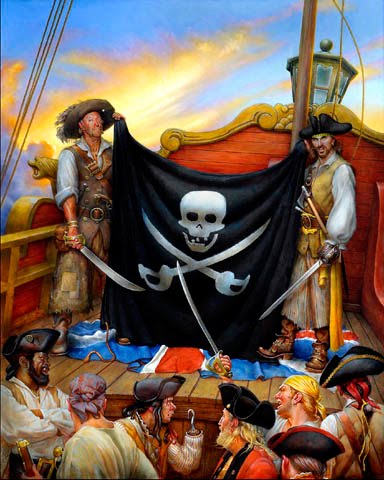
(The painting at the header is from Don Maitz' Pirate Calendar, 2009)

Sunday, April 4, 2010

Seafaring Sunday: The Sea Dog Becomes A Knight

On this day in 1581, Elizabeth I knighted Francis Drake for his service to Britain and to her Queen. Of course, this sea dog had made Elizabeth rich through his efforts as a privateer so it does seem only fair. Happy Easter to those among you celebrating. I shall spy ye in the week ahead.

Wednesday, March 10, 2010

Lady Pirates: Queen Of The Manannans Part 2

When we left off yesterday, Grania ni Maille was making Barbary corsairs hurry below to change their underwear with her swagger. Unfortunately there was another redhead preparing to put her fist squarely down on Ireland. Despite the rebellious spirit of the people of Erin, Elizabeth I wasn't used to taking "no" for an answer.

In 1576, when Grania was in her 40's, Sir Henry Sidney became the English Governor of the Western provinces of Ireland. He had orders to bring the area to heel because the Crown was concerned that the wild Irish would team up with Spain in her war with England. Grania evidently smelled the change in the air and, though she did not disband her pirate fleet, she presented herself and her husband to Sidney as loyal subjects. Sidney went with it, even knighting Richard-an-Iarainn making he and Grania Lord and Lady Burke in 1583.

Lord Burke died the same year, but that didn't slow down the now fifty-something Lady. Her predations around Galway were legendary and Queen Elizabeth decided it was time to get things under control. She sent Richard Bingham in as the new Governor of Connacht in 1584. Bingham, who seems to have been especially well suited for the job, was specifically ordered to destroy Grace O'Malley.

Grania was finally apprehended by the Governor's men in 1586 and unceremoniously chained in Dublin Castle's dungeon. Bingham built a gallows. His mission was almost accomplished. But he was foiled by valiant behavior when Grania's own son-in-law, Devil's Hook, showed up and offered himself as hostage in exchange for his "elder mother". Bingham was stuck; he'd look like no gentleman at all if he hung an old woman when one of her clan had offered himself as a replacement. Grania walked out of Dublin Castle and Devil's Hook walked in. There he would stay for many years.

Bingham wasn't finished though. If he couldn't kill the pirate queen outright he'd shut her down and starve her out. He sent his brother John to Clare Island where Owen O'Flaherty was looking after things for Ma. John requested asylum on the island for he and his men. When Owen granted it, as was custom, Bingham's men treacherously slaughtered Grania's people and turned to rounding up her cattle and horses. Owen was stabbed over a dozen times.

Grania retaliated by mounting a guerrilla war against the English in Western Ireland. It worked for awhile, but the world was changing around the aging pirate. In 1592 Bingham managed to blockade and seize Grania's fleet in Clew Bay. Left without income, she was forced to seek asylum inland with Red Hugh O'Donnell. Her sons and daughter were on the lamb too and things looked bleak for the O'Malley's.

The pirate queen treated all this as no more than a setback, though. She decided, quite shrewdly, to petition the most powerful person in England. In July, 1593 she wrote to Elizabeth I directly. Grania asked that her two sons be allowed to hold their lands under English law and that some provision be made to "grant her [Grania] some reasonable maintenance" for life. She wanted her sons made rightful lords and herself to receive a pension from the crown. A bold request, indeed.

The Queen, obviously curious, sent back a series of interrogatories to which Grania promptly responded. Then Grania packed up her things and headed off to Greenwich Palace on the off chance that she might meet Elizabeth face to face. As Grania travelled, Bingham continued his assaults. By the time she reached England, her favorite son Tibbot-ne-Long was in chains at Dublin Castle.

In September of 1593, Grania ni Maille was granted a private audience with Elizabeth I. History is unfortunately silent on the meeting of two great Queens. Whatever was said, though, Elizabeth was clearly impressed. She granted Grania an English privateering commission and wrote to Bingham to free Grania's relatives, make Murrough and Toby proper Lords and see to Grania's pension.

Bingham went into a lather. He call the commission a "grave oversight on the part of her Majesty" as if he thought Elizabeth didn't know what she was doing. The lady who funded Drake and Hawkins knew what she was doing. He freed Toby and Devil's Hook but refused to acknowledge Murrough or Toby as English Lords, and he denied Grania's pension. Grania's fleet was returned but, on Bingham's orders, an English soldier was required to be aboard each of her galleys to make sure things were above board.

Grania returned to sea raiding, while continually petitioning the privy council for redress. It took some time but by 1595 Bingham, in hot water over other issues, was recalled to London. Grania again fell afoul of England when one of her galleys was taken by an English warship. She countered any bad blood by putting Toby in charge of her fleet and ordering him to sail only in England's service. He fought for England at the Battle of Kinsale, and was officially knighted as Sir Theobald Burke for his trouble. The year was 1603.

Grania saw her son become a Lord and then, at age around 73, she died. The great Elizabeth passed away shortly before. Two surprisingly successful women, the Virgin Queen and the Queen of the Manannans, gone in the same year.