Showing posts with label Boston. Show all posts

Tuesday, August 21, 2012

Ships: Small but Mighty


On August 21st in the year of our Lord 1607, a group of Englishmen began construction on the first vessel built by Europeans in the New World. She would make her maiden voyage on the Kennebec River in what was then Massachusetts Territory and is now the sovereign state of Maine. Her builders would name her Virginia, after Elizabeth I, and her type would be recorded as a pinnace. Exactly what sort of pinnace, for there were several over the course of history, is open to debate. Two possibilities stand out in particular, so let us explore them both.

The first type of pinnace built by Europeans would probably be more recognizable to modern historians as a small galleon. This sturdy, useful vessel was originally built by the Dutch, who called her a pinas. These ships were used mostly for the merchant round from the British Isles, around the Iberian Peninsula into the Mediterranean and back. You can see a modern replica here.

According to the Chatham Dockyard website, the first pinnace of the galleon class built in England was named Sunne and launched in 1586. Shipwrecked evidence leads to the conclusion that the British may have been the first country to use the galleon-built pinnace as a warship. An English pinnace, probably from the early 17th century and carrying 12 matching cannon, was found in 2009.

This type of ship-rigged, three masted vessel was also popular with the buccaneers of the Caribbean during the age of Laurens de Graff and Henry Morgan. Its shallow draft and light construction – the ships were often made of pine, which may be the origin of their name – made them ideal from men who were more interested in plundering on land than sailing on wave.

Another type of pinnace was being built in the same era, and its small frame and ease of design make it a more likely candidate as a descendant of Virginia. These were a sturdy ship that must more properly be called a boat and resembled the illustration at the header. Rowed with eight oars or propelled by sails on one or sometimes two masts, this pinnace would become a staple among large ship’s boats in the Great Age of Sail.

These smaller pinnaces were most often used as a tender by larger ships. They were utilized for provisioning, as mail packets, to run men or messages between ships at sea and to carry parties of men ashore when necessary. They were extremely popular with smugglers in Europe and their construction may in part have influenced the pirogue, built in the American south and used for much the same purpose.

This second type of pinnace, a smaller, lighter, less cumbersome invention, was probably what the Puritans at the mouth of the Kennebec River put together in 1607. It was only a matter of time, however, until larger ships were turned out from dockyards along the Atlantic coast. Still, the small but mighty pinnace continued and is still in use today.

Header: An American Pinnace in Virginia 1584 by Seth Eastman c 1850 via Wikipedia

Monday, July 30, 2012

History: The Glendower Murder


It is my pleasure and privilege to welcome one of my favorite people, writers and storytellers to Triple P.  My dear friend Undine, who long time Brethren will know from her insightful and delightful  World of Edgar Allan Poe blog, as today’s anniversary guest blogger.  You can also follow her on Twitter.  Don’t miss a word of today's post; they’re all worth savoring.

For an Edgar Allan Poe devotee such as myself, the strange and bloody goings-on aboard the good ship “Glendower” have an irresistible fascination.  Here we have a murder claustrophobic enough to unsettle Hitchcock, strange enough to make Dame Christie throw up her hands, and impenetrable enough to baffle Poe’s M. Dupin.  It resembles the Lizzie Borden case, in the sense that we think we “know” who committed the crime in question, but we can never truly know.  Also like the Borden murders, the complete absence of discernible motive leaves one deeply disquieted.  If the captain of the “Glendower” could be slaughtered in such an apparently pointless fashion, who among us is safe?

Our tale-without-a-moral began on June 9, 1911.  The “Glendower,” a coal barge that had seen seventeen years of service, was part of a three-ship flotilla.  The captain was fifty-five year old Charles Wyman, a man with a long, and so far as is known, perfectly commendable history at sea.  His three crew members, William DeGraff, William Nilsen, and Antonio Priskich, seemed both hard-working and respectable.  The vessel appeared to be approaching its scheduled destination of Newburyport, Massachusetts without incident.  The first sign of trouble came at about eight in the evening, when the barge began whistling.  It sent out signals indicating it wanted the “Monocacy,” the tug that was leading it, to change course and come alongside. 

The “Monocacy’s” pilot, a Captain Camp, realized this was a sign of trouble, but what happened next must still have been a great shock.  When his tug approached the barge, the ship’s cook, William DeGraff, shouted to him, “The captain is dead!”  When Camp sputtered out words of disbelief, DeGraff reiterated phlegmatically, “He took a rest this noon at twelve, and when we went to call him around five o’clock—well, he was dead, that’s all.  We found him dead.”

Camp was understandably stunned by the news, but he assumed Wyman had died of some unexpected, but perfectly natural causes.  Before heading to shore and notifying the police, the flotilla dropped anchor and he attempted to question DeGraff further.  In response to these inquiries, the cook said that Wyman had evidently died around noon, casually adding the information that “there was blood in the bunk, too.”  He invited Camp to come aboard and inspect the corpse himself.

Camp declined—he probably already suspected by this point that events  were becoming far too weird for him to handle alone—and the ships made their way to Boston, where he went ashore to file a report with the police and the local coroner.

It was not until dawn of the following day that the Suffolk County medical examiner, Dr. George Magrath, accompanied by several policemen, went aboard the ill-fated barge.  DeGraff greeted them quietly.  DeGraff, a sailor for nearly forty years, had joined the crew of the “Glendower” only a month before.  DeGraff ‘s background was and is a puzzle—virtually all we know of him is contained in the previous sentence—and although he was a strongly-built man with powerful arms and shoulders, he was also extremely hunchbacked.  His strange, oddly composed figure only compounded the grim atmosphere of the scene.

The visitors found Wyman’s body lying face-down in his bunk.  He was wrapped in a blanket, which was heavily bloodstained.  Drops of blood also covered the area around him.  His head had been repeatedly battered with what was believed to be a hatchet or large club.  Dr. Magrath found a hammer loosely held in the dead man’s hand.  It was, however, bloodless, proving that it had been placed in Wyman’s hands after the blood on them had already dried.  It did not take a forensic genius to realize this was not, as Camp had assumed, a stroke or heart attack, or even a suicide.

When Magrath and the patrolmen questioned the crew, they obtained little helpful information.  The trio insisted that there could not have been anyone but themselves aboard ship, and they all professed complete ignorance of how their captain met his violent end.   The policemen made a minute search of the little barge, without discovering a single clue to help them solve the mystery.  The crewmembers were all placed under arrest and brought ashore.  It was noted that DeGraff, unlike his obviously confused shipmates, was quietly wary, taking careful notice of all that went on around him.

When the trio faced a Boston Grand Jury, it was brought into evidence that while Nilsen and Priskich bunked some distance away from the captain, DeGraff’s cabin communicated with Wyman’s, enabling him to clandestinely enter Wyman’s quarters.  It was also revealed that the other two survivors of the “Glendower” were continuously alone together during that fatal afternoon, in a different part of the ship.  It was judged to be a ridiculously easy case to solve.  There appeared to be literally no one in the world who could have killed Captain Wyman but his crippled cook.

DeGraff went on trial on February 19, 1912.  Testimony showed that DeGraff called the men to meals by ringing a bell.  Three of them ate at a time, while the fourth manned the wheel.  On the day of the murder, Nilsen was at the wheel for the midday meal, which was served at eleven.  Priskich was with him until the dinner bell rang, and DeGraff arrived for his turn at the wheel.  Wyman ate a full meal and retired to the chartroom, which adjoined his cabin, shortly before twelve.  It was the last time anyone admitted seeing him alive.

Nilsen took the wheel at noon, and Priskich went to the engine room, where it was impossible for him to reach Wyman’s cabin unobserved.  DeGraff went somewhere below deck, where he was unseen by Nilsen or Priskich until close to five PM.  Around one-thirty Nilsen thought he heard a groan or cry, without being able to place its source.  (Some vaguer accounts state he heard an angry cry of “Get out of here!”)  Doctors who examined the murder victim believed that what he heard were the last sounds made by Captain Wyman.

At two, Priskich took his place at the wheel.  Nilsen testified that he briefly rested in his bunk, and then rejoined Priskich.  From then until the four-thirty supper time, the pair were constantly within sight of the other.

Supper was—for the first time—late, by about fifteen minutes.  DeGraff came to take the wheel, and Nilsen and Priskich went to eat.  They were surprised to find the captain was not there.  After waiting fruitlessly for a while, they went to question the cook about what they should do.  DeGraff told them indifferently to go ahead and eat—the captain would turn up eventually.  Priskich knocked on Wyman’s door, but got no reply.

After the two men ate, they again consulted DeGraff about their increasing unease with the situation.  The cook, with the same air of nonchalance he displayed throughout the entire story, dismissed their worries.  When Priskich pointed out that Wyman was due to take the wheel at five, DeGraff replied that he himself would take the captain’s place.  However, after Priskich left to look after the engines, the cook told Nilsen to take over the wheel, as he had to clean up after the meal.

Priskich returned to the wheelhouse an hour and a half later.  Upon seeing that the captain had yet to make an appearance, he insisted on breaking into Wyman’s cabin—a plan DeGraff strongly discouraged--but his crewmates finally overruled him.  Priskich and DeGraff entered Wyman’s cabin, where their captain’s body was finally discovered.  Priskich—again over DeGraff’s demurrals—insisted on immediately alerting their tug.  Before doing so, he suddenly stopped and said “I don’t really know Captain Wyman is dead.”

“Sure, he died,” DeGraff replied.  “He died long ago, for I took his hand like this,” holding his left wrist with his right hand.

The weapon that killed Wyman was never found, and no blood was on the clothing of the three survivors.  However, only one of DeGraff’s aprons—freshly washed and unused—could be located.

At DeGraff’s trial, the prosecution’s main difficulty was establishing motive.  They found two witnesses who testified that DeGraff had said Wyman was “no good,” and that he had sworn to kill him.  These men were unable to give any reason for the cook’s reputed hostility, however.

When DeGraff himself took the stand, his testimony was terse and unenlightening.  The best his attorney could do for a defense was to suggest that a stowaway had secretly hidden aboard ship, slaughtered the captain for reasons unknown, and then managed to jump overboard and swim to shore unseen.  The prosecutor, on the other hand, was able to establish that DeGraff was the only one on the ship who had the time and opportunity to commit the crime.  He also pointed out that the murder must have been done by someone familiar with Wyman’s habits, and surely some secret lurker would be unable to know when the captain would be invisible to the rest of the ship.

By the morning after both sides had rested their case, the jury reached a verdict:  “Not guilty.”  Evidently, the prosecution’s inability to prove why DeGraff would wish to kill his captain so deliberately and violently outweighed everything else, as far as these jurymen were concerned.  They also likely found it difficult to picture such a calm, nondescript figure in the role of wild butcher.  DeGraff left the courthouse, and disappeared into history.  Some believed he changed his name and went on with his life at sea, but his subsequent history remains as shadowy as everything else in this case.

There is a legend that, immediately after DeGraff was freed, he confided to someone who had struck up an acquaintance with him during his imprisonment the story of his murder of Charles Wyman.  The tale said that many years before, when DeGraff was a strong, healthy young man, the brutal Wyman had attacked him, causing him to suffer a fall that left him permanently crippled.  DeGraff waited decades to take his revenge, biding his time until Wyman had forgotten him and the tragic incident.  Aboard the “Glendower,” he finally found the opportunity to settle scores.

This slice of Gothic melodrama is almost certainly the product of an enterprising journalist or overly imaginative local blowhard, but in the absence of any other explanation for what happened that gruesome day on the “Glendower,” it has lingered ever since.

The fate of the “Glendower” itself may be clearer.  Robert Ellis Cahill, the founder of Salem Massachusetts’ New England Pirate Museum, has told of visiting an abandoned building in his city where the second story is composed of an old barge.  Upon entering this upper half of the site, he was greeted by a ghostly voice yelling “Get out of here!”

Cahill was convinced that the barge used to construct the building was none other than the remains of the “Glendower,” complete with the restless, un-avenged spirit of its murdered Captain.  “It sounds,” he wrote, “like the ‘Glendower’ was kind of a hoodoo vessel.”  This is certainly as good an answer to the mystery as any.

In any case, let us pay tribute to the otherwise unmemorable William DeGraff.  This quiet, unassuming little cook may well have been as mad, bad, and dangerous to know as the most bloodthirsty pirate.

Once more, my appreciation to Undine for making Triple P's third anniversary all the more special!

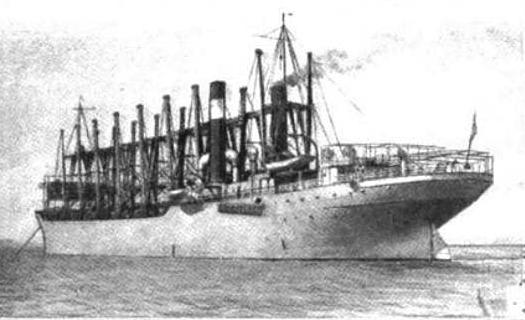
Header: Collier Jupiter c 1921 via Wikipedia

Wednesday, July 4, 2012

Ships: Privileged to Serve

Though I know that "Privileged to Serve" is generally a motto of the U.S. Army, this wonderful article from the Boston Globe on line makes it clear that the members of the U.S. Navy who work the oldest commissioned warship afloat feel very privileged indeed.

USS Constitution - the fabled Old Ironsides - carries a crew of 60 sailors and each and every one is honored to serve aboard her.  The quotes in the article are fascinating as we learn about men and women who have seen duty in such far flung places as African, European and Asian ports of call literally "jump at the chance" for a spot aboard Constitution.

As an example, Anthony Costa, senior chief boatswain's mate and sailing master on the ship, has this to say in the article:

What better way is there to learn about our nation's naval history?  This is where it all began.  The Constitution is one of the ships that said to the world that America wasn't fooling around when it came to the Navy.  

Constitution is a working sailing ship and, though it is a rare event to find her sailing past the outer harbor in Boston, she is on the water at least six times a year.  That means that all the modern sailors assigned to her need to handle her rigging and sails just as their ancestors would have. 

To this day, Constitution even has a master at arms which was one of the original positions in the U.S. Navy.  It would probably come as a surprise to men like Stephen Decatur, James Barron and David Porter that the position is today filled by a woman, Marina Chavez.  Other things have changed too; as Chavez notes, one of the master at arm's duties originally was to assist with flogging.  "No longer part of my job description," she says.

If you'd like to know more about Constitution's participation in events celebrating the bicentennial of the War of 1812, or just find out the museum's hours, check out their official website.

Happy 4th of July to all the Brethren in the U.S. of A.  We've a proud heritage and we should never forget what our ancestors went through to ensure our freedom. As John Adams so righteously put it:

Posterity!  You will never know how much it cost the present generation to preserve your freedom!  I hope you will make good use of it.  If you do not, I shall repent in Heaven that I ever took half the pains to preserve it.

To bring that into modern terms, allow me to quote another righteous American, RuPaul:  "Don't f**k it up."

Header:  Marina Chavez, USS Constitution's Master-at-Arms via Boston.com 

Sunday, March 25, 2012

Seafaring Sunday: Another Arrival

March 25, 1634: A mixed group of Catholic and Protestant Englishmen, led by Father Andrew White, disembark from the ships Ark and Dove on St. Clement's Island in what is now the state of Maryland.  Puritans from the Boston area will later try to revoke these settlers charter in order to remove anyone not practicing their religion from the Atlantic seaboard.  This will lead to a brief civil war between the colonists, which will end in 1655 with the Toleration Act passed by Governor William Stone.

Header: Boats in Port by Andre Lhote c 1918 via Old Paint

Monday, March 19, 2012

The Pirates Own Book: When Charles Ellms Met Henry Avery

Most of the stories told of our favorite pirates have trouble at the beginning. No one is really sure where the gentleman rover in question came from. What is more certain is the grisly death met by the dread fellow; from Bartholomew Roberts to Jean Laffite, from Francois L’Olonnais to Thomas Tew, spilled blood and guts come before the end of the story. In other it must be said less frequent cases, the pirate in question fades from history never to be seen or heard from again. From Christopher Condent to that fiction about the Laffite brothers, they simply stop being pirates and “blend in”. Henry Avery was among those “lost to history”, but Charles Ellms tells us that was not at all the case.


In The Pirates Own Book, Ellms begins his chapter on Avery with the usual story of the Captain’s exceeding wealth and marriage to the Great Mogul’s daughter thanks to his capture of one of the ruler’s treasure ships. Ellms quickly sets us straight, however, by informing us that Avery was “… actually starving without a shilling” at the time of his death.

Ellms then launches into the usual routine. Avery was born in Devonshire, he tells us, and went to sea in merchant ships at an early age. Avery was mate aboard the vessel of Captain Gibson when, in 1715, he began to foment mutiny among his fellows. He clearly had the itch to go a-pirating and the rest of the crew, according to Ellms, was just as eager. Gibson was fond of the bottle and one night when he was sleeping off a drunk, Avery and his men cut the ship’s cable and headed out from Corunna in the West Indies. When Gibson awoke, Avery informed him that he had taken over the ship. “You must know that I am captain of this ship now, and this is my cabin, therefore you must walk out; I am bound for Madagascar, with a design of making my own fortune, and that of all the brave fellows joined with me.”

Gibson decides against joining Avery, and is set on shore with a small group of like-minded sailors.

Once in the waters around Madagascar, Avery recruits the captains of two armed sloops to join him in his pirating venture. They form a little flotilla and take a galley of the aforementioned Mogul in the Indian Ocean. The ship is bound for Mecca where the Mogul’s daughter is making a pilgrimage, and it is packed to the gunnels with more riches than can reasonably be imagined. As Ellms points out: “It is a well known fact that people of the east travel with great magnificence…”

Avery and his cohorts plunder the ship of all its wealth and the ship limped home to India where the Mogul immediately protested to the British government. “The noise which this made over all Europe,” Ellms says, “gave birth to the rumors that were circulating concerning Avery’s greatness.”

Meanwhile, Avery was duping the two captains of those sloops out of their share of the Mogul’s treasure. Through assurances of his own ship’s superior sailing and fighting power, he led these captains to understand that their booty would be better off aboard him. When they agreed and transferred their wealth, Avery sailed for the West Indies under cover of night, leaving the unfortunate captains behind.

Convincing his men that their wealth would now allow them to live like kings ashore, Avery first considered settling at New Providence. He then moved on to Boston but was concerned that he would not be able to sell the gems of the Great Mogul without raising suspicions. He sailed for Ireland and eventually ended up in Brideford, Devonshire, according to Ellms.

At this point, most historians agree that further information on what became of Avery is unattainable, but Charles begs to differ. In a wonderful plot twist – which the reader has to hope wasn’t true – he has Avery casting about Devonshire trying to sell his cache of diamonds. “When he unbosomed himself to [a speculator] and other pretended friends,” these men, posing as merchants, assured Avery that they could sell his treasure for the highest possible price. Leaving a deposit with former pirate, they took the diamonds and disappeared with no intention of returning. As Ellms so eloquently puts it: “… the merchants thus proving themselves as good pirates on land as [Avery] was at sea.”

The end of this story is poignant in the extreme. Avery sets out for Ireland in search of the con men. Having no luck, he is reduced to walking home to Brideford from Plymouth. “He had been there but a few days, when he fell sick and died; not being worth so much as would buy him a coffin!”

Thus the man once known as Long Ben and “the Arch Pyrate” ended up buried in a paupers’ field in Devonshire. Or so Charles Ellms tells us.

Header: Captain Avery receiving the three chests of Treasure on board his Ship from The Pirates Own Book

Thursday, February 9, 2012

Women at Sea: "My life is not accepted..."

Some time in the early 17th century a remarkable woman was born somewhere in England. This vagueness on my part may sound coy but, as with so many biographical sketches here at Triple P, the beginning of the life of Mary Dyer is lost to the mists of time.


Our first historical glimpse of this woman who would change the course of New England’s history is in 1635. In that year Mary and her husband William crossed the treacherous Atlantic Ocean to join fellow Puritans in the Massachusetts Bay colony. The crossing in an unnamed merchant vessel would have been no less harrowing for the Dyers than it was for the original Pilgrims. Fortitude and faith were probably about all that saw them through that wet, sickening, miserable time on the vast sea. Sailors, it must be admitted, these people were not.

Mary and William set up housekeeping in probable relative comfort. Mary at this time, perhaps in her early twenties, would later be described by those who knew her as “comely,” “grave,” and “of goodly personage… fearing the Lord.” A God-fearing goodwife to an up and coming lawyer probably appeared the very root-stock of Puritan society, but Mary was a rebel in drab homespun linsey-woolsey.

Not long after the Dyer’s settled in, Mary met Anne Hutchison. Anne, the now famous Puritan heretic who had the audacity to claim that even women to could have a profoundly personal relationship with the Divine, was probably a neighbor and the two women seem to have become fast friends. Mary began attending Anne’s all-female “Bible studies” where local women sought to understand God’s plan without the guidance of preachers or even husbands.

When Mary went in to labor in late 1637, Anne – who was a practicing midwife – was by her side. The birth was not a joyful occasion; the baby was stillborn and malformed. Anne whisked the infant away and buried the little girl’s corpse privately. This may have been standard operating procedure for midwives of the era, who were often accused of causing children to be born dead, with defects or both.

Little was said of the unfortunate incident until after Anne Hutchinson’s trial for heresy and subsequent banishment. The Dyers chose to follow their friend and her family to the wilds of what is now Rhode Island, where the Hutchinsons established a new colony. Once they were gone, Massachusetts Bay colony Governor John Winthrop had their houses and property searched. Discovering the little grave he had it dug up and distributed his account of the “monstrous birth” locally and in England. The malformed infant was, he assumed, proof of God’s wrath against heretics.

Mary and William, meanwhile, seem to have prospered in the new Rhode Island colony. Life was doubtless hard, but William was successful enough by 1652 to make a trip back to England on business. Mary accompanied him and it was in England that she came into contact with George Fox, founder of the Society of Friends known as the Quakers. Mary was entranced with Fox’s teachings; his doctrine of personal revelation jibed nicely with what Anne Hutchinson had been preaching back home. Mary joined the Society; when her husband returned to Rhode Island, she stayed behind to become a Quaker preacher in her own right.

In 1656, the Massachusetts Bay colony enacted an anti-religious law that included a ban on Quaker preaching and practices. When news that men, women and children of the Quaker faith were suffering mutilation, imprisonment, banishment and threats of death reached England, Mary booked passage straight to Boston. She would arrive there, after another untenable crossing and this time at around the age of 47, in 1657.

Mary immediately began preaching in the city and was almost as immediately arrested. The authorities, led now by new Governor John Endecott, released Mary only when William – who had not converted to the Society – arrived in the city to take charge of her. Both were admonished that Mary should not return on pain of death, a threat which frightened her not at all.

When Mary learned that two of her Quaker congregation who had gone out to preach in Massachusetts, had been arrested, she hurried to Boston to help. She was herself put back in prison and all three were brought before the court in September of 1659. The miscreants were again banished and warned that their sentence would be death if they returned. A short time later Mary’s companions, Marmaduke Stephenson and William Robinson, were back in Boston to “bear witness against” the colony’s anti-Quaker laws. Mary followed them soon after.

As good as their word, the authorities arrested the three Quakers again. This time Robinson and Stephenson were hanged while Mary stood by with a noose around her neck. An 11th hour reprieve was staged by Endecott and Mary was again remanded to the custody of her husband. Obviously, the Governor imagined that this brush with death would put Mary in her womanly place. Clearly, he wasn’t paying attention.

Mary continued to preach in Connecticut, Rhode Island, New York and elsewhere but ongoing persecutions in Massachusetts drew her back to Boston. Horatio Rogers says in Mary Dyer of Rhode Island that she stated her mission at her final trial before the Governor:

I came in obedience to the will of God… desiring you to repeal your unrighteous laws of banishment on pain of death. And that same is my own work now, and earnest request, although I told you that if you refused to repeal them, the Lord would send others of his servants to witness against them.

This time Mary had gone too far. Endecott, who at her trial became so infuriated with Mary that he screamed “Away with her,” ignored her family’s pleas and sentenced her to hang. She was marched to the tree at Boston Commons, all the while refusing to repent. Mary Dyer died by hanging in May of 1660.

Mary’s fight for religious freedom in New England was won only after – and to a large degree because of – her martyrdom. A year later, King Charles II forbade imprisonment, banishment or execution on religious grounds in his colonies. In 1686, the Massachusetts Bay colony’s charter was revoked, an English Governor was set in place and the reign of terror instigated by the “Pilgrim fathers” was brought to a halt.

All this because a “goodly personage” had the courage to cross the ocean and stand up for what she believed.

Header: “I Have Been Preserved for This”, a portrait of Mary Dyer by Howard Pyle via Ideas Made of Light

Wednesday, January 25, 2012

People: Fly in the Ointment

Today's Golden Age pirate is famous, not for plunder, seamanship, or success, but because of his actions prior to his execution. He is mentioned briefly in Captain Johnson’s History of Pyrates, dwelled on at length in Marcus Rediker’s Villains of All Nations and written about by Cotton Mather. As is so often the case, we know next to nothing about William Fly’s background, but his death made a splash that resonates into our own time.


Fly, according to Johnson, was born to “very obscure parents” probably around the turn of the 17th to the 18th century. By 1726 he was bosun aboard Captain John Green’s brig Elizabeth headed out from New England for the coast of West Africa. Many who have written about Fly assume that Elizabeth was one of those ships involved in the so called “triangle trade” carrying rum to Africa where it would be traded for slaves. There is nothing specific in the record to confirm this, but it is certainly a possibility. What we do know for sure is that Elizabeth was involved in some sort of merchant endeavor and that Green did not run a happy ship.

Before the ship left for blue water to cross the Atlantic, Fly and his captain were butting heads. At his trial, and even before, Fly complained bitterly of the “bad usage” suffered under Captain Green by him and his mates. Fly’s comments are in line with the classic argument as to why merchant seamen turned pirate. Small crews, low wages, grueling schedules, unreasonable discipline, poor food and a host of other trials sent men over the edge to desertion, mutiny and even murder.

Fed up from virtually the start of Elizabeth’s cruise, William Fly organized a mutiny. One night in the spring of 1726, he and fellow crewman Alexander Mitchell pulled Captain Green out of his cot, dragged him up on deck and subjected him to a beating. When he was half-unconscious, they and others tossed Green over the ship’s side. Still prepared to fight for his life, Green caught part of the rigging and held on tight. One of the mutineers grabbed an ax, several of which would have been kept handy to cut away rigging in foul weather, and chopped off his captain’s hand. The first mate, Thomas Jenkins, followed the captain over the side. The final target of the men’s ire, an unnamed surgeon, was spared as “they might find him useful”. He was shackled in bilboes instead.

Fly was quickly chosen as the new captain of Elizabeth. He immediately changed her name to Fame’s Revenge and he and his men set out a-pirating. They took five prizes in all and each one appears to have been a poorly laden merchant. Fly made it his signature move to torture or in other ways punish the captains he took hostage. He notoriously whipped Captain John Fulker of the John & Hannah so viciously that the man nearly died.

It seems that William Fly was no more popular as captain than Green had been. A group of his men, possibly those pressed into service from prize vessels, rose up and took Fly’s ship. They turned it over to the authorities of Boston in June of 1726. Fly and a dozen of his crew were incarcerated and set to be tried for piracy and murder on the high seas.

At this point, the notorious Puritan minister Cotton Mather enters the picture. Sent by the judge in the case to exact confessions and guide penitence in the pirates, Mather ran into a man that he himself called “a most uncommon and amazing instance of impenitence and stupidity and what spectacles of obduration the wicked will be” in William Fly. Mather writes that, when confronted with the crimes of mutiny and murder, Fly would, no pun intended, fly into an uncontrollable rage. At one point the pirate ranted that he “… would not own myself guilty of any murder, our captain and his mate used us barbarously…” While Fly does not list specific actions, he laments that “… poor men can’t have justice done us…” no matter how badly they are treated by their nominal betters.

Fly continued his obduration straight up until his conviction and execution. While others convicted with him stood on the gallows and “preached” to the crowd – as Mather had hoped – the ills of drink and rebellion, Fly did exactly the opposite. He came to face death with a “smiling aspect” and eyed the crowd “unconcerned”.

Fly even went so far as to chastise the hangman for “not understanding his trade” and stepped forward to retie the noose with which he would be killed. He then addressed the crowd as he had Reverend Mather, saying frankly that he had “wronged no man”. He went on to say that he wanted those who commanded vessels to “… take warning by the fate of [our] captain… and to pay sailors their wages when due, and to treat them better”. It was an ominous warning from a man who had taken the ultimate step in eliminating his tormenter and was facing death because of it.

Some writers and historians, notably Rediker, have used Fly as an example of the underlying reason for piracy as a life pursuit. In this scenario, William Fly and his fellows stand as anti-heroes bucking the “barbarous” establishment. As this post at Executed Today puts it “… the radical doomed sphere of resistance pirates offered to the enormous cruelty of the developing Atlantic economy…” To my mind, this is overstating the case. From Barbary to the buccaneers, through the Golden Age and into the last days of the privateers, most of the men who went out seeking prizes on the high seas were no more freedom fighters than modern day drug dealers. They were in it for the simple reward of cash. While some men may have had good intentions, it is important to note that Fly’s short career as a sea captain turned out to be no more glorious than that of the commander he killed.

Fly’s body and those of his compatriots were gibbeted on the little island in Boston Harbor known as Nix’s Mate as a “warning to other seamen”. To this day, stories of strange lights around the island – particularly on summer nights – lead some to believe that his ghost still haunts the rocky outcropping. While that, too, is probably overstating the case it is a possibility worth imagining.

Header: Engraving from The Pirate's Own Book

Wednesday, December 28, 2011

People: The Leg, the Saw and the Ax

Today's pirate is a shadowy figure about whom we know very little. What we do know comes second hand from Philip Gosse via Johnson/Defoe and most of it has to do with a serious injury suffered, endured and recovered from. To this end, the brief story of William Taylor tells us a lot – perhaps more than we want to know – about medical treatment aboard the average freebooter in the Golden Age.


According to Gosse in his The Pirate’s Who’s Who, Taylor was “one of Captain Phillips’s crew.” Which Captain Phillips, for there were several, he does not say but we can reasonably rule out John Phillips, of whom we have previously spoken, based on the date of Taylor’s trial for piracy. Gosse does not give us a ship’s name or location, but indicates that Taylor was “wounded in the leg while attempting to desert.”

The true misery for unfortunate William Taylor begins here. There being no surgeon on board ship, Taylor’s mates took a very piratical approach to the would-be desert’s recovery: they elected the ship’s carpenter to amputate his shattered leg. It probably goes without saying that surgical instruments were not to hand either, so the carpenter took up a tool that he was familiar with and proceeded. At this point Gosse quotes, probably from Johnson’s History of Pirates:

Upon which [the carpenter] fetch’d up the biggest saw, and taking the limb under his Arm, fell to Work, and separated it from the Body of the Patient in as little Time as he could have cut a Deal Board in two.

Here we moderns imagine the pain that poor Taylor must have suffered under such work but other factors jump to mind shortly thereafter. Not the least of these is the bacteria swarming on that saw. By this era a well trained naval surgeon would, at the very least, have poured vinegar over the “instrument” to take off the worst of any visible muck.

Our carpenter, however, is not to be outdone by any quack doctor either in the way of pain or sterilization. The story continues:

he had heated his Ax as he perform’d the other Part for he so burnt the Flesh distant from the Place of Amputation that it had like to have mortify’d.

This grisly process resulted in a surprising recovery for the hearty if ill-fated William Taylor. Recovery enough, at any rate, for trial and sentence to hang; Gosse tells us that Taylor was found guilty of piracy in Boston on May 12, 1714. The end of the brief entry says, however, that “… for some reason not explained [he] was reprieved.”

Who exactly William Taylor was, and on what ship he went a-pirating remains a mystery. His fate after trial and reprieve is also unknown, as is just how long he lived with his sawed-off leg.

Header: The Amputation by Thomas Rowlandson

Thursday, December 8, 2011

People: The Villain Quelch

The story of John Quelch, mariner turned privateer turned pirate, is a controversial one. On the one hand, we have a man whose piracy is fairly well documented due to a sensationalized trial in Boston during the summer of 1704. Quelch did indeed sign aboard the Massachusetts privateer Charles, probably as First Lieutenant, where he preceded to lead his fellow crewman in mutiny, toss their captain overboard and make for the coast of Brazil to plunder Portuguese merchants. On the other, certain modern historians argue that Quelch, and the dozen or so men hanged with him, was the victim of railroading by prominent Boston businessmen who did not want their names attached to piracy. Either way, Quelch is one of the first men to be tried for piracy in the British Colonies of North America proper.


John Quelch’s early life is a mystery, which should surprise no one who studies pirates and piracy. Philip Gosse, who is one of Quelch’s main biographers, will say only that he was a native of Massachusetts Colony. He was certainly familiar with the sea when he signed aboard the brig Charles of 80 tons in 1703. Charles was captained by Daniel Plowman and was sponsored by a group of Boston businessmen who had obtained for her a letter of marque to raid French ships off the coast of Newfoundland. This was a potentially lucrative endeavor at the time with the fisheries off the coast of modern Canada booming. The problem for those at sea was the weather, cold and generally dirty even during the summer months, and the puny prizes available. A privateer in those waters would have to work almost as hard as the fishermen he preyed upon.

Whether or not this consideration was what drove Quelch to stir up a mutiny is unknown. What we do know is that, shortly after Charles departed from Marblehead, the crew took her over. They locked Captain Plowman away, either in his cabin or below decks, elected John Quelch as their leader and set a course for the coast of Brazil. Along the way, Plowman would be committed to the deep, either killed first or thrown overboard alive.

Upon entering Brazilian waters, Charles went straight to work. According to Clifford Beal in his 2007 publication Quelch’s Gold, Quelch and his men took nine Portuguese ships from late 1703 to early 1704. These were wealthy merchants full of not only saleable goods like cloth, hides, wine and guns but specie as well in the form of gold dust, jewels and coins. The value of Quelch’s haul has been estimated at over 1 million in modern U.S. dollars.

Apparently satisfied with this impressive booty, Quelch turned for home. According to local rumors, Charles landed at Star Island, New Hampshire where someone – possibly Quelch himself – buried some of the loot. This very unlikely happenstance grew into legend when gold coins were found beneath a stone wall on the island in the mid-1800s. Whatever the case, Charles returned to Marblehead and the crew quickly dispersed to spend their ill-gotten gains. Quelch seems to have had no qualms about what he had accomplished for he was very soon arrested and sitting in jail in Boston. Authorities sent navy ships to apprehend Quelch’s crew and a dozen or so were rounded up to join their former captain in gaol.

On June 17, 1704, a trial was held at the Star Tavern in Boston. The sailors, now beaten down after too much time chained in filthy cells, were by and large defiant nonetheless. Though extreme physical torture does not seem to have been used on the prisoners – that sort of thing being tacitly illegal in British courts – they do seem to have been badgered relentlessly for confessions and repentance by local ministers. Gosse, who’s The Pirates Who’s Who has an entry, however brief, on 40 of the pirates, notes that most were “wretched” and “beaten down” by the time they came to the gallows at Scarlil’s Wharf, Boston. Gosse quotes from “a pamphlet published at the time”:

The Ministers of the Town used more than ordinary Endeavours to Instruct the Prisoners and Bring them to Repentance.

What this means in practice we cannot say, but Massachusetts as a whole and Boston specifically was still a stronghold of Puritan religion in the New World. That these pirates were treated little better than the “witches” of Salem Village is probably a very safe bet.

Quelch and his men were marched through Boston barefoot to the wharf with a heavy guard and the silver Admiralty oar carried before them. This made their execution an official maritime punishment and they were hanged as if on the dock at Wapping, within sight of the ocean. Legend has it that they were buried on the shore at low tide. Only one of their number was pardoned; a thirteen year old boy named John Templeton was determined to have been “only a servant on board” and therefore no part of the mutiny that killed Captain Plowman.

The previously mentioned pamphlet has John Quelch saying to the crowd as the noose was placed around his neck, “They should take care how they brought Money into New England to be Hanged for it.”

Many historians believe that Quelch felt he was within the parameters of his letter of marque in taking those Portuguese merchants. Some have gone so far as to call the hanging of Quelch and his mates the “first case of judicial murder in America.” To me this statement goes too far and points to the misunderstandings still in circulation about privateering and letters of marque. If the facts as they have come down to us are true, then Quelch did turn pirate. His letter of marque was against French shipping only, making the taking of a ship of any other nationality piracy. Then too there is the little matter of murdering Captain Plowman if we want to do more than split hairs.

Whether Quelch was a bloodthirsty villain who got what he deserved or a pawn of greater men in the same manner as William Kidd, I’ll let you judge, Brethren. History is always one part detective work, two parts educated guess and a little crazy supposition thrown in to taste.

Header: Quelch’s alleged flag known as “Old Roger”: it is probably that the flag never flew from the masthead of Charles

Monday, November 14, 2011

Ships: Six Frigates

The United States Navy was reestablished by order of Congress in 1794. Since the Continental Navy had been largely a privateer operation, and the ships that she did have had been sold after the Revolutionary War, the fledgling navy had no ships of her own. Secretary of War Henry Knox proposed that six heavy frigates be built. They should be both strong of hull and fast sailors, something not often seen at the time. And they needed to be ready as quickly as possible given naval threats not only from England and France but from Barbary corsairs as well.


Joshua Humphreys was given the task of designing the ships. Although he is generally credited with their building as well, in fact five other ship builders had a hand in overseeing their execution along with Humphreys. As Ian W. Toll notes in his excellent book on the birth of the U.S. Navy Six Frigates, Knox had the foresight to suggest to President Washington that the building of each ship be completed at different dockyards on the Atlantic Coast. This would not only insure quicker build times but also pump money into local economies which were lagging after the war. Washington agreed immediately and construction was approved in April of 1794.

USS Chesapeake was built at Gosport, Virginia by Josiah Fox. Launched in August of 1799, she would achieve notoriety in the Chesapeake/Leopard Affair. HMS Leopard fired upon Chesapeake in 1807, ostensibly because Commodore James Baron refused to comply with a search request. Baron, his guns unready for a fight, struck almost immediately and would be vilified for his action – or inaction – for the rest of his life. Chesapeake, of 36 guns, would go on to be captured by HMS Shannon during the War of 1812. When she was broken up in 1820, some of her timbers were used to build Chesapeake Mill in Wickham, England.

USS Congress was built at Portsmouth, New Hampshire by James Hackett. Also a 36, Congress was launched at the same time as Chesapeake. She served on the Mediterranean Squadron and in the West and East Indies. She became a receiving ship in 1824 and was broken up ten years later.

USS Constellation was built at Baltimore, Maryland by David Stodder. She carried 36 guns and was launched in September of 1797. She famously captured the French man-of-war L’Insurgent during the Quasi-War, making her the first American built ship to win such a victory. She would go on to duty in the West Indies and on the African Station hunting slavers until she was broken up in 1853. Some of her timbers were used to build a second Constellation; she is now in dry dock and functions as a museum.

USS Constitution was built at Boston, Massachusetts by George Claghorn. Old Ironsides, as she became known, was a true 44 launched in October of 1797. Her greatest victories were achieved during the War of 1812 when she captured the British ships Guerriere, Java, Cyane and Levant. She was marked for breaking in 1830 but, saved by popular outcry, she is now the oldest commissioned vessel afloat.

USS President was built at New York, New York by Forman Cheeseman and launched in April of 1800. Of 44 guns, she served on the Mediterranean Squadron and in the War of 1812 when she was captured by HMS Tenedos after suffering severe damage from running aground. Her captain, Stephen Decatur, struck to the British but it was soon revealed that the Battle of New Orleans had been won by General Jackson the same day. The war was over. Though the British paroled Decatur and his men, they kept President as prize. She was broken up in 1817.

USS United States was built at Philadelphia, Pennsylvania by Joshua Humphreys. Launched in May of 1797 she also carried 44 guns. She captured HMS Macedonian in the War of 1812 and was commissioned into the Confederate States Navy during the Civil War. She was scuttled in 1862 but raised again after the war. Her repair was never properly finished and she was broken up in 1865.

Header: Battle Between USS United States and HMS Macedonian by Thomas Birch

Friday, October 28, 2011

Horror on the High Seas: Nix's Mate

Out in Boston Harbor there sits a tiny speck of an island that, at first glance, almost appears to be man made. Known from about 1636 as Nix’s or Nixes Mate, the island is the site of a pyramid beacon run by the Coast Guard and on the U.S. National Register of Historic Places.


In the 17th century, the island was large enough to mine for ship’s ballast, graze sheep and unload smuggled goods for reloading onto less suspicious vessels. Probably because of its continued use by smugglers and pirates, the place became notorious; from the time the island was granted to John Gallop in 1636, the good folk of Boston used it as a place of execution for those who committed crimes on the high seas.

Many legends have grown up around the fascination with piratical doings and the demise of scurvy seadogs on the island. One of the most popular stories explains the name of the island as well as why it is now just a speck of earth in Nubble Channel.

It seems that one Captain Nix put out to sea and was killed mysteriously one night in a violent storm. The next morning, the crew found their First Lieutenant – Nix’s mate – soundly sleeping with blood on his shirt. Assuming the worst, they clapped the man in irons despite his protests of innocence, and turned back toward Boston. The First Lieutenant was tried and found guilty, although he continued to tell anyone that would listen that he had not done the bloody deed. He was rowed out to the island and led to the gallows. There he made a promise to the people of Boston about the place where his corpse would hang as a warning. The island, he said, would be washed away to nearly nothing by the sea as proof of his innocence. With that warning on his lips, he died. Within a decade, the Lieutenant’s prophecy had come true and the people of Boston named the little island Nix’s Mate in his honor.

In fact, this story first appeared in 1883 in a purported historical entitled King’s Handbook of Boston Harbor by M.F. Sweetser. It is a charming tale, of course, but probably pure fiction. No one seems quite sure why the island is called Nix’s Mate and the continued use of its rock for ship’s ballast throughout the 17th century insured that it would errode with wind and tide to its present size.

The most famous pirate to swing in the sea breeze on Nix’s Mate was William Fly, whose story is curious enough to deserve a post of its own. Hanged in July of 1726, Fly went to his death with such steadfast obduration that he impressed that bitter witch hunter Cotton Mather himself.

Local legend has it that Fly’s spirit continues to cling to the place where he proclaimed not his innocence but his conviction that piracy was born of the harsh treatments allotted men in the merchant service. Treatments Fly referred to as “bad usage”. It is said that blue lights are seen hovering over the little pyramid beacon at Nix’s Mate on warm summer nights. They dance about in the dark air but disappear when a vessel pulls in for a closer look, flying up like embers out of a fire.

True or no, all sailors love a good ghost story and they are always so much more believable when the mate in question was put to “bad usage”.

Header: Nix’s Mate by Joe McGurl

Sunday, October 16, 2011

Seafaring Sunday: Taxation Without Representation

October 16, 1773: In an act of rebellion that would become known as the Boston Tea Party, colonists in Boston dressed up as natives and boarded British merchant ships Eleanor, Beaver and Dartmouth to dump highly taxed tea into Boston Harbor.

Header: The Boston Tea Party, engraving by Nathaniel Currier

Sunday, May 29, 2011

Seafaring Sunday: More Trouble for the Colonies

May 31, 1774:  The Boston Port Bill, the first of the so called Intolerable Acts, took effect.  The port of Boston was closed by the British until restitution was paid for the destruction wrought by the Boston Tea Party the year before.

Header: The Boston Tea Party colored engraving by Currier mid-1800s

Tuesday, May 10, 2011

People: Lived Beloved and Died Regretted

So many of the famous pirates whose stories – I will not say “histories” because that’s stretching the truth to the point of breaking – are familiar to us today either did not exist or are so cloaked in the mantel of legend that sorting out fact from fiction seems impossible. Today’s gentleman rogue is part of the latter group, but is unfortunately no exception.


John Halsey (or Halsy or Halsie) was certainly born in Boston in the year 1670. Both Johnson in his General History of Pyrates and Gosse in The Pirate’s Who’s Who tell the tale of Captain Halsey and the stories seem to jibe pretty well. Of course there is the issue that Gosse, writing in the 1920s, may have taken his information entirely from Johnson but let’s be optimistic, shall we.

Halsey was given a British privateering commission by the Governor of Massachusetts during the War of Spanish Succession which began in 1701. Halsey seems to have stuck to taking legal prizes at first. His brig Charles sailed from Boston to Newfoundland where Halsey got his feet wet, so to say, capturing French fishing vessels. He then set a course for the Azores and graduated to Spanish merchants. Along the coast of Portugal, some of Halsey’s men deserted. There was evidently conflict over a disagreement between Halsey and his First Lieutenant, who was put ashore at Cape Verde. There is documentation that some of the deserters were captured by authorities and returned to Halsey’s ship by the local Governor. This would verify the story that Halsey carried a legitimate commission.

Halsey was still hunting in the Atlantic when that commission expired, probably some time in 1705. Rather than turn home or to England to retrieve new papers, Halsey decided to go rogue. He took Charles around the Cape and sailed to one of the many piratical outposts on Madagascar. Here he refitted, watered, provisioned and took on new men. The Captain generously allowed those among his New England crew who did not care to go a pirating to leave his ship. Then Halsey set off for the rich hunting grounds of the Red Sea and the Indian Ocean.

Gosse tells us that Halsey decided not to go after “Christian ships” but instead announced his “… sudden determination to attack only Moorish ships in the future.” This decision seems to have enraged his pirate crew for, when they came upon a Dutchman they all agreed was a fat merchant on her way home from India, they threw Halsey and his few loyal mated in chains and proceeded to give chase. Unfortunately for the audacious crew, the Dutch ship was in fact a man-of-war – or at the very least an extremely well gunned merchant. She turned and began to fire on Charles rather than running, as the crew has expected.

A fire fight ensued and Charles was battered to the point of being in danger of wrecking. Halsey was released from irons and took charge immediately, managing to get his ship out of harm’s way. The now contrite crew decided to let their Captain run the show. On the flip side, Halsey seems to have reconsidered his prize taking stance. After a refit near the island of Reunion, Halsey set Charles on a course back towards Madagascar.

En route, the pirates met at least two English merchants, Essex and Rising Eagle, whom they managed to take without much trouble. The captain of Essex turned out to be a friend of Charles’ quartermaster and, due to this connection, Halsey allowed the man to keep all of his personal goods. It did not seem much of a loss to the pirates, however, as Gosse states that Halsey took sixty thousand pounds in “English gold” out of both ships. He also managed to ransom the ships, being paid cash for their return to their owners. Clearly the entire adventure netted the crew of Charles a handsome amount.

Sailing toward Madagascar, Halsey met two more ships. Gosse tells us that one, the Greyhound, was carrying goods from some of Halsey’s previous prizes. Whether or not this coincidence actually occurred, it is a good example of how close the businesses of privateers, pirates and merchants actually were when abroad on the high seas.

Halsey put ashore at last, probably at the pirate haven of Ile Saint-Marie, and settled down with his generous booty. Unfortunately the tropical climate does not seem to have agreed with him as he contracted a fever within a few months. He died, Johnson tells us, in 1708 (Gosse says 1716) and was buried with all solemnity on the island. His funeral included the firing of guns in salute and a church service.

Johnson concludes his chapter on pirate John Halsey with this:

He was brave in his Person, courteous to all his Prisoners, lived beloved and died regretted by his own People. His Grave was made in a garden of watermelons, and fenced in with Palisades to prevent his being rooted up by wild Hogs.

What more could a seaman ask for?

Header: Full Rigged Sailing Ship by C.L. Bille

Monday, January 31, 2011

History: The Almost Forgotten Wharf

In November of 1734 Newburyport, Massachusetts resident Ralph Cross sold valuable waterfront property to one of his neighbors, Philip Coombs. The price was a decidedly steep 198 pounds according to records still available for view at city hall but Coombs had grand ideas that were certain to make him back that cost and then some. Over the course of the next twenty years Coombs, with surprising foresight, built a wharf big enough for the loading and unloading of fishing, merchant and privateering vessels. By 1756 the town was, just as Coombs had anticipated, a bustling port and Philip was collecting fees from ship owners hand over fist.

Philip Coombs served Britain during the French and Indian war. He left his family to fight in 1756 and was taken prisoner and killed that same year. Given this tragedy another family may have let the wharf go to seed but not the Coombs. Young William inherited his father’s property and, evidently, his genius for seafaring business. When the Revolution broke out, Coombs wharf became a key landing and departure point for Continental privateers bringing with them the benefits of trade goods like copper, iron, sugar, indigo and yardage which led to a boom in Newburyport’s economy.

William Coombs himself organized some of the privateers into a small flotilla that sailed to the Caribbean and pillaged British stores of gunpowder and shot. Local historians believe this to be the first case of a Continental raid for gunpowder, with many more to come. Coombs became one of his town’s selectmen and eventually represented his area in the state legislature. He died in 1814 when his wharf was again bristling with privateers due to the War of 1812.

His wharf continued in use until the early 20th century, with significant refit including granite slabs undertaken around the time of the Civil War. By World War II, however, the area was filled in for first housing and then businesses and the wharf was largely forgotten by those who strolled, worked and lived just above it.

Last June, digging for a new waste-water operations plant revealed those granite slabs and capping stones from the 1860s refit and further digging took archeologists, who came on scene almost immediately after the first discovery, down to the original wooden structure that was Coombs’ wharf.

Unfortunately, as this
article from The Boston Globe reveals, the entire area was contaminated by oil tanks which rested above the wharf and leaked during the 1950s. This makes what has been and what is being found inelligible for protection under the National Register of Historic Places and too dangerous to move. All the archeologists and local historians can do is document and catalogue without moving most of the actual artifacts they are finding.

The crews on site on doing their best to collect as much data as possible and, as Newburyport Historical Commission member Tom Kolterjahn says in the article, “…trying to preserve what they can and leave as much of it intact as they can.” Perhaps some day soon there will be a way to clean up the area and make it accessible again. Until then, it’s nice to know that a significant piece of American history is being looked after and remembered.

Header: Newburyport Waterfront from a local realtor’s brochure

Thursday, September 9, 2010

People: An Illiterate Sailor

The life story of William Phips is one of those that, if you novelized it, agents and publishers would scoff at as too amazing to be “believable”. Truth, as the philosopher said, is stranger than fiction.

According to the biography written by Cotton Mather of Salem Witch Trials fame (more on that later), Phips was born one of many children in the far northern area of the Territory of Massachusetts. The place of his birth is not named but it can be reasonable surmised that he was raised on the coast of what is now the U.S. State of Maine. Phips, who was known as Will until his fortunes changed, grew up relatively wild. His sailor father probably died at sea and his mother had all she could do to feed and cloth her huge brood. Teaching them to read was not part of the program.

By his teens, Will himself had gone to sea. He became a carpenter’s mate and was rated carpenter aboard the fishing vessels that plied the Newfoundland cod trade by the early 1670s. Reading between the lines of Mather’s stony writing one gets the impression of a gregarious and handsome young man who enjoyed his life at sea. Will was tall; “taller than most”, Mather says. And he seems to have had a way with the ladies. This particular talent would serve Phips extremely well.

Somehow, young Will met an upstanding and decidedly well-to-do Boston widow named Mary and managed to get her to agree to marry him. The couple wed in 1674 and, though Mather is specific as to Will’s age at the time – 23 – he tactfully avoids mentioning Mary’s. This leads me to wonder whether or not she may have been a “woman of a certain age”. Whatever the relationship actually amounted to, the new Mrs. Phips seems to have had great plans for her husband. She taught him how to read and write almost immediately and tried to horn him into the high society of Boston.

Society would have nothing to do with the sailor from Maine but that seems to have mattered very little to Will. At least on the surface. Some time within the first year of his marriage, Will got it into his head to go treasure hunting. And not just any treasure by half. Will planned to go “wracking” for the storied Spanish treasure ship Nuestra Senora de la Concepcion. She sunk in dirty weather off the coast of Jamaica over thirty years earlier and she was reputed to have gone down with billions in treasure aboard. Mary seems to have caught the bug; probably due to Will’s almost unbelievable gift of salesmanship. She financed her husband’s trip to England, where he hoped to talk King Charles II into backing his project.

In another of the many unbelievable twists that comprise Phips’ life, he met Sir John Narborough on arriving in London. Narborough had a life long fascination with not only buccaneering and the wracking trade but the wreck of la Concepcion itself. He was an avid fan of Henry Morgan, in the modern sense of the word “fan”, and he may have hoped that being involved in Phips’ Jamaican venture would bring him not only wealth but a nod from his aging hero. He jumped on Phips’ bandwagon and introduced the young Colonist to the King. Charles bought in as well, and Phips was given a ship and crew almost miraculously.

Phips took to his new command like a fish to water. He sailed into Boston Harbor to acquire stores for his venture as if he were an Admiral aboard a flagship. He demanded that all ships in the harbor strike flags in deference to his royal commission and even fired a gun over the bow of a ship that refused to do so. A man named John Knepp, who had been purposefully put aboard Phips as a spy by Charles II, protested vehemently to anyone who would listen. Mary Phips got wind of the trouble with Knepp and advised her husband to not only curb his behavior but make very, very certain that Knepp was on his ship when he weighed anchor for Jamaica.

The appearance of propriety never fell away from Mary in this or any other of her husband’s follies. That said, it is interesting that when Knepp got wind of Mrs. Phips’ advice to her husband, he assumed that her insistence on him being aboard on route to Jamaica implied that Phips would toss him overboard in blue water. Knepp stayed in Boston and wrote a scathing report to the King as well.

Things turned ugly for Phips for awhile thereafter. His initial attempts at wracking were spoiled by mutinous uprisings and bad weather. When he returned to England for more money and a new ship in 1685, Charles II died. The new King James II had more to deal with than a sailor’s pipe dream and Phips was left without funding. Interestingly, the newly named Governor of Jamaica stepped in. Via his wife, the crazy Elizabeth, the Duke of Albemarle heard of Phips and decided to bankroll his venture. With the help of a few other backers, Will – now 34 years old – was up and running again.

Though Daniel Defoe wrote of Phips’ adventure as “… a Lottery of a Hundred Thousand to One odds”, good fortune returned to the boy from Maine. In February of 1687, Phips’ divers found the wreck they had hoped for. La Concepcion yielded up a fortune in diamonds, emeralds, rubies, and silver. The King’s portion in taxes alone amounted to well over 20 thousand pounds and the entire haul was worth more than the dying Henry Morgan had accumulated on all his raids put together. It was probably the most successful expedition in the 100 year history of the wracking trade.

Phips returned to England where he was feted at court. The King made him a knight and offered him an Earldom in Scotland complete with land and castle. William Phips, though, was more interested in returning home. He took his share of 11,000 pounds back to Boston and brought with him the King’s appointment to the position of Provost-Marshal of New England. He and Mary settled into a charming mansion on Green Lane and the Duke and Duchess of Albermarle sent Mary a gold cup worth a thousand pounds.

On May 14, 1692, William Phips was named Lord Governor of New England; the only stain on his term being his tacit approval of the horrors of the Salem Witch Trials. In the end, though, Phips lived well. And certainly that was the best revenge on all who ever snubbed him for an illiterate sailor.