And, I'm back. Miss me? Just time enough today for a look at the word iron at sea and on the dock. And we're not just talking about the famous ironclads CSS Virginia (ex-Merrimack) and USS Monitor here.
So let us start, then, with ironclad vessels. Also spoken of as ironcased, coated or plated, these were the ships, emerging in the 19th century, entirely encased in iron plates. The trick of making such vessels seaworthy was one that led to the practice of putting plate on only specific parts that were more open to missiles until the dawn of the 20th century iron age ship.
By the 19th century, most ships had some iron parts. Iron work was the general name for these and any pieces of iron used in the construction of ships or equipment for ships. Iron bound blocks were those fitted with iron strops. The "iron horse" was the latter-day iron railing of the head attached most usually to the fore- or boom-sheet. A ship was said to be iron-sick when her iron work was coming loose from the timbers and her sheathing nails are rusted. A sorry condition that no right-thinking sailor would allow.
A coast may be spoken of as iron-bound when it is made up of rocks that are predominately perpendicular to the sea as they rise up from it. These are dangerous shores indeed, and should be avoided at all costs.
A ship may be said to be in irons when, as Admiral Smyth explains in The Sailor's Word Book:
... by mismanagement, she is permitted to come up in the wind and lose her way; so that, having no steerage, she must either be boxed off on the former track, or fall off on the other; for she will not cast one way or the other, without bracing in the yards.
Irons are the tools used by caulkers, of which my grandfather was proudly one, to hammer oakum into the wooden seams of a vessel. These are sometimes known as boom irons, probably for their loud racket while in use. Grandpa went deaf caulking. Irons were also, of course, the bilboes that would be fitted around a miscreant sailor's ankles to keep him both in place and in discomfort. Sailors, with their sarcastic wit, might euphemistically refer to same as "iron garters."
And a ship might be lovingly spoken of as having "iron-sides" when she seemed immune to the blasts of enemy cannon. Here in the U.S., we still know one of our first frigates, USS Constitution, as "Old Ironsides."
Thus ends another addition of SMS. Fair winds and following sees, Brethren, until next we meet...
Header: Hudson River Under the Moonlight by M. F. Hendrik de Haas via American Gallery
Showing posts with label Rituals at Sea. Show all posts
Saturday, May 11, 2013
Saturday, April 13, 2013
Sailor Mouth Saturday: Break
While the word break generally makes lubbers think - when they think of the sea at all - of those rocks upon which the ocean waves so noisily crash, it has and had many more meanings to men and women who belong to the sea.
Breakers are indeed those reefs, rocks and so on that stop the mighty ocean waves, particularly at shallower points along the shore. Admiral Smyth describes this situation most poetically in The Sailor's Word Book:
... those billows which break violently over reefs, rocks, or shallows, lying immediately at, or under, the surface of the sea. They are distinguished both by their appearance and sound, as they cover that part of the sea with a perpetual foam, and produce loud roaring, very different from what the waves usually have over a deeper bottom. Also, a name given to those rocks which occasion the waves to break over them.
One imagines that, in a heavy sea, the rocks pictured above might become breakers. "Breakers ahead!" This call warns the helm of broken water in a ship's direct course.
A break water may be a natural bar or a man-made jetty or mole that protects a harbor or bay from the more violent roiling of the open ocean, thus keeping the ships there safe from being beaten up by waves and wind.
Breakers is also a term for the small barrels used to store water or other liquids, rum for instance. A crew might break such things out; breaking out meaning to pull up stores or cargo from stowage. Thus breakage was the empty spaces where nothing was stowed in a ship's hold. In ocean marine insurance, however, it is the part of the cargo that arrives damaged. Break bulk means to open and unload the hold of said cargo and can allude to the "disposal" of ill-gotten, perhaps piratical gains.
A sudden end to a deck's planking was called the break-beams. A break was the rise of a deck; the break of the poop was where that half-deck aft ended at its fore-point.
At sea, breaking ground means the beginning of the weighing process; breaking the anchor from the ground beneath the water. A ship may break sheer when she is forced toward her anchor rode, or sheer, by the wind.
A gale is said to break when it slows down and gives way to better weather. But the breaking of a gale can mean the mournful howling of the wind through shrouds and rigging. Those sailors familiar with the East Indies would speak of the "break-up of the monsoon", when winds would rage so violently as to literally break a ship caught off guard apart. A ship may break off her course when the wind is such that the direction intended cannot be maintained. Break off is also an order for a sailor or sailors to move swiftly from one chore to another.
A man is said to break liberty when he does not return to his mess after shore leave. To break a man is to "deprive him of his commission, warrant, or rating by court-martial." To break up a ship is to dismantle her when her parts are worth more to the service than she is. All of these instances may be a very sad time indeed.
And that is all for today, Brethren. Fair winds, following seas and full tankards to y'all!
Header: A Maine Windjammer from Isa Bella's Pics via Naval Architecture
Saturday, April 6, 2013
Sailor Mouth Saturday: Lee
The word lee is commonly heard in discussing the sea and sea terms. "Have I brought you by the lee," is one of those euphemisms that just about everyone but the dog uses around chez Pauline. But what does it really mean? Let us look closer, shall we?
According to Admiral W.H. Smyth writing in The Sailor's Word Book, the English word lee comes from the Scandinavian loe or laa which roughly translates as the sea. With that in mind, we know that the word always had two feet firmly planted in the water and probably came from our intrepid Viking ancestors. To English speakers, lee has long meant the side of a vessel opposite the side upon which the wind is blowing. Thus leeward versus windward and leewardly meaning a ship unable to keep up with the wind versus weatherly, a ship that is capable in almost any weather.
Larger ships may have a lee anchor; any anchor catted to the leeward side. All ships riding at anchor may refer to their lee anchor if indeed the kedge is to the vessel's lee.
The lee beams are those on her lee side, positioned at right angles to the keel. The lee boards are wooden frames that are attached to the sides of small, flat-bottomed vessels like wings to keep them from drifting to leeward. The lee side of a ship is considered to be the portion of her that lies, as the Admiral describes it, "between the mast and the side farthest from the wind, the other half being the weather-side."
The lee side of the quarterdeck, which is often relatively shielded from the wind, is said to be the prerogative of the captain. It is here aboard the dear Surprise that Patrick O'Brian's Jack Aubrey took his exercise daily on the advise of his physician and particular friend, Stephen Maturin. On men-of-war, the lee side of the quarterdeck was sometimes known colloquially as "the midshipman's parade" since they were often being instructed there by the ship's captain or lieutenants.
A lee tide runs in the same direction of the wind and must be taken into account in navigation as it can push a ship to leeward. Thus the lee gauge refers to being farther from the wind than another vessel, either friend or foe. A ship may take a lee lurch and roll to leeward when struck by a unusual wave on her weather side. The dangerous lee shore is directly on a ship's leeward side with the wind battering her into it.
When a ship is on a lee hitch the helmsman has allowed her to drift to the lee. Being under the lee-gunnel is slang for a ship being troublesomely over taxed by wind, weather, or enemy fire. "Take care of the lee hatch!" This is an order to the helmsman not to get off on a lee hitch.
And then there's that bit about being brought by the lee. A ship is said to be under the lee when she is in water near a weather shore where the wind is coming off the land and the sailing is easier than it might be further out. In the uncomfortable situation known as to lay by the lee or to be brought by or come up on the lee, a ship is run out, brought by the lee quarter and looses the wind in her sails. Thus, when one is brought by the lee, they are speechless, dumbfounded; something a loquacious person like your humble hostess finds very vexing indeed.
Happy Saturday, Brethren. I do apologize for the long absence and hope to have that corrected within the next month. Until than - and in between as well - may your ship be weatherly, and never troubled by being brought by the lee.
Header: The lovely Mouzho on a sunset sail via the wonderful Naval Architecture on tumblr
Thursday, March 21, 2013
History: The Home Remedy
While sawing off bones and applying blisters may have been more dramatic, the surgeon at sea was usually more occupied with the dispensing of pills and syrups to keep his mates going. Often, perhaps more often than we might suppose, these little remedies came from home rather than the wards of a training hospital. The truth is, most naval surgeons had no formal training and most pirate surgeons were simply kidnapped away from various navies.
The cures were generally for such recognizable maladies as colds, sore throats, indigestion, nausea and "the itch" (more on that in a minute.) Some of these are documented, to one degree or another, in the large seafaring memoirs of doctors like Alexander Exquemelin but most are more readily found in writings more close to shore. Mrs. Child in her The Family Nurse of 1837, for instance, gives us some insight into the time-tested cures that were certainly in use for centuries when she wrote them down.
Just as a few examples, colds could be treated by soaking the feet in warm water, binding them up with a warm onion each and then putting the patient to bed with a half pint of strong penny royal or calamint tea. Mrs. Child assures the reader that this is "almost sure to cure a cold."
Likewise, a small lump of saltpeter held in the mouth until it dissolves will help alleviate a sore throat. Wrapping the neck in warm flannels will hurry the process along. Given that saltpeter can be poisonous, one imagines that dosing would need to be carefully monitored.
A tablespoonful of "the brine in which rennet is preserved is extremely salutary in cases of indigestion and an acid stomach." This ancestor of Alka-Seltzer, Mrs. Child says, "is less disagreeable" if taken with a little water, "but it is better to take it clear."
"Common ashes," as from a fire, stirred into twice as much boiling water is given a teaspoon at a time "at intervals" to help control nausea and vomiting. Mrs. Child notes that "some prefer to stir it in cider" and given that cider was most often an alcoholic beverage at the time the results must have varied to say the least.
"The odor of burning feathers, horn or leather, is good for hysteric fainting fits," and "O'Meara, surgeon to Napoleon, declares that a teaspoon of salt, moistened and put upon the tongue of a patient during an epileptic fit, affords immediate relief."
Finally, both Mrs. Child and Exquemelin, in his The Buccaneers of America, agree on the cure for what they refer to as "the itch." This, of course, would have been the infestation of various crawling, biting parasites that have the habit of crawling around on the human body. Particularly in warmer climates the problem could become incapacitating fairly quickly. The recommended remedy is as follows:
... to stand half an hour, or more, in a tight barrel, cover to the throat with old blankets or carpets; two or three lighted brimstone matches should be placed inside the barrel, by means of a small hole near the bottom, and every crevice stopped, that no smoke may escape. It is well to take moderate doses of sulphur, night and morning, for some days after.
Exquemelin notes that this cure was risky at best at sea and generally reserved for times ashore, such as when careening or plundering.
Header: The Astrolabe and Zelee Aground in the Torres Strait by Louis le Breton c 1810s via Wikimedia
Tuesday, March 19, 2013
Tools of the Trade: Navigation Essentials
If there is doubt as to advisability of including some item of equipment, the safer decision is to include it. It is better to have unused equipment than to risk danger of becoming lost because of lack of needed equipment. ~ from the American Practical Navigator by Nathaniel Bowditch
What to bring, then? A ship can be a small thing with little room for human bodies much less spare equipment. Of course, as the advice above notes, it is better to have a thing sitting around than to not have that same thing when your life depends on it. According to Peter H. Spectre, Bowditch recommended this bare minimum in the early 19th century:
A watch with a second hand for timing courses
Gimbaled lamp to light your charts
Barometer for forecasting weather
Parallel rulers for making courses
Dividers for stepping off distances
Pencils, paper, etc.
All of these things would most often have been found at the so called "navigation station" aboard ship. Generally, but not always, this would have been located in the captain's cabin. Today, much of the busy work has been eliminated by GPS and computers. All the same, better have the above just in case. Technology is a wonderful thing... until it ceases to function, that is.
Header: View of Ships Near Venice by Oliver D. Grover via American Gallery
Saturday, March 16, 2013
Sailor Mouth Saturday: Fresh
Tomorrow is Saint Patrick's Day: the day we're all Irish. Aside from corned beef, beer and all things green I always harken back to - and I'm really dating myself here - these very old Irish Spring soap commercials. Making a "strong" man "fresh" was what Irish Spring was about and thus, today's SMS word.
Fresh at sea generally refers to one of three things: water, wind or rigging. Let's look at them in that order, shall we?
Fresh water if, of course, that that is not salt. A ship freshens her water by taking on more casks of same for drinking and cooking but rarely if ever for washing. Other fresh water, particularly that from rain or snow, was used for that purpose. If none of that was to hand one might have the good luck to use the freshening from a local river. The so called fresh shot was the fresh water that came down stream from a large river and emptied into a body of salt water. As Admiral Smyth notes in The Sailor's Word Book, in such cases - particularly after a large dump of rain or with snow melt inland - "... fresh water is often to be found on the surface a good way from the mouth of the river." There is, in similar cases, the freshes which refer to the large deposits of silt and other materials swept into the oceans and gulfs by the world's mightiest rivers. With the Nile, Congo, Ganges, Mississippi and others, the discolorations in the salt waters can be seen from outer space.
In relation to rivers, a sailor with blue water experience may refer to one who works rivers and lakes pejoratively as a "fresh water jack." This was essential an insult and meant that the individual was just this side of a lubber. Samuel Clemens, as an example, might be called a fresh water jack by the likes of Richard Henry Dana, Jr. or Joseph Conrad. Sorry, Mark Twain...
Fresh water seas are those that are so large, they essentially behave like the ocean. Probably the best example of these is the Great Lakes at the U.S. and Canada boarder. Superior, Michigan, Huron Erie and Ontario are all example of lakes that are just as vast - and potentially deadly - as any gulf we know.
A fresh breeze is a brisk and often sudden wind but can also refer to the way a ship is handled in known channels of wind, such as the trades or gulf stream. A fresh gale is just a more powerful form of a fresh breeze. When a ship begins to feel the push of a fresh breeze, she is said to freshen her way. Fresh way is also said of a man who picks up his stride or sets out at a run. Fresh way is slightly different, and refers to a ships increased speed through the water; she gathers fresh way, for instance, after completing a successful tack when her sails once again catch the wind.
One can freshen rigging by adjusting ropes or cable, thus relieving pressure points and potential failure on or of same. To freshen the hawse, for instance, means to relieve the part of the cable that has been repeatedly exposed to friction from the hawse hole. This is necessary in times when a ship sits at anchor for some days. The term freshen the nip follows this rule and essential refers to the same duty. It also has been used to essentially mean "the sun is over the yardarm" for those officers who are ready for a glass.
The ballast is freshened when it is raked and/or moved to better purpose. Fresh grub are new stores taken aboard. A fresh spell means new men to taking on a repetitious task such as turning the capstan. And finally, your mate might be fresh meaning not that he is a bit too friendly but that he is just this side of drunk. As the Admiral puts it delicately, "excited by drink."
So cheers mates and a Happy St. Pat's. Perhaps a Guinness rather than a grog is in order. Slainte!
Header: Merchant's Quay at Newry; photo from the National Library of Ireland via Naval Architecture
Sunday, March 3, 2013
Seafaring Sunday: What's in a Name
March 3, 1819: An Act of the U.S. Congress legislates the naming of navy ships:
Ships of the first class for states, of the second class for rivers, and of the third class for cities and towns.
This form of naming began before the legislation, at least to some degree, as can be noted by the name of the great frigate pictured above.
Header: USS Chesapeake c 1812 by F. Muller c 1900 via Wikipedia
Thursday, February 28, 2013
Tools of the Trade: The Art of Swimming
We've spoken before about our sailing ancestor's love/hate relationship with swimming. Many who ventured out to sea, particularly in the 16th and 17th centuries, believed that it was simply better to drown quickly in the event of an unthinkable foundering or shipwreck. Knowing how to swim, the logic went, would only prolong the agony in the event that one's ship went down in the blue ocean, with no land in sight.
As their contact with Africa and the Americas increased, Europeans began to witness populations along these shores and particularly in the West Indies that all knew how to swim. Not knowing how to get around in the water was considered shameful among the locals and laughable in the case of the invaders. A new mindset was born and, though many career sailors, particularly in the Royal Navy, clung to the idea of avoiding the skill, knowing how to swim became somewhat of a rage.
Mechisedec Thevenot's L'Art de Nager, an illustrated book published in 1696, was on the cutting edge of this new wave. The book's entire title reads:
The Art of Swimming. Illustrated by proper figures. With advice for bathing. By Monsieur Thevenot. Done out of French. To which is prefixed a prefatory discourse concerning artificial swimming, or keeping oneself above water by several portable engines, in case of danger.
Quite the mouthful there. At any rate, as this wonderful post over at BibliOdyssey makes clear, the illustrations may be the best part of the book. But there is a good deal in the text that lends itself as well:
To mention some few advantages of Swimming. In case of Shipwreck, if one is not very far from Shore, the Art of Swimming may set one safe there, and to save from being drowned. In case of being pursu'd by an Enemy, and meeting a River in ones way, you have the advantage of escaping two sorts of Death, by gaining the Shore on the other side, and so escaping from your Enemy, and from being drowned in the attempt of doing it.
This quote, from the introduction, speaks specifically to the era in which Monsieur Thevenot wrote. So, too, does the caption from the illustration above entitled "To Tread Water":
By this way you remain upright in the water without making any motion with the hands, only you move the water round with your Legs from you, the Soals of your Feet being perpendicular to the bottom; you may make use of this if you are cast into the water bound hand and foot.
Considering that tossing captives, bound hand and foot, into the sea was a favorite piratical torture, this kind of advice could potentially be invaluable.
Click over to BibliOdyssey, which is a wonderful spot on the web for those of us obsessed with both books and history by the way, and see more of Monsieur T's fabulous tome. You won't regret it.
Header: To Tread Water from L'Art de Nager via BibliOdyssey
Monday, February 25, 2013
Sea Monsters: The Mermaid Song
One Friday morn when we set sail,
And our ship not far from land,
We there did espy a fair pretty maid,
With a comb and glass in her hand, her hand, her hand,
With a comb and glass in her hand.
And the stormy winds did blow,
And we jolly sailormen were up, up aloft,
And the lubbers lying down below, below, below,
And the landlubbers lying down below.
Then up spake the cabin boy of our gallant ship,
And a well-spoken boy was he,
I'va a father and mother in fair Portsmouth town,
And this night they will weep for me, for me, for me,
And this night they will weep for me.
Then up spake the captain of our gallant ship,
And a right good captain was he,
I have married a wife in fair Plymouth town,
And tonight she a widow will be, will be, will be,
And tonight she a widow will be.
Then up spake the cook of our gallant ship,
And a dirty old sinner was he,
I don't care a damn for the pots and the pans!
They may go to the bottom of the sea, the sea, the sea,
They may go to the bottom of the sea!
Then three times round went our gallant ship,
And three times round went she,
And she sank to the bottom of the sea, the sea, the sea,
And she sank to the bottom of the sea.
And the raging seas did roar,
And the stormy winds did blow,
And we jolly sailormen were up, up aloft,
And the lubbers lying down below, below, below,
And the landlubbers lying below.
This old sea song, whose origin remains in question, seems to imply from its title that sighting the mermaid at the beginning of the voyage is what doomed the song's ship. As any good seaman knows, this is surely a ruse. Leaving port on Friday was doubtless what actually did her in...
Header: Mermaids by George W. Maynard via American Gallery
Saturday, February 23, 2013
Sailor Mouth Saturday: Victualler
When Henry VIII had the brilliant notion to establish the Royal Navy, ships were a bit different than they would be 300 years later in the glory days of Admiral Nelson. A fine carrack of war, like the iconic Mary Rose, was often filled to bursting with men and arms, leaving very little in the way of room for the food and water needed to keep those men in good working trim.
Enter the smaller, but equally important, companion ship that became known as the victualler. As Admiral Smyth notes in The Sailor's Word Book:
In the early age of the navy, each man-of-war had a victualler especially attached to her; as, in Henry VIII's reign, we find the Nicholas Draper, of 140 tons and 40 men, was victualler to the Trinity Sovereign; the Barbara of Greenwich to the Gabriel Royal, and so on.
The smaller ships, probably more closely resembling a Medieval cog than their larger companions, could ship supplies far out to sea allowing their man-of-war to focus on the important duties to hand.
The word victualler and victualling thus entered the parlance of the Royal Navy and in turn her American daughter. The same could not be said of the Latin-speaking navies, who relied more on a form of the word "provider"; le fournisseur in French, for instance.
Thus we find in the English speaking countries the victualling bill which was essentially the receipt kept at a customs house for provisions and stores provided to the quartermaster of a merchant ship after payment or bond had been received. The victualling book would have been kept aboard ship, generally by the purser, and would have been a log of incoming and outgoing provisions. This would have been inspected on a regular basis by the captain and/or owner to ensure that all was on the up-and-up, so to say.
In the navy, the victualling yards were a series of warehouses where provisions and other dry goods were stored for the stocking of naval vessels. These yards were generally located near naval dockyard such as Boston, New York, Baltimore, Charleston and New Orleans in early 19th century America, and Plymouth, Gosport, Gibraltar and Jamaica for the Royal Navy (to name only a few.)
And now that we have our victuals in, I'm away to sea Brethren. Fair winds for this Saturday and beyond; huzzah!
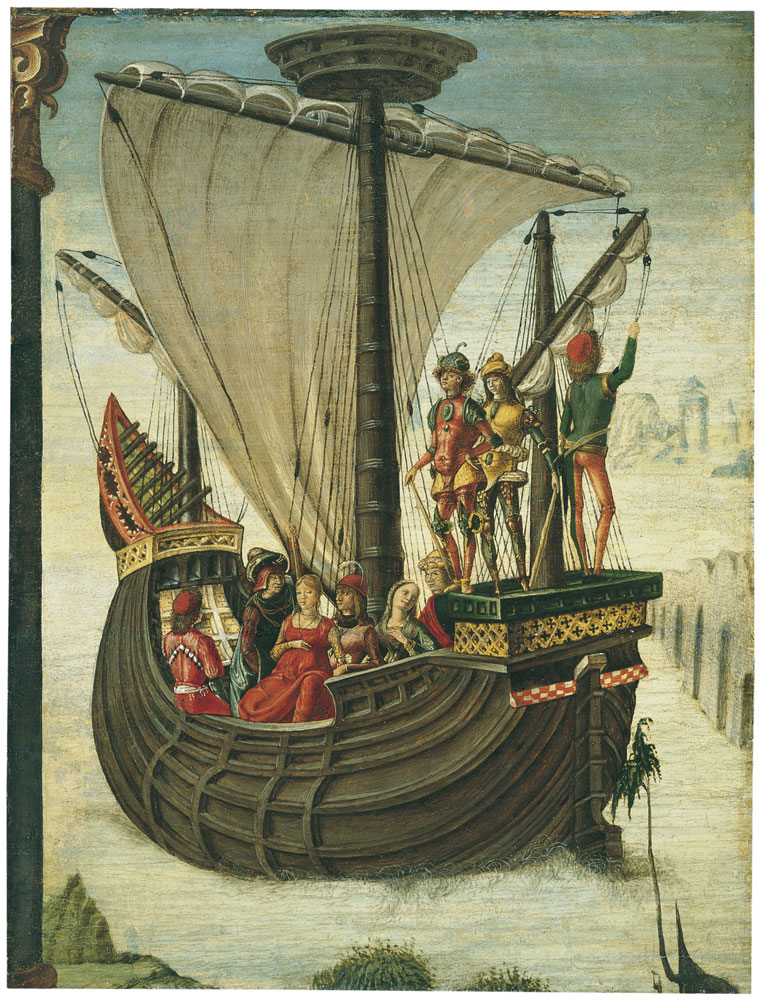
Header: The Argonauts Leaving Colchis by Ercole de Roberti c 1480 via Old Paint; a fanciful interpretation of a round ship, or cog
Tuesday, February 12, 2013
Literature: Great Ship's Language
Hoists of bunting broke out at yardarms, ascended to mast heads, hovered a minute or two, and came down in rainbow curves where flagship talked to flagship. A shore signal station was speaking in white flashes that dazzled you even in the strong sunshine; and between ship and ship of the same squadron minute conversations, visible only through a strong glass, were being carried ceaselessly on by the busy tossing arms of semaphores and by the small flags that a signalman, perched on the rail of a bridge like a fly, was waving to his opposite number in the next ship.
What were they all saying?
~ Filson Young (find his groundbreaking book Titanic, published in 1912, here)
Header: Lake Scene by George W. Maynard via American Gallery
What were they all saying?
~ Filson Young (find his groundbreaking book Titanic, published in 1912, here)
Header: Lake Scene by George W. Maynard via American Gallery
Monday, February 11, 2013
Tools of the Trade: The Cut of Her Jib
JIB: A large triangular sail, set on a stay, forward. I extends from the outer end of the jib-boom towards the fore topmast head; in cutters and sloops it is on the bowsprit, and extends towards the lower mast-head. The jib is a sail of great command with any side wind, in turning her head to leeward. There are other jibs, as inner jib, standing jib, flying jib, spindle jib, jib of jibs, jib-topsail &c. Jib is also used for the expression of the face, as the cut of his jib. Also, the arm of a crane. To jib, is when, before the wind, the sail takes over to the opposite quarter; dangerous in strong breezes [and known a jibbing or gybing]. Clear away the jib! The order to loose it, preparatory to its being set. Flying jib; a sail set upon the flying jib-boom. Middle or inner jib; a sail sometimes set on a stay secured to the middle of the jib-boom.
~ from The Sailor's Word Book by Admiral W.H. Smyth
Header: the modern barque Alexander von Humbolt out of Bremen with four jibs set and a fifth furled on the bowsprit; photo c 2003 via Wikipedia
~ from The Sailor's Word Book by Admiral W.H. Smyth
Header: the modern barque Alexander von Humbolt out of Bremen with four jibs set and a fifth furled on the bowsprit; photo c 2003 via Wikipedia
Friday, February 8, 2013
Booty: Pirate Treasures
My friend Elizabeth (find her here on Twitter) is exceptionally talented at digging up unique and sometimes macabre pieces for personal and home adornment. So I was far more delighted than surprised when she sent me a link to Italian jewelers Percossi Papi's exquisite collection entitled Collezione Oceano. That's right, Brethren it's fine pirate jewelry.
Of course fish and seaweeds feature in the collection, but there are beautiful pieces with an unmistakable pirate theme. Anchors, skulls, swords and perfectly sculpted galleons are featured in jewelry that is really more art than adornment.
The only drawback here is these gorgeous bobbles are probably far out of my financial reach. Makes one want to go a-plundering though...
Header: Galleon and seaweed earrings from the Percossi Papi website
Saturday, February 2, 2013
Sailor Mouth Saturday: Mid/Middle
We've talked about midshipmen before here at Triple P, but there are a few other reference points for the words mid and middle at sea. None are particularly surprising, but they are interesting.
The word middle, perhaps curiously, comes from the Anglo-Saxon into Middle English words middel and middle. According to our old friend Webster they both indicate the halfway point between two others. That's fairly straight forward at least.
At sea, this general application of the word applies often but not always. A middle band is the central band on any sail, one of the many that is sewn to the canvas to give it extra strength. Middling a sail, on the other hand, is the act of arranging the sail for attaching it to the yard. A middle-topsail is one usually particular to schooners and sloops. This type of sail was - and still is - set on such vessels between the top and the cap of their topmasts.
Midrib is an old word for a slender or narrow canal. Mid-channel is the center, or halfway point from one shore to the other of a river, channel or smaller lake.
When a ship's position is determined by converting departure/arrival in difference of longitude, the type of navigation used is said to be middle latitude sailing. In such cases the middle latitude is used as a point of reference rather than the meridion.
Middle-timber reference the planking amidships and to the stern. Middle-wales are the strakes or outer planking along each side of a three decked vessel between the lower and middle deck ports.
The middle watch on naval ships was counted between midnight and 4:00 AM. A middle-watcher is no a member of that watch but a light, usually hand-held meal (such as a biscuit or sandwich) which officers of the middle watch might be able to, as Admiral Smyth puts it, "snatch" at about five bells or 2:30 AM. Fortifying oneself is always a good idea in the middle of the night, after all.
To return to where we started, midshipmen were often referred to, particularly as a group, as mids. Either affectionately or derogatorily they may also be referred to as "middies." I suppose it would depend on the individual young gentleman whether or not he appreciated such a moniker.
A happy Saturday to all the Brethren, then. Fair winds, following seas, and a little sunshine is my wish for you.
Header: Lake Superior by Walter Shirlaw via American Gallery ~ an example of a lake more like a small sea and far too large to have a mid-channel
Tuesday, January 15, 2013
Literature: Old Ship Riggers
Yes, we did a heap o' riggin'
In those rampin' boomin' days,
When the wooden ships were buildin'
On their quaint old greasy ways;
Crafts of ever sort an' fashion,
Bin an' little, lithe an' tall,
Had their birthplace by the harbor,
An' we rigged 'em one and all.
Our riggin' was for sailors,
Tough an' hardy Bluenose dogs,
With their hands as hard as leather,
An' their boots thick heavy clogs,
They were nothin' much like angels,
But they'd learned their business right,
An' they trusted to our riggin'
When the sea was roarin' white.
~ "Old Ship Riggers" by H.A. Cody
Header: Harbor Scene by Franklin D. Briscoe via American Gallery
Saturday, January 5, 2013
Sailor Mouth Saturday: Jaw
I apologize for the lack of posting here at Triple P this week. The ravages of the flu have yet to leave me and I may just have to relent and drag myself to the doc for some meds. But I hate to miss a SMS so here's a short but I find interesting review of the word jaw at sea.
Jaw generally refers to semicircular end of a boom or gaff which presses against a ship's mast. The points of the jaw are called horns. The jaw-rope is a line or cable attached to the horns of the jaws to keep the gaff attached to the mast. Admiral Smyth notes that the line is usually finished with bull's eyes, specific types of blocks usually without a sheave, to ensure that the jaw-rope can run easily against the mast.
Along those lines, blocks with sheaves also have a jaw. This is the place in the hull of the block where the sheave turns.
Any line can be said to be long jawed if, through the strain of use, it begins to untwist and eventually breaks or otherwise fails.
Often, though, jaw when used at sea has more to do with men than equipment. A man is said to be jawing when using language generally thought of as reserved for sailors. Jaw breakers are the words we're referring to. A man who speaks this way on a regular basis is said to have brought his jawing tacks aboard us. He may also be labelled a jaw-me-down, particularly if he is prone to argue.
As an interesting if unrelated aside, javels were the "dirty, idle fellows, wandering about quays and docks" in times gone by. That would be a nice little addition to a piece of historical fiction, I think.
Happy Saturday, Brethren. I hope you feel better than me and that the winds are fair where ever you're at sea.
Header: Sunset Seascape with Boats by Franklin D. Briscoe via American Gallery
Saturday, December 29, 2012
Sailor Mouth Saturday: Ham
Ham is the standard protein at New Year's Day dinner around chez Pauline. So why not discuss the word - or in this case that part of so many words - at sea? No reason I can think of.
The first word with a nautical bent which probably comes to mind is hammock. This suspended bed that has cradled so many generations of sailors is now as familiar hanging over the backyard lawn as it once was foreign, at least to Europeans.
The word comes from the Carib native word for their own suspended beds. Made of cotton netting and known to them as hamacs, these very comfortable sleeping arrangements were first witnessed by Columbus. Given their ideal usefulness in keeping the sleeper cool in torrid climes, the invaders soon appropriated the design for not only land but also sea. A true "swinging sea-bed" is wonderfully described by Admiral Smyth in The Sailor's Word Book:
... the hammock consists of a piece of canvas, 6 feet long and 4 feet wide, gathered together at the two ends by means of clews, formed by a grommet and knittles, whence the head-clue and foot-clue: the hammock is hung horizontally under the deck, and forms a receptacle for the bed on which the seamen sleep. There are usually allowed from 14 to 20 inches between hammock and hammock on a ship of war. In preparing for action, the hammocks, together with their contents, are all firmly corded, taken upon deck, and fixed in various nettings, so as to form a barricade against musket-balls.
The hammock, the need to both hang and stow it in particular, gives rise to other utilitarian items. Hammacoe, hammock battens and hammock racks are all one and the same: cleats nailed to the sides of a ship's beams which are used to suspend the hammocks. Hammock gant-lines are those strung from the jib around the ship to support the drying of cleaned hammocks. Hammock nettings hold the hammocks in place when they are stowed on deck. These are then wrapped in hammock cloths to prevent the bedding from getting wet. Hammock berthing is the order and placement of hammocks according to rank aboard naval vessels.
Other words involving ham are less familiar, perhaps. Hambro lines are small lashings used around a ship. I think we all know about hammers, hammer-head sharks - "chiefly found on the coasts of Barbary" according to the Admiral - and the hammer-lock of a gun or pistol, so I won't trouble you explaining the obvious. Hammering, however, may refer to a heavy cannonade at close range.
Hamron is a very old word meaning the hold of a ship.
Hamper is anything in the way aboard ship, particularly during dirty weather or an engagement. A man is said to be hampered if he is anxious or confused. And at times, perhaps drunk.
And that is enough ham for one evening. Although all things being equal, a nice ham on the table is perhaps the most welcome thing of all.
Header: Supper at Home by Thomas Rowlandson via Wikimedia
Thursday, December 27, 2012
History: The Sailors' Saint
When modern Americans hear the name St. Nicholas, they think of that right jolly ol' elf who brings presents to good girls and boys on Christmas Eve. But this very versatile saint has many other duties to attend to; some of which involve the safety of sailors.
St. Nicholas, who was born at Lycia some time in the fourth century CE, is better known as "of Myra" in honor of the city over which he presided as a Catholic bishop. The saint is sometimes also know by the moniker "of Bari" although why I cannot determine. He is the patron saint of a vast and seemingly disjointed array of items and people. According to Butler's Lives of Patron Saints, the Bishop is responsible for children of both sexes, brides, unmarried women, pawnbrokers, perfumers and perfumiers, travelers, pilgrims, safe journeys, sailors and maritime pilots. He is also the protector of Russia and the cities of Amsterdam, New York, Baranquilla, Bari, Myra and Liverpool. His feast day is December 6th, coincidentally the day after Krampus, the celebration of St. Nicholas' unsavory helper who goes by the same name.
The most famous story of the saint - and the one that awarded him the red and white suit of Santa Claus - has to do with Bishop Nicholas rescuing the three Christian daughters of a poor pagan who, unable to provide them with the dowries required for proper marriages, was going to sell them to a brothel owner. The future saint, hearing of the girls' distress, managed to raise three bags of gold, one for each girl's dowry. As he amassed these small fortunes, St. Nicholas threw the individual bags into the poor man's cottage under cover of darkness. Thus the bishop remained anonymous and, through this generosity, became not only a patron of children and brides, but an overarching giver of gifts, particularly at Christmas.
The connection of the saint to sailors is probably just as much legend. St. Nicholas was said to have made pilgrimages to the Holy Land and Egypt, both of which would have required travel via ship. The most compelling story of the saint and sailors, however, has the Bishop appearing to a vessel about to be beaten open on the rocks off Lycia. Through his intervention, the ship was brought safely into the port. A shrine was built to the saint there and, from that time forward, sailors stopped in to prayed to St. Nicholas for safe passage. Those who survived rough seas were also known to bring a piece of canvas from their rescued ship to the shrine as an offering of thanks.
Finally, if you're interested in the subject, you can find a lengthy and fascinating discussion of St. Nicholas and his importance to sailors over at the always informative gCaptain.
Be sure to stop by again tomorrow when the lucky winner of Triple P's very first giveaway will be announced. Until then, I hope the Holidays continue happy for all!
Header: Saint Nicholas and the Sailors from the Tres Riches Heures of the Duc of Berry via Wikipedia
Monday, December 10, 2012
Tools of the Trade: Making Sails
The sailmaker's art has always been just that: an art. Passengers aboard ships in the Great Age of Sail commented again and again on the precision of sailors making sails. This all important craft required an equally precise set of tools. Generally speaking, these were:
The sailmaker's bench
A bench hook to hold the sailcloth taut while sewing seams
Needles of different sizes, and a small case - usually of leather or cloth - to hold them
Stabbers and spikes used to make holes in the canvas for fitting eyelets, cringles and so on
Knives, scissors and sharpening stones for both
A seam rubber for smoothing seams, working the rope into the surface of the sail to reduce chafing when the sail was being hoisted up or taken in
Seam gauges and a tape measure
At least two sailmaker's palms; one for seaming and the other for roping. The former being more delicate and the latter having at least two layers of leather at the thumb to guard against the sailmaker being cut by the heavy rope or twine.
Wax for lubricating the ropes. This had the added benefit of waterproofing the rope or twine as well.
Here is an early 19th century recipe for sailmaker's wax from Peter H. Spectre's A Mariner's Miscellany:
4 pounds of beeswax
5 pounds "slush" or tallow from the galley
1 pound turpentine
All these ingredients should be melted together in a double boiler, and then turned out after the congealed for use in the form of small cubes or chunks.
As Robert Whyte wrote after his experiences at sea in the mid-19th century:
I was surprised at the expedition and neatness with which [the sailors] sewed with their coarse needles and long thread.
The art is still alive and well today and will hopefully be passed on to the next generation, and the next, and the next.
Header: Toy Ships by John Thomas Peele via American Gallery
Tuesday, November 27, 2012
Tools of the Trade: Tips from the Galley
While a ship's galley in this day and age will have all the modern conveniences, even if they are a bit smaller than the average person is used to, challenges still arise for the cook at sea. Imagine, then, just how taxing trying to wrangle up large meals for hundreds of men in sailing ships must have been at one time. Staying organized and keeping clean were absolute priorities for Slushy in the Great Age of Sail. Knowing a few tricks of the trade couldn't hurt at all. Here are just a few of those little tricks, none of which have lost their effectiveness with time.
When boiling water, always cover the pot to avoid spillage. Ideally, a large tea kettle was used.
Keeping foods like yeast and salt dry was always a challenge in the damp of a wooden ship. Many cooks doubled up glass jars to accomplish this. The food stuff was placed in a smallish jar with a locking lid which was then placed in a larger jar or crock with a secure lid. The creep of moisture was still inevitable, but not quite as immediate.
Vermin were a constant issue aboard ship. Even the most spick and span vessel would have a certain level of infestation. Most bulk items like rice, flour and sugar were stored in barrels but old Slushy had a time tested method for keeping them relatively weevil and cockroach free: add bay leaves. The bugs don't like the odor, evidently, and the leaves won't harm the edibility of the foods even if they do make them taste slightly like pasta sauce.
Speaking of spick and span, more than one navy commander has been known to judge the orderliness of his ship's galley by the shine of her copper pots and pans. These were polished to a blinding sheen with either lemon juice or, more often on long voyages, vinegar. Those shiny pans were degreased with the help of another common item: coffee grounds.
Slushy made sure to tar or otherwise waterproof his apron to avoid being burned by sloshes and spills. Burns were unavoidable in the galley, however, and more than one sailor in the 18th and 19th centuries noted their scars as the sign of a good cook.
With space at a premium, storing large items could be tricky. Some were gotten out of the way by wrapping them in old cloth and suspending them from the bulkheads. This was particularly handy with large cuts of cured meat such as ham or bacon.
To keep pots and pans from slipping about on whatever surface might suffice as a counter, wet cloths were set down first. Most modern galleys are equipped with non-skid mats for this purpose.
And what about any glass jars and crockery that had to be packed cheek-by-jowl in available cupboard space? Wasn't breakage a constant concern? Not for the clever cook. Simply wrapping the jars in paper or, even more efficiently, slipping them into old socks or mittens before storing them actually did the trick pretty well. One has to imagine the ship's cook as a great collector of cast-off stockings - or a pilferer of those not quite ready to be given up. What a remarkable, and amusing, sub-plot that would make in a story of nautical bent...
Header: Saturday Night at Sea by George Cruikshank c 1840 via Wikimedia
Subscribe to:
Posts (Atom)