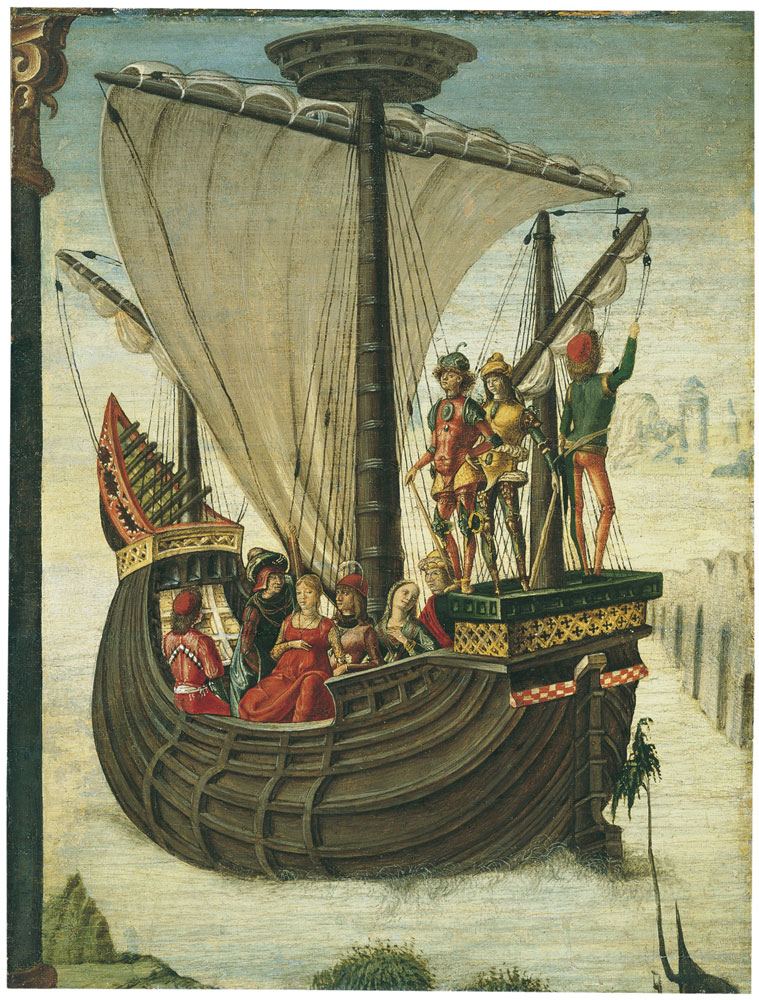
Enter the smaller, but equally important, companion ship that became known as the victualler. As Admiral Smyth notes in The Sailor's Word Book:
In the early age of the navy, each man-of-war had a victualler especially attached to her; as, in Henry VIII's reign, we find the Nicholas Draper, of 140 tons and 40 men, was victualler to the Trinity Sovereign; the Barbara of Greenwich to the Gabriel Royal, and so on.
The smaller ships, probably more closely resembling a Medieval cog than their larger companions, could ship supplies far out to sea allowing their man-of-war to focus on the important duties to hand.
The word victualler and victualling thus entered the parlance of the Royal Navy and in turn her American daughter. The same could not be said of the Latin-speaking navies, who relied more on a form of the word "provider"; le fournisseur in French, for instance.
Thus we find in the English speaking countries the victualling bill which was essentially the receipt kept at a customs house for provisions and stores provided to the quartermaster of a merchant ship after payment or bond had been received. The victualling book would have been kept aboard ship, generally by the purser, and would have been a log of incoming and outgoing provisions. This would have been inspected on a regular basis by the captain and/or owner to ensure that all was on the up-and-up, so to say.
In the navy, the victualling yards were a series of warehouses where provisions and other dry goods were stored for the stocking of naval vessels. These yards were generally located near naval dockyard such as Boston, New York, Baltimore, Charleston and New Orleans in early 19th century America, and Plymouth, Gosport, Gibraltar and Jamaica for the Royal Navy (to name only a few.)
And now that we have our victuals in, I'm away to sea Brethren. Fair winds for this Saturday and beyond; huzzah!
Header: The Argonauts Leaving Colchis by Ercole de Roberti c 1480 via Old Paint; a fanciful interpretation of a round ship, or cog

