Tuesday, February 26, 2013

History: The Darien Scheme

In the 1690s, the independent Kingdom of Scotland was deep in financial trouble. A series of civil wars and hard feelings from and against England, as well as year after year of sorry harvests, saw the landed gentry in tight straights and the poor in very hard conditions indeed. Something had to be done, of course; if Scotland grew too weak, both physically and financially, England would pounce of what she imagined was already hers.

Fortunately, the age of exploration - and get-rich-quick schemes - in the East and West Indies was in full swing. The Lords of Scotland were ready to dive in with both feet, and make a monetary killing in the process, and they were primed for what Education Scotland online calls the "economic guru" to fan the flames of greed. One William Paterson stepped in to do just that.

Paterson, a founder of the Bank of England, was also a preacher of the new word: anyone could get rich in the Americas. All it took, he insisted, was the right amount of cash and the right men to do the job. The Lords, hungry for the kind of wealth that was flowing in to countries like Spain and England, bought into Paterson's idea immediately. Scotland would establish a colony at Darien, what is now the Isthmus of Panama and - more specifically - the treacherous area known as the Darien Gap. The colony would be called New Caledonia and, for a small fee, the Scottish nobility could get in on the deal.

Paterson set to work inventing the Company of Scotland to raise "public capital." Initially, funds funneled in from all over Europe, including Holland, Germany and England. Colonists lined up to sign the charter singing the much familiar refrain: better to build in the New World than starve in the Old. A group of unsavory muscle men, former mercenaries for the most part led by a despicable character named Thomas Drummond, were also assembled, and five ships were commissioned for the voyage.

All appeared to be going well until William III, that king of England sometimes called "of Orange," got wind of the affair, probably from the aristocrats who invested in England's East India Company. He decreed that Scotland and her Company had no authority to raise money outside of Great Britain; Paterson had no choice but to return the much needed income from Germany and Holland. Much needed, it turned out, because Paterson - who was for all intents and purposes a penniless con man - had been siphoning coin into his own pockets. When the discrepancies were discovered, he was kicked out of the Company, but his disastrous plan went forward nonetheless.

There is an old saying among the indigenous people of Panama that the Darien can kill you in a thousand different ways. To this day it is ill-advised to make a trek through the area, as one particular episode of NatGeo's "Locked Up Abroad" proved without a doubt. The unfortunates who sailed for their New Caledonia, 1,200 in all, in July of 1698 were about to find that out the hard way. The journey itself, which began with a meandering sail around the north of Scotland to avoid English warships, was a nightmare. People and animals were sick most of the time, with many failing to survive the trip. Arriving at what the colonists called Golden Island in the Bay of Darien on November 2nd must have been something like seeing paradise.

But paradise it wasn't.

The colonists immediately set to building what they hoped would be a prosperous settlement, Fort St. Andrew, on the main peninsula of the Isthmus. Unfortunately, lack of nourishment - most of the stores had spoiled on the crossing due to the infiltration of pests and bilge water - a shortage of fresh water and disease made the work slow. Drummond, the brutal thug who became de-facto leader of the group, pushed the colonists to exhaustion. Their letters home were reviewed; everything had to appear to be going according to Paterson's original plan. No whining allowed. And then summer came and literal clouds of mosquitoes brought the horror of yellow fever to the yet unfinished Fort St. Andrew.

Worse than all this was the lack of agriculture and trade. The swampy land, riddled with salt water pools, was bad for growing. Both Spanish and English merchants refused to trade with the colonists as well. Their marching orders from Madrid and London were to let the Scots starve, grow sick and die. There was no room, in European opinion, for another colony in the Americas. Things grew so horrible that the colonists finally threw up their hands. in July of 1699, the 300 remaining colonists left a small number of their dying comrads at the tent city on the Isthmus and sailed for Port Royal, Jamaica. There they were denied food and water and not even allowed to come ashore. They sailed home, but not in time to save more wide eyed adventurers.

1,000 more colonists left Scotland in November of 1699. Their journey was also pitiable. From aboard the Rising Sun a man named Shields wrote of "our company very uncomfortable, consisting for the generality, especially the officers and volunteers of the worst of mankind, if you had scummed the Land and raked the borders of hell for them, men of lewd practices and venting the wickedness of principles; for these things God was provoked to smite us very signally and severely with a contagious sickness of the fleet." You can read the rest of the letter here.

The ships were so close packed that the "contagious sickness" was probably gaol fever: typhus. The colonists, weakened as before by illness and lack of proper food, could do very little for fortify what was not really the settlement they had hoped to find. They subsisted, to a large degree, through the kindness of passing buccaneers. These men, having no country on many occasions on often of French or Creole descent, were not hampered by orders from the kings of Europe. But the help was sparse as, for the most part, the colonists had little or nothing to offer the freebooters in exchange for food, fresh water and medicine.

The final blow to New Caledonia came when the Spanish, fed up with the annoying Scots, besieged what was left of Fort St. Andrew. According to Nat Edwards in his book Caledonia's Last Stand, the Scottish colonists made a daring raid on the Spanish stockade at Toubacanti in January of 1700. This was the last straw for the Spanish. By April of the same year, the colonist capitulated to the Spanish. Less than 200 men and women sailed for Scotland, leaving the dream of New Caledonia behind forever.

Many historians, Edwards included, see the failure of the Company of Scotland and the Darien Scheme as the death knell of the Scottish Kingdom. Their coffers empty and their crops still meager, the Lords of Scotland had no choice but to sign the Acts of Union and become part of Great Britain in 1707. The Darien Scheme, then, cost Scotland her chance at empire.

Header: New Caledonia and the Isthmus of Darien from a Scottish map possibly informed by adventurer Lionel Wafer c 1699 via Wikipedia

Monday, February 25, 2013

Sea Monsters: The Mermaid Song

One Friday morn when we set sail,
And our ship not far from land,
We there did espy a fair pretty maid,
With a comb and glass in her hand, her hand, her hand,
With a comb and glass in her hand.

And the stormy winds did blow,
And we jolly sailormen were up, up aloft,
And the lubbers lying down below, below, below,
And the landlubbers lying down below.

Then up spake the cabin boy of our gallant ship,
And a well-spoken boy was he,
I'va a father and mother in fair Portsmouth town,
And this night they will weep for me, for me, for me,
And this night they will weep for me.

Then up spake the captain of our gallant ship,
And a right good captain was he,
I have married a wife in fair Plymouth town,
And tonight she a widow will be, will be, will be,
And tonight she a widow will be.

Then up spake the cook of our gallant ship,
And a dirty old sinner was he,
I don't care a damn for the pots and the pans!
They may go to the bottom of the sea, the sea, the sea,
They may go to the bottom of the sea!

Then three times round went our gallant ship,
And three times round went she,
And she sank to the bottom of the sea, the sea, the sea,
And she sank to the bottom of the sea.

And the raging seas did roar,
And the stormy winds did blow,
And we jolly sailormen were up, up aloft,
And the lubbers lying down below, below, below,
And the landlubbers lying below.

This old sea song, whose origin remains in question, seems to imply from its title that sighting the mermaid at the beginning of the voyage is what doomed the song's ship. As any good seaman knows, this is surely a ruse. Leaving port on Friday was doubtless what actually did her in...

Header: Mermaids by George W. Maynard via American Gallery

Sunday, February 24, 2013

Seafaring Sunday: USS Hornet vs HMS Peacock

By the middle of February 1813 the U.S. Sloop of War Hornet (Master Commandant James Lawrence) had been cruising the Atlantic for nearly four months, sometimes in company with the big frigate Constitution, but by herself since early January. She had spent half of December and most of January off Bahia, Brazil, blockading the British sloop of war Bonne Citoyenne, and subsequently captured a couple of merchantmen.

On the 24th, still operating off northern South America, Hornet encountered HMS Peacock, a somewhat smaller and less powerful brig-rigged sloop of war. The two warships closed from opposite directions and, shortly before half-past five in the afternoon, opened fire on each other. Hornet's gunnery was so much more effective that Peacock surrendered within fifteen minutes, having lost her commanding officer and seven men killed or mortally wounded. The Royal Navy brig-sloop was so badly shot up that she sank in shallow water shortly after the end of the action.

Hornet, which had suffered one fatality among her crew, took aboard Peacock's survivors (except for a few who escaped to shore) and quickly repaired her own damages. Badly overcrowded, she the sailed for the United States, arriving at Martha's Vineyard on 19 March.

~ via the Naval History and Heritage Command website where you can find more information about USS Hornet, MC James Lawrence, and the etching above

Saturday, February 23, 2013

Sailor Mouth Saturday: Victualler

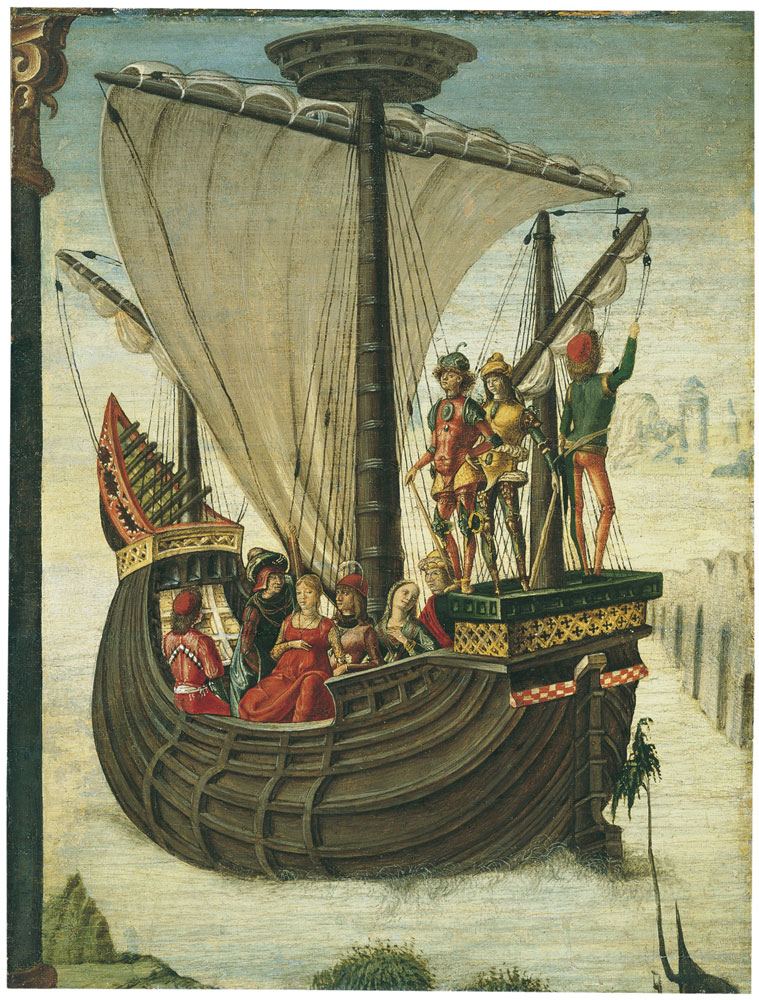
When Henry VIII had the brilliant notion to establish the Royal Navy, ships were a bit different than they would be 300 years later in the glory days of Admiral Nelson. A fine carrack of war, like the iconic Mary Rose, was often filled to bursting with men and arms, leaving very little in the way of room for the food and water needed to keep those men in good working trim.

Enter the smaller, but equally important, companion ship that became known as the victualler. As Admiral Smyth notes in The Sailor's Word Book:

In the early age of the navy, each man-of-war had a victualler especially attached to her; as, in Henry VIII's reign, we find the Nicholas Draper, of 140 tons and 40 men, was victualler to the Trinity Sovereign; the Barbara of Greenwich to the Gabriel Royal, and so on.

The smaller ships, probably more closely resembling a Medieval cog than their larger companions, could ship supplies far out to sea allowing their man-of-war to focus on the important duties to hand.

The word victualler and victualling thus entered the parlance of the Royal Navy and in turn her American daughter. The same could not be said of the Latin-speaking navies, who relied more on a form of the word "provider"; le fournisseur in French, for instance.

Thus we find in the English speaking countries the victualling bill which was essentially the receipt kept at a customs house for provisions and stores provided to the quartermaster of a merchant ship after payment or bond had been received. The victualling book would have been kept aboard ship, generally by the purser, and would have been a log of incoming and outgoing provisions. This would have been inspected on a regular basis by the captain and/or owner to ensure that all was on the up-and-up, so to say.

In the navy, the victualling yards were a series of warehouses where provisions and other dry goods were stored for the stocking of naval vessels. These yards were generally located near naval dockyard such as Boston, New York, Baltimore, Charleston and New Orleans in early 19th century America, and Plymouth, Gosport, Gibraltar and Jamaica for the Royal Navy (to name only a few.)

And now that we have our victuals in, I'm away to sea Brethren. Fair winds for this Saturday and beyond; huzzah!

Header: The Argonauts Leaving Colchis by Ercole de Roberti c 1480 via Old Paint; a fanciful interpretation of a round ship, or cog

Friday, February 22, 2013

Booty: Time to Get Back to Da Bayou

It's that time again. Time for all the seadogs and wenches to head down to New Orleans, LA and commune with our own. That's right; NOLA Pyrate Week is coming.

Thanks to my dear friends Captain John Swallow and Quartermaster Seika Hellbound, this event happens annually in NOLA and beyond. They work hard all year to put this wonderful even together and this year it's bigger and better than ever. Be sure to click over to the Pyrate Week website for more details on all the wonderful events and history awaiting you in southeastern Louisiana.

My only regret here is my inability to attend due to the sudden collapse of income aboard us; both the First Mate and I are looking for gainful employment with health benefits.

But that's temporary and we'll get down to Pyrate Week sooner than later. If you can at all, Brethren, be sure to head to NOLA for this one of a kind event March 29th through April 7th. Give the Captain and QM my very best regards, and thank them for all they do to keep pirate and Louisiana history alive and well.

On a final note, a heart felt Happy Birthday to the United States' first President, George Washington. As he once said:

Without a decisive naval force we can do nothing definitive, and with it, everything honorable and glorious.

And that is a visionary for you; always thinking ahead of his time.

Header: 2013 NOLA Pyrate Week poster featuring the lovely QM and the dashing Captain via the Pyrate Week website

Thursday, February 21, 2013

Women at Sea: "An Extremely Manly Woman"

For over 300 years, the lady we will speak of today was revered as, for lack of a better analogy, the Jeanne d'Arc of Holland. She was, according to contemporary if anonymous accounts, a key player in the city of Haarlem's defense against its Spanish overlords. During the siege of the town that began in the winter of 1572 and would drag on until July of 1573, Kenau Simonsdochter Hasselaar fought the Spanish with the spirit of a lion. Or so it was said until a particular Victorian minded historian got a hold of her story and brought the idea of a fighting matron into question.

Kenau Hasselaar was evidently born in the city she held dear some time in 1526. Her parents, Simon Hasselaar and Grietje Koen, ran a brewery and Kenau grew up learning a great deal about business at her mother's knee. It would doubtless be to that Victorian historian's great chagrin that we are now aware of the facts about middle class women in 16th century Haarlem. Most were partners in their husband's businesses, or ran their own outright as Kenau would. Their business acumen was stellar and Dutch women gained a reputation on both sides of the Atlantic for driving a hard bargain, so to say.

Kenau grew up tough and smart. She was married at 18 to a shipwright and wood seller named Nanning Borst. It appears that Kenau jumped right in to the ship building business while also continuing to deal in grain, the best of which she funneled to her parents' brewery, no doubt at wholesale. The Borsts were blessed with four children, all of whom had reached maturity by the time Nanning died in 1562.

Kenau along with her youngest child and only son, Gerbrand, continued to run the lucrative shipbuilding business. There is also some hint that Kenau may have been involved in the usually illegal, often piratical and always profitable logwood trade. Although the documentation is sketchy, if true, this would have made Kenau the next best thing to a pirate in her own right.

When the Spanish, who were already occupying the Low Countries, decided they were fed up with the free-thinking and free-speaking Dutch, Frederick of Toledo, the son of the powerful Duke of Alva, descended on Haarlem with 12,000 men. Frederick's intention was to lay siege to the wealthy port city and thereby cut off supply routes to the interior of the country. He imagined the siege would last no more than seven days; in fact it would stretch out to a full seven months.

Inside the city, things were not as bad as they might have been. Haarlem, with its various water ways, was almost impossible to isolate. Provisions and arms came into the city across the Harlemmermeer lake and, despite the vast superiority of Spanish numbers, the 4,000 or so fighting men of Haarlem stubbornly refused to give in to tyrants.

Meanwhile Kenau, now in her forties and, according to one contemporary, "an extremely manly woman", was not about to sit by and let the heretics destroy her city. She rallied some 300 able bodied women - those with children that could be left at home and who were not pregnant, nursing, infirm or too aged to be of much use - and marched to the city walls with pike and sword in hand. From the moment she and her "batallion of Amazons", as historian Vicki Leon refers to them, set right to work. They shored up breaches in the walls, carried earth to build new ramparts, nursed the wounded and sick, carried water both for drinking and to swab the city's cannon, and cheered on those who seemed to falter in their resolve. All in all, their tireless efforts proved very worth while to their city and their cause.

To some degree, all that sweat and struggle was for naught. The city surrendered to the Spanish of July 13, 1573. While it appears that no women were put to death, perhaps in part because of a general ransom paid by the city to Frederick, the entire city garrison and 40 of Haarlem's burghers were executed. According to Robin Cross and Rosalind Miles in their book Warrior Women, there were so many men to kill that the executions took more than a week to complete. When the Spanish executioners grew too weary to lift their swords, they tied their victims back to back and threw them into the Spaame river to drown.

Kenau, whose nephew was briefly held by the Spanish but later released, continued her shipbuilding business. She traveled a good bit after the fall of Haarlem, which is documented by sales receipts for things she bought and sold. Was this a purposeful way of avoiding punishment for her defiance during the siege? No historian I can find has said so, but one has to wonder.

Some time after 1585, Kenau bought a ship and apparently departed upon it bound for Norway. The ship was carrying wood, and possibly some of that precious and contraband logwood, but was lost at sea. When the ship returned to Haarlem under the command and ownership of a captain named Lieven Hansz, Kenau's no doubt savvy daughters cried foul. They took Hansz to court as a possible thief and murderer. Hansz claimed he bought the ship at the port of Flensburg where the port official was selling deserted ships. Hansz's theory, which the court seemed to buy, was that Kenau must have been attacked by pirates and murdered with her crew.

Regardless of the actual circumstances of Kenau Hasselaar's death, she remained a national hero for centuries. She was celebrated at each centennial of the siege of Haarlem in etchings, paintings and song. Ships were named after her, statues erected and her given name, Kenau, became part of the Dutch language; its meaning denoted a feisty, unconquerable woman.

And then along came Dr. C. Ekama who, in 1872, disputed not only Kenau's role during the siege but that of any other woman. His argument centered around the lack of documentation of women dying in battle or, in particular, being executed with the burghers. There is very little to his theory aside from this and, it must be said, his obvious 19th century take on the place and capability of women in general.

Kenau's actual contributions during the siege may never truly be known, but the rewriting of her history is an old and sad story. Our recent ancestors, at least in the West, decided that we should not know the whole truth about our distant past. But we are digging up those truths one at time, and the story of Kenau Hasselaar, that extremely manly woman, and her bravery is worth knowing.

Header: An etching of Kenau Haselaar by an anonymous artist from the 17th century via Wikimedia

Tuesday, February 19, 2013

People: The Antarctic Hero

James Clark Ross joined the Royal Navy in 1812 and remained a sailor for the bulk of his life. Like many lifetime navy men, Ross was born to it. His uncle, Sir John Ross, would become one of the foremost explorers of the Arctic in his day. He took his young nephew off to search for the Northwest passage - a popular but often deadly pastime for British seamen - in 1818 when young James was 18.

The younger Ross made captain in 1834 and took command of HMS Cove in 1835 when he sailed off to Baffin Bay to rescue a wayward group of British whalers. The trip was difficult, but Ross, as can be guess by his portrait above featuring Polaris over his left shoulder, had a way with cooler climes. Cove did not meet up with the whalers but nonetheless returned safely home in September of 1836 with all men alive and healthy.

Ross' greatest achievement as a sailing Captain occurred over the years 1839 to 1843 when he led an expedition to the Antarctic. His vessels at this time were Erebus and Terror, whose names will ring a bell with anyone familiar with the aforementioned search for the nonexistent Northwest passage. Under Ross' care, the two ships would have greater successes than they would in later life. The expedition mapped much of the Antarctic coast where some features, such as the Ross Ice Shelf, still speak of the commander by name.

Ross returned to England to great praise. He was named to the Royal Society, married into landed gentry and returned to the Arctic more than once, even exploring inlets that would later thwart the doomed expedition of Sir John Franklin.

All in all Ross' career was remarkable but not unusual. Certainly two things about the commander have come down to us that continue to intrigue and delight to this day. First, the portrait above, which has been deemed swoon-worthy by more than one blogger. Second, the poem written by Louisa Sheridan as a memorium to his death in 1862. Entitled "Song of Captain Ross (of the North Pol-ice station)", the thing is full of somewhat less than respectful puns regarding Ross' career as an Arctic and Antarctic explorer. Everything is cool and chili and frosted; Louisa must have been very droll in conversation. One wonders what Lady Ann Ross thought of this "tribute" to her hero husband. You can find the poem in its entirety over as the wonderful Two Nerdy History Girls blog.

And so goodnight to another sailing man. Fair winds in the far beyond, Ross; with luck they'll all be warm.

Header: James Clark Ross by John R. Wildman c 1834 via Wikipedia